
Short Answer
Main Explanation
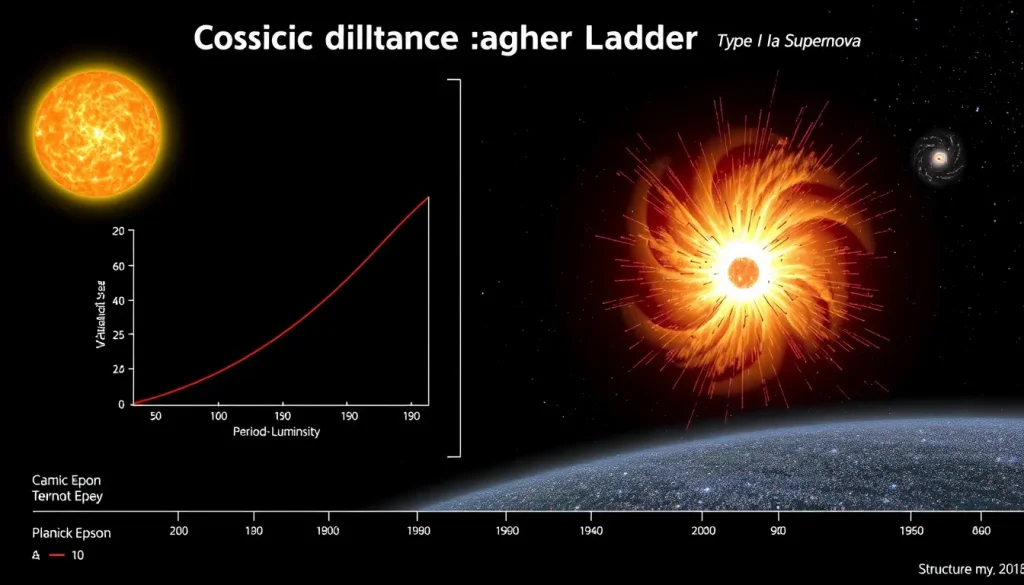
Astronomers measure the universe using a set of techniques known as the cosmic distance ladder. At each rung, objects with known luminosities—called standard candles—allow distances to be determined by comparing their intrinsic brightness with their observed brightness. The most famous standard candles are Cepheid variable stars and Type Ia supernovae, each serving different distance ranges.
In 1929, Edwin Hubble used Cepheid observations to discover that galaxies are receding from us, establishing the expansion of the universe. Henrietta Swan Leavitt had earlier found that a Cepheid’s period is directly related to its intrinsic luminosity, allowing distances to be calculated. Type Ia supernovae, which occur when a white dwarf accretes matter and explodes, have a remarkably uniform peak brightness, making them reliable standard candles for distances far beyond the reach of Cepheids.
Standard candles are not just tools for measuring distance; they are also essential for probing the evolution of the cosmos. They have been used to measure the Hubble constant, the rate of expansion, and to discover dark energy through observations of distant supernovae.

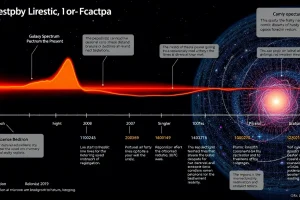
The Cosmic Distance Ladder and the Evolution of the Universe
The cosmic distance ladder extends from parallax measurements of nearby stars to Cepheids in nearby galaxies, and then to Type Ia supernovae in distant galaxies. This ladder allows astronomers to calibrate distances across billions of light-years, providing a framework for understanding the age and expansion of the universe. The standard candles also serve as probes of the universe’s history, from the first stars to the current accelerating expansion.
| Epoch | Time After Big Bang | Key Events |
|---|---|---|
| Planck Epoch | 0 to 10⁻⁴³ s | Quantum gravity era, unification of forces |
| Grand Unification Epoch | 10⁻⁴³ to 10⁻³⁶ s | Strong force separates |
| Inflationary Epoch | 10⁻³⁶ to 10⁻³² s | Exponential expansion, seeds for structure |
| Electroweak Epoch | 10⁻³² to 10⁻¹² s | Electromagnetic and weak forces separate |
| Quark Epoch | 10⁻¹² to 10⁻⁶ s | Quarks and gluons form plasma |
| Hadron Epoch | 10⁻⁶ to 1 s | Protons and neutrons form |
| Lepton Epoch | 1 to 10 s | Leptons dominate |
| Photon Epoch | 10 s to 380,000 years | Photons dominate, nucleosynthesis |
| Recombination | 380,000 years | Atoms form, CMB released |
| Dark Ages | 380,000 to ~150 million years | No stars, neutral hydrogen |
| Reionization | ~150 million to 1 billion years | First stars and galaxies ionize gas |
| Structure Formation | 1 billion years to present | Galaxies cluster, dark energy dominates |
Concept
Definition
A standard candle is an astronomical object whose intrinsic luminosity is known. By measuring its apparent brightness, its distance can be determined using the inverse-square law.
How It Works
Light spreads out over a sphere, so the observed flux (F) decreases with the square of the distance (r). If we know the luminosity (L), we can solve for r: F = L / (4πr²).
Equation
F = L / (4πr²)
Example
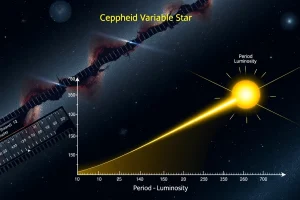
Cepheid variables have a period-luminosity relation: longer period means higher luminosity. By measuring the period, we know L; measuring F gives r.
Observable Consequences
Standard candles allow us to measure distances to galaxies, leading to Hubble’s law and the discovery of cosmic acceleration.
Common Misconceptions
Not all standard candles are identical; they are calibrated populations. Type Ia supernovae have a small dispersion but are not perfectly uniform.
Why It Matters
Standard candles are fundamental to modern cosmology. They provide the distance measurements that underpin the Hubble–Lemaître law, the cosmic distance ladder, and the discovery of dark energy. Without them, we would have no way to map the large-scale structure of the universe or trace its expansion history. They also connect the early universe—through the cosmic microwave background and the formation of first stars—to the present epoch, allowing us to test the Lambda-CDM model.
Evidence / Sources
Key evidence comes from observations of Cepheids in nearby galaxies, which calibrated the distance to the Andromeda galaxy and led to the discovery of cosmic expansion. The Hubble Space Telescope extended Cepheid measurements to about 100 million light-years, while Type Ia supernovae have been observed out to billions of light-years, revealing the accelerating expansion. Missions like COBE, WMAP, and Planck have mapped the cosmic microwave background, providing independent constraints on cosmological parameters that agree with supernova distances.
Related Registry Entries
FAQ
What is a standard candle in astronomy?
A standard candle is an astronomical object whose intrinsic brightness (luminosity) is known. By measuring how faint it appears from Earth, its distance can be calculated using the inverse-square law.
Why are Type Ia supernovae used as standard candles?
Type Ia supernovae have a remarkably consistent peak brightness because they occur when a white dwarf accretes enough matter to trigger a thermonuclear explosion, making them reliable for measuring distances to very remote galaxies.
How do Cepheid variables help measure cosmic distances?
Cepheid variables have a period-luminosity relation: the longer the pulsation period, the greater the intrinsic luminosity. By observing the period, astronomers know the luminosity, and comparing with apparent brightness gives the distance.
Leave a Reply