
Short Answer
Main Explanation
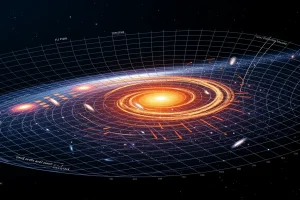
The question “What is the shape of the universe?” is really two questions. The first concerns local geometry—whether space is positively curved like a sphere, flat like an infinite plane, or negatively curved like a saddle. The second concerns global topology—how space is connected on the largest scales, which cannot be determined by curvature alone. A flat universe, for example, could be infinite and simply connected, or finite and multiply connected like a three-dimensional torus [1].
Observations of the cosmic microwave background (CMB) by WMAP, BOOMERanG, and Planck show that the observable universe is spatially flat to within a 0.4% margin of error in the curvature density parameter [1]. Yet this measurement does not reveal whether the whole universe is simply connected like Euclidean space or multiply connected like a torus [1]. Recent analyses argue that the simple “flat means infinite” conclusion has deep flaws, and the universe could have at least 18 possible shapes, including a donut-like topology [3].
Local Geometry: Flat, Open, or Closed?
General relativity relates the curvature of space to the density of matter and energy. If the average density equals the critical density, space is flat and Euclidean geometry holds on large scales. If the density is higher, space is positively curved and finite like the surface of a sphere; if lower, space is negatively curved and infinite like a saddle. Current measurements place the density parameter very close to 1, consistent with flatness, but the global topology remains unconstrained [1].

Global Topology: More Than Curvature
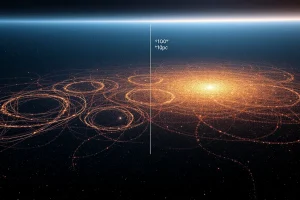
Even a flat universe can have different topologies. It could be an infinite Euclidean space, or it could be a finite, multiply connected space such as a 3-torus, where traveling far enough in one direction brings you back to your starting point. Mathematicians have identified 18 possible flat topologies in three dimensions, and the universe could resemble a donut in a generalized sense [3]. Detecting such a topology would require looking for repeating patterns or circles in the CMB, but no definitive signal has been found.
The Cosmic Epochs: From Planck to Present
The shape and evolution of the universe are intertwined. The standard Lambda-CDM model describes a cosmos that began in a hot, dense state and has expanded and cooled for 13.8 billion years. The following table summarizes the major epochs.
| Epoch | Time after Big Bang | Approx. Temperature | Approx. Redshift | Key Events |
|---|---|---|---|---|
| Planck epoch | <10⁻⁴³ s | >10³² K | — | Quantum gravity; all forces possibly unified |
| Grand unification epoch | 10⁻⁴³–10⁻³⁶ s | ~10²⁹ K | — | Strong force separates from electroweak |
| Inflationary epoch | 10⁻³⁶–10⁻³² s | ~10²⁷ K | — | Exponential expansion; seeds of structure |
| Electroweak epoch | 10⁻³²–10⁻¹² s | ~10¹⁵ K | — | Weak and electromagnetic forces separate |
| Quark epoch | 10⁻¹²–10⁻⁶ s | ~10¹² K | — | Quarks, leptons, gluons; baryogenesis |
| Hadron epoch | 10⁻⁶–1 s | ~10¹⁰ K | — | Quarks bind into protons and neutrons |
| Lepton epoch | 1–10 s | ~10⁹ K | — | Leptons dominate; neutrino decoupling |
| Photon epoch | 10 s–380,000 yr | 10⁹–3000 K | >1100 | Photons dominate; Big Bang nucleosynthesis |
| Recombination | ~380,000 yr | ~3000 K | ~1100 | First neutral atoms; CMB released |
| Dark Ages | 380,000–~150 million yr | <3000 K | 1100–20 | Neutral hydrogen; no stars |
| Reionization | ~150 million–1 billion yr | ~50 K | 20–6 | First stars and galaxies ionize gas |
| Structure Formation | ~1 billion yr–present | 2.7 K | <6 | Galaxies, clusters, cosmic web |
During the Planck epoch, our current physics breaks down because quantum gravity is needed. The inflationary epoch is a brief period of accelerated expansion that stretched the universe enormously, smoothing and flattening it while generating tiny density fluctuations. These fluctuations later grew into galaxies and clusters. The photon epoch includes Big Bang nucleosynthesis, when protons and neutrons fused into the first light nuclei. At recombination, about 380,000 years after the Big Bang, the universe cooled enough for electrons and protons to form neutral hydrogen, releasing the cosmic microwave background—a relic radiation now observed at 2.725 K. The Dark Ages followed, with no luminous sources, until the first stars and galaxies formed and reionized the intergalactic medium. Structure formation has continued to the present, producing the large-scale cosmic web.
What We Know
Cosmologists are confident that the observable universe is very close to spatially flat. The curvature density parameter Ωk is measured to be consistent with zero within 0.4% [1]. This flatness is a key prediction of cosmic inflation, which stretched any initial curvature to near zero. The Lambda-CDM model, which includes dark energy and cold dark matter, successfully explains the CMB power spectrum, the large-scale distribution of galaxies, and the accelerated expansion of the universe.
The CMB is the most important observational tool. COBE first measured its near-perfect blackbody spectrum and detected tiny temperature anisotropies. WMAP mapped those fluctuations across the full sky, and Planck refined them to unprecedented precision. These maps reveal acoustic peaks that encode the geometry, density, and composition of the universe. The observed peak positions strongly favor a flat universe.
What We Don’t Know
Despite the flatness measurement, the global topology of the universe is unknown. A flat universe could be infinite or finite, simply connected or multiply connected. We do not know whether space wraps around on itself, whether there are repeating patterns in the CMB, or whether the universe has an edge. The observable universe is limited by the cosmic horizon—the distance light has traveled since the Big Bang—so we cannot directly see beyond it [4].
Recent work has highlighted that the standard interpretation of flatness as implying an infinite universe is not logically forced. There are at least 18 possible flat topologies, and some, like the 3-torus, are finite [3]. Searches for topological signatures, such as matched circles in the CMB, have not found conclusive evidence, but they also cannot rule out many possibilities.
Evidence
The primary evidence for the universe’s shape comes from the CMB and large-scale structure. The angular scale of the first acoustic peak in the CMB power spectrum is sensitive to the curvature of space. Planck’s measurements place the peak at the angle expected for a flat universe. Baryon acoustic oscillations in galaxy surveys provide an independent check, and supernova distance measurements constrain the expansion history. Together, these data support a flat Lambda-CDM model with about 70% dark energy, 25% dark matter, and 5% ordinary matter.
The CMB also provides a snapshot of the universe at recombination, about 380,000 years after the Big Bang. Its near-uniform temperature and tiny fluctuations are relics of the early hot, dense state and the inflationary seeds of structure. Missions such as COBE, WMAP, and Planck have measured these fluctuations, while JWST is now observing the first galaxies that formed during reionization.
Competing Explanations
The main alternative to a flat, infinite universe is a finite, multiply connected topology, such as a 3-torus or a dodecahedral space. These models are not ruled out by current data and could produce observable effects, including repeating patterns in the CMB or a suppression of large-scale power. Another possibility is that the universe has a slight positive or negative curvature that is too small to be detected with current precision. Some researchers have also proposed that the universe’s shape may be fundamentally unknowable if the relevant scales are beyond the cosmic horizon [4].
Current Research
Ongoing and future surveys, including the Simons Observatory, ACT, and SPHEREx, will improve CMB measurements and search for topological signatures. Galaxy surveys and 21-cm observations of the Dark Ages and reionization may reveal new clues about the universe’s large-scale geometry. The James Webb Space Telescope is probing the first stars and galaxies, testing models of reionization and structure formation. While the local geometry appears flat, the true global shape remains one of cosmology’s most profound open questions [2].
Why It Matters
The shape of the universe is not just an abstract question. If the universe is finite and multiply connected, it would have profound implications for the total amount of matter and energy, the fate of cosmic expansion, and the possibility of seeing the same region of space in different directions. A flat, infinite universe is consistent with the standard model, but a finite topology could leave detectable imprints on the CMB and large-scale structure. Understanding the shape also tests the theory of inflation, which predicts flatness but does not specify the global topology. Ultimately, the shape of the universe connects the smallest quantum scales of the Planck epoch to the largest observable structures, linking quantum gravity, particle physics, and cosmology.
Evidence / Sources
The following sources were used to ground this article. They are authoritative, up-to-date references on the shape and evolution of the universe.
- Wikipedia: Shape of the universe
- Scientific American: We thought we knew the shape of the universe. We were wrong
- Scientific American: The universe could have 18 possible shapes
- New Scientist: Can we ever know the shape of the universe?
Related Registry Entries
- Cosmic Microwave Background
- Inflation
- Recombination
- Dark Ages
- Reionization
- ΛCDM
- Curvature
- Observable universe
- Cosmic Timeline
- Large-scale structure
Last reviewed / updated: September 8, 2026
FAQ
Is the universe flat?
The observable universe is flat to within 0.4 percent, but this does not determine the global topology. A flat universe could be infinite or finite and multiply connected.
What is the difference between curvature and topology?
Curvature describes local geometry—whether space bends like a sphere, plane, or saddle. Topology describes global connectedness, such as whether space wraps around on itself.
Could the universe be shaped like a donut?
Yes. A flat universe could have a 3-torus topology, which is a three-dimensional generalization of a donut's surface. At least 18 flat topologies are possible.
What is the cosmic microwave background?
The CMB is relic radiation from about 380,000 years after the Big Bang, when the first neutral atoms formed and photons could travel freely. It provides a snapshot of the early universe and evidence for its shape.
Leave a Reply