Short Answer
Main Explanation
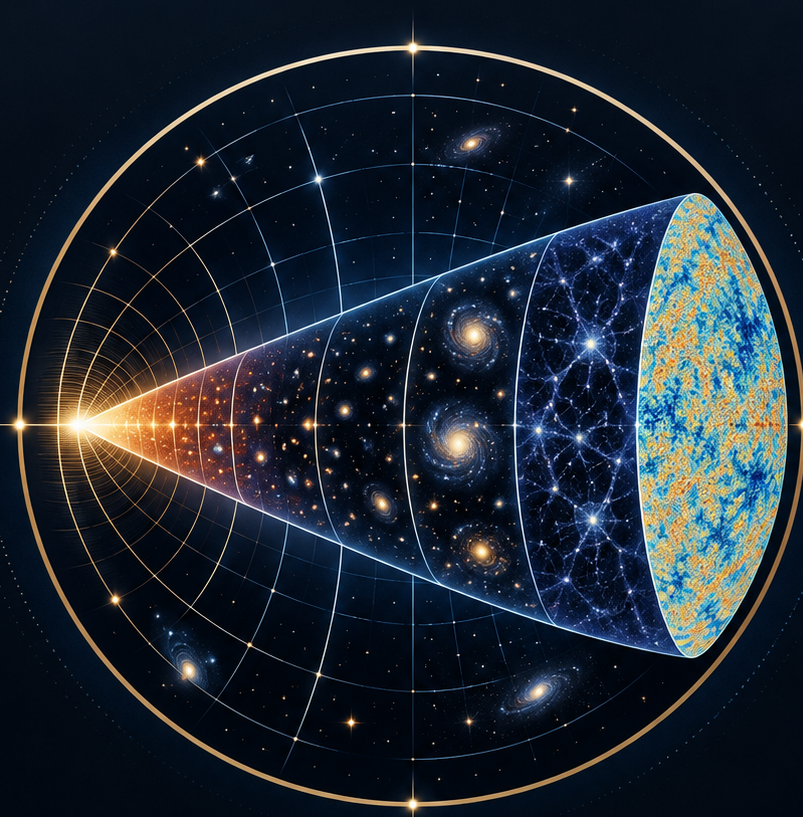
The Big Bang is the prevailing cosmological model that describes the origin and evolution of the universe. According to this model, the universe began as an extremely hot and dense state approximately 13.8 billion years ago and has been expanding ever since. This expansion, first inferred from the redshift of distant galaxies, is the cornerstone of modern cosmology. The Big Bang is not an explosion in space, but rather the expansion of space itself, carrying matter and radiation with it.
What Is the Big Bang?
At its core, the Big Bang model posits that the entire observable universe—every atom, star, and galaxy—was once compressed into a volume smaller than a peach (Popular Mechanics, 2023). This state was unimaginably hot and dense. The model is based on two key assumptions: the cosmological principle (that the universe is homogeneous and isotropic on large scales) and the validity of Einstein’s general relativity (Britannica, 2026). The modern version of the Big Bang theory was developed in the 1940s by George Gamow and colleagues, building on earlier work by Friedmann and Lemaître.
The Cosmic Epochs
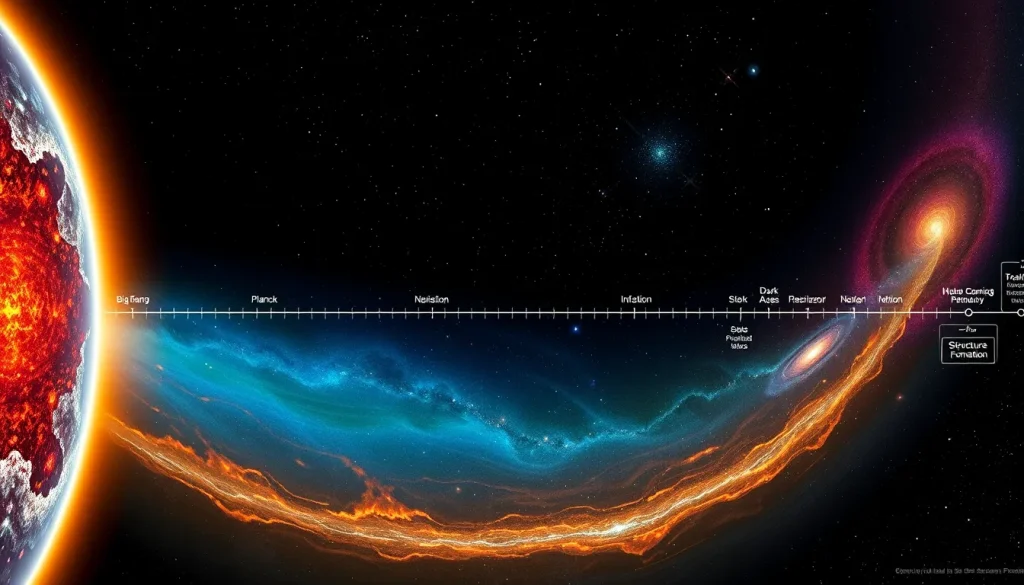
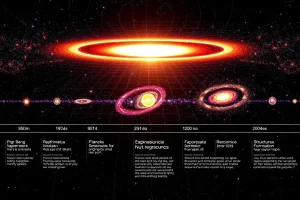
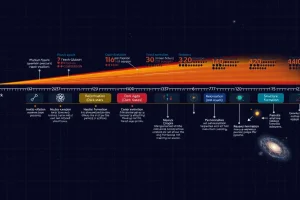
The history of the universe is divided into distinct epochs, each characterized by specific physical processes and particle interactions. The following table summarizes the major epochs from the Planck epoch to the present day.
| Epoch | Time After Big Bang | Temperature | Key Events |
|---|---|---|---|
| Planck Epoch | 0 to 10⁻⁴³ s | >10³² K | Quantum gravity dominates; all four fundamental forces unified. |
| Grand Unification Epoch | 10⁻⁴³ to 10⁻³⁶ s | 10²⁷–10³² K | Strong force separates from electroweak force. |
| Inflationary Epoch | 10⁻³⁶ to 10⁻³² s | ~10²⁷ K | Rapid exponential expansion; seeds for large-scale structure. |
| Electroweak Epoch | 10⁻³² to 10⁻¹² s | 10¹⁵–10²⁷ K | Electromagnetic and weak forces separate; Higgs mechanism gives mass. |
| Quark Epoch | 10⁻¹² to 10⁻⁶ s | 10¹²–10¹⁵ K | Quarks and gluons exist freely; quark-gluon plasma. |
| Hadron Epoch | 10⁻⁶ to 1 s | 10¹⁰–10¹² K | Quarks combine into protons and neutrons; matter-antimatter annihilation. |
| Lepton Epoch | 1 to 10 s | 10⁹–10¹⁰ K | Leptons dominate; neutrinos decouple. |
| Photon Epoch | 10 s to 380,000 yr | 3,000–10⁹ K | Photons dominate; nucleosynthesis forms light elements. |
| Recombination | ~380,000 yr | ~3,000 K | Electrons combine with nuclei to form neutral atoms; universe becomes transparent. |
| Dark Ages | 380,000 yr to ~150 million yr | ~3,000 K to ~50 K | No stars yet; only dark matter and neutral hydrogen. |
| Reionization | ~150 million to ~1 billion yr | ~50 K to ~10 K | First stars and galaxies form; ultraviolet light reionizes hydrogen. |
| Structure Formation | ~1 billion yr to present | ~2.7 K (now) | Galaxies, clusters, and large-scale structure form; dark energy accelerates expansion. |
Planck Epoch
The Planck epoch is the earliest period, from time zero to about 10⁻⁴³ seconds (the Planck time). At this stage, the universe’s temperature exceeded 10³² K, and the four fundamental forces—gravity, electromagnetism, weak nuclear, and strong nuclear—are thought to have been unified into a single force. Our current physics, which combines general relativity and quantum mechanics, breaks down at this scale, so we lack a complete description of this epoch.
Grand Unification Epoch
From 10⁻⁴³ to 10⁻³⁶ seconds, the strong nuclear force separated from the electroweak force. This is the realm of grand unified theories (GUTs), which predict that at these extreme energies, the strong and electroweak forces merge. The universe was a hot soup of quarks, leptons, and gauge bosons.
Inflationary Epoch
Cosmic inflation occurred between 10⁻³⁶ and 10⁻³² seconds. During this period, the universe expanded exponentially, increasing in size by a factor of at least 10²⁶. This rapid expansion, driven by a hypothetical scalar field called the inflaton, smoothed out any initial irregularities and stretched quantum fluctuations to cosmic scales, providing the seeds for galaxy formation. NASA notes that for a fraction of a second, the universe expanded faster than the speed of light (NASA Science, n.d.).
Electroweak Epoch
From 10⁻³² to 10⁻¹² seconds, the electromagnetic and weak nuclear forces separated. The Higgs mechanism gave mass to elementary particles. The universe was filled with a quark-gluon plasma and a high density of W and Z bosons.
Quark Epoch
Between 10⁻¹² and 10⁻⁶ seconds, quarks and gluons existed freely in a quark-gluon plasma. The temperature was still too high for quarks to bind into hadrons. This state has been recreated in particle accelerators like the LHC.
Hadron Epoch
From 10⁻⁶ to 1 second, the universe cooled enough for quarks to combine into protons and neutrons. Matter and antimatter annihilated, leaving a slight excess of matter (about one part per billion) that survives today. This asymmetry is a major unsolved problem in physics.
Lepton Epoch
Between 1 and 10 seconds, leptons (electrons, muons, taus, and neutrinos) dominated. Neutrinos decoupled from the rest of matter, creating a cosmic neutrino background that we have not yet directly detected. The universe was still too hot for electrons to bind to nuclei.
Photon Epoch
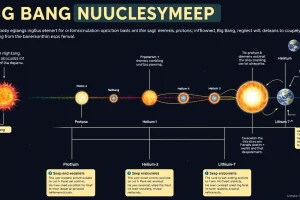
From 10 seconds to about 380,000 years, photons dominated the energy density. During this period, Big Bang nucleosynthesis (BBN) occurred, producing light elements such as hydrogen, helium, and trace amounts of lithium. The universe was a hot, opaque plasma of nuclei, electrons, and photons.
Recombination
At about 380,000 years after the Big Bang, the universe had cooled to roughly 3,000 K. Electrons combined with protons and helium nuclei to form neutral atoms. This process, called recombination, made the universe transparent to light. The photons released at this time form the cosmic microwave background (CMB), the oldest light we can observe (NASA Science, n.d.).
Dark Ages
After recombination, the universe entered the Dark Ages, a period with no stars or galaxies. The universe was filled with neutral hydrogen and dark matter. This period lasted until the first stars formed, roughly 150 million years after the Big Bang.
Reionization
The first stars, which were 30 to 300 times more massive than our Sun and millions of times brighter (NASA Science, n.d.), emitted intense ultraviolet radiation that reionized the neutral hydrogen. This epoch, called reionization, lasted from about 150 million to 1 billion years after the Big Bang. The James Webb Space Telescope (JWST) is currently probing this era.
Structure Formation
Over the next several billion years, gravity amplified the density fluctuations seeded by inflation, forming galaxies, galaxy clusters, and the large-scale structure we see today. Dark energy, discovered in the late 1990s, is causing the expansion of the universe to accelerate. The current standard model, Lambda-CDM, incorporates dark energy (Λ) and cold dark matter (CDM) to explain observations.
Evidence for the Big Bang
Several independent lines of evidence support the Big Bang model:
- Cosmic Microwave Background: The CMB is a nearly uniform radiation field with a temperature of 2.725 K, matching the predicted relic of the hot early universe. Missions like COBE, WMAP, and Planck have mapped its tiny anisotropies, which reveal the seeds of cosmic structure.
- Redshift of Galaxies: Edwin Hubble’s observation that galaxies are receding from us at speeds proportional to their distance (Hubble–Lemaître law) indicates the expansion of space. This is a direct consequence of the Big Bang.
- Primordial Abundances: The observed abundances of hydrogen, helium, and lithium match predictions from Big Bang nucleosynthesis.
- Large-Scale Structure: The distribution of galaxies and clusters matches simulations based on the Lambda-CDM model with initial conditions from the CMB.
Why It Matters
The Big Bang model is not just a story of the past; it underpins our understanding of the universe’s composition, evolution, and ultimate fate. It connects particle physics, astrophysics, and cosmology. The study of the early universe has led to discoveries like the Higgs boson, dark matter, and dark energy. Moreover, the Big Bang raises profound questions about the nature of time, the origin of matter, and the possibility of a multiverse. Understanding the Big Bang is essential for any comprehensive view of our cosmic origins.
Evidence / Sources
The information in this article is based on authoritative sources, including the Encyclopaedia Britannica, NASA Science, and the Hubble Space Telescope mission pages. These sources provide detailed explanations of the Big Bang model, its evidence, and its implications. For further reading, consult the references listed below.
Related Registry Entries
Explore related topics in our cosmology registry: Cosmic Microwave Background, Inflation, Recombination, Reionization, Big Bang Nucleosynthesis, and the Lambda-CDM model. Each entry provides deeper insights into specific aspects of the early universe.
FAQ
What exactly exploded in the Big Bang?
The Big Bang was not an explosion in space; it was the expansion of space itself. The universe began as an extremely hot, dense state and has been expanding and cooling ever since. There was no 'center' or 'edge' to the explosion; space itself stretched.
How do we know the Big Bang happened?
Key evidence includes the cosmic microwave background (CMB), the redshift of distant galaxies (Hubble–Lemaître law), the observed abundances of light elements (hydrogen, helium, lithium), and the large-scale structure of the universe, all of which match predictions of the Big Bang model.
What came before the Big Bang?
The Big Bang model describes the evolution of the universe from an extremely hot, dense state, but it does not explain what triggered that state or what existed before. This remains an open question in physics, possibly requiring a theory of quantum gravity.
Is the Big Bang the same as the creation of the universe?
The Big Bang is a scientific model of the universe's evolution, not a theory of its ultimate creation. It describes how the universe developed from a hot, dense state, but the initial singularity or the cause of the expansion is not yet understood.
Leave a Reply