Short Answer
Main Explanation
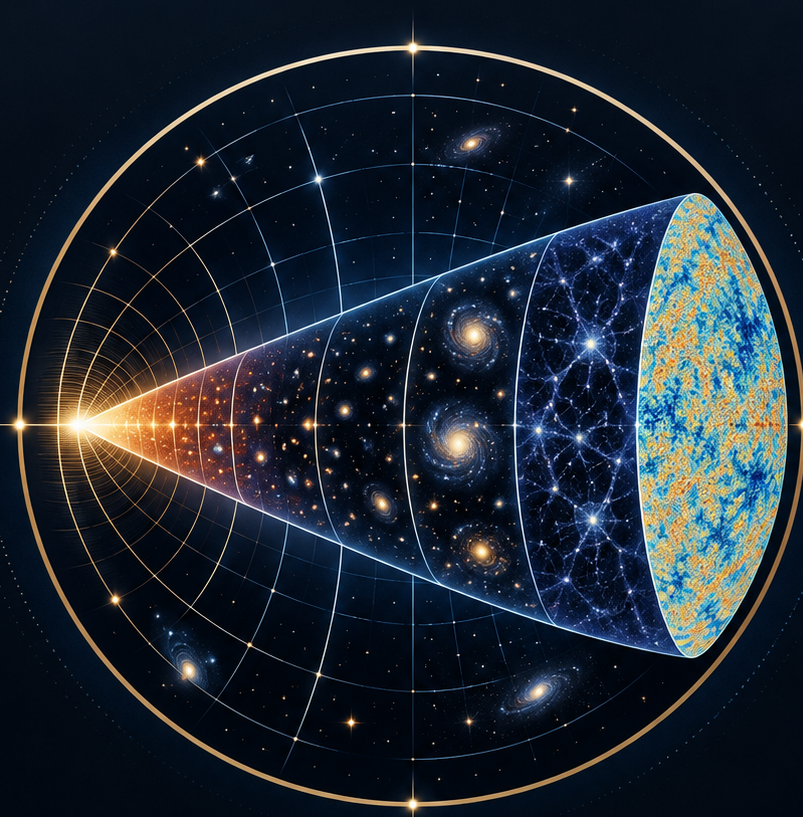
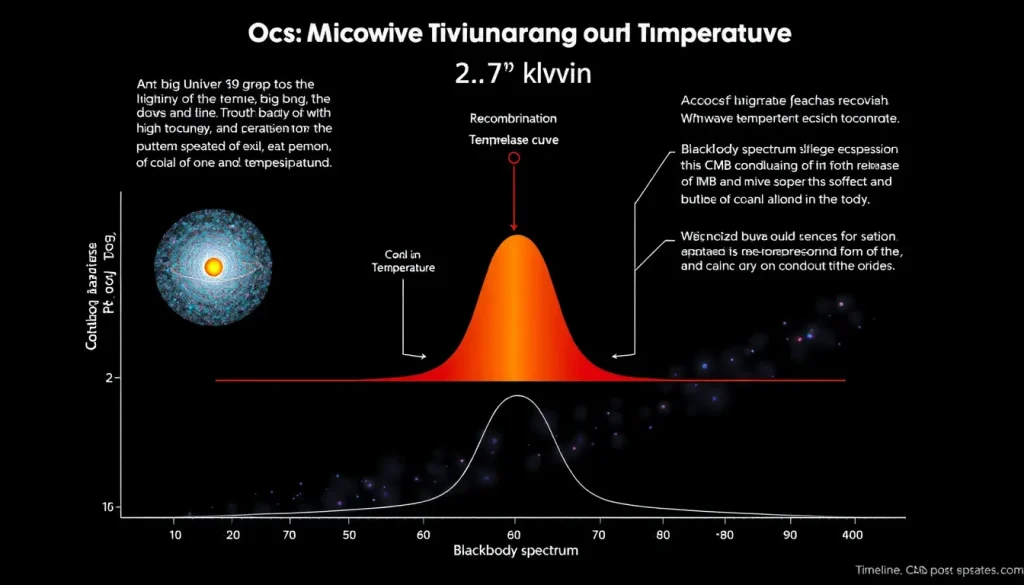
The universe began in an extremely hot, dense state. As it expanded, it cooled. The cosmic microwave background (CMB) is the thermal radiation left over from this early phase. Today we observe it as a nearly perfect blackbody with a temperature of 2.7255 K, as measured by the COBE satellite and confirmed by WMAP and Planck.
Why exactly 2.7 K? The answer lies in the expansion of space and the thermal history of the universe. When the universe was about 380,000 years old, it had cooled to about 3000 K. At that temperature, protons and electrons combined to form neutral hydrogen—an event called recombination. Before this, photons were constantly scattered by free electrons, making the universe opaque. After recombination, photons could travel freely. These photons are the CMB we see today.
As the universe expanded, the wavelength of these photons stretched proportionally to the scale factor. The temperature of a blackbody radiation field falls inversely with the scale factor: T ∝ 1/a. Since the scale factor has increased by a factor of about 1100 since recombination, the temperature dropped from ~3000 K to ~2.7 K. This simple relation explains the observed temperature.
The CMB is not just a temperature; it carries a wealth of information about the composition and evolution of the universe. Tiny anisotropies in the CMB temperature—at the level of 1 part in 100,000—reflect density fluctuations that grew into galaxies and clusters. The angular power spectrum of these anisotropies, measured by WMAP and Planck, provides precise constraints on cosmological parameters such as the Hubble constant, dark matter density, and the curvature of space.
Cosmic Epochs: A Timeline
| Epoch | Time after Big Bang | Temperature | Key Events |
|---|---|---|---|
| Planck epoch | < 10⁻⁴³ s | > 10³² K | Quantum gravity effects dominate |
| Grand Unification epoch | 10⁻⁴³ – 10⁻³⁶ s | 10²⁸ – 10³² K | Unified forces separate |
| Inflationary epoch | 10⁻³⁶ – 10⁻³² s | ~10²⁷ K | Exponential expansion; seeds of structure |
| Electroweak epoch | 10⁻³² – 10⁻¹² s | 10¹⁵ – 10²⁸ K | Electromagnetic and weak forces separate |
| Quark epoch | 10⁻¹² – 10⁻⁶ s | 10¹² – 10¹⁵ K | Quarks and gluons form plasma |
| Hadron epoch | 10⁻⁶ – 1 s | 10¹⁰ – 10¹² K | Protons and neutrons form |
| Lepton epoch | 1 – 10 s | 10⁹ – 10¹⁰ K | Leptons dominate; neutrinos decouple |
| Photon epoch | 10 s – 380,000 yr | 3,000 – 10⁹ K | Nucleosynthesis; photons dominate |
| Recombination | ~380,000 yr | ~3,000 K | Atoms form; CMB released |
| Dark Ages | 380,000 – 150 million yr | ~60 – 3,000 K | No luminous sources; neutral hydrogen |
| Reionization | ~150 million – 1 billion yr | ~20 – 60 K | First stars and galaxies ionize hydrogen |
| Structure Formation | ~1 billion yr – present | 2.7 K (now) | Galaxies, clusters, large-scale structure form |
The CMB temperature is a direct measure of the cooling of the universe. The observed value of 2.7255 K is consistent with the standard ΛCDM model, which predicts the temperature from the energy density of radiation and the expansion history. Any significant deviation would require new physics.
Question Article
Short Answer
The CMB is 2.7 K because the universe has expanded by a factor of ~1100 since the photons last scattered at recombination, cooling the blackbody radiation from ~3000 K to its present value.
What We Know
We know the CMB spectrum is blackbody to extraordinary precision, with no detectable deviations. The temperature is isotropic to about 1 part in 100,000, with small fluctuations that match predictions from inflationary cosmology. The CMB provides the tightest constraints on many cosmological parameters.
What We Don’t Know
We do not fully understand the physical processes that generated the initial density fluctuations, though inflation is the leading candidate. The nature of dark matter and dark energy, which influence the expansion history and thus the CMB temperature, remains mysterious.
Evidence
Key evidence includes the COBE satellite’s measurement of the blackbody spectrum (1989), WMAP’s high-resolution anisotropy maps (2003), and Planck’s even more precise data (2013). The agreement between these measurements and theoretical predictions is remarkable.
Competing Explanations
Alternatives like tired light or steady-state models fail to explain the blackbody spectrum and the observed anisotropies. The standard Big Bang model with inflation remains the only framework consistent with all observations.
Current Research
Ongoing experiments (e.g., Simons Observatory, CMB-S4) aim to detect polarization signals from inflation (B-modes) and to measure the CMB temperature with even higher precision to probe new physics.
Why It Matters
The CMB temperature is not just a number—it encapsulates the entire thermal history of the universe. It confirms the Big Bang, provides a snapshot of the universe at 380,000 years, and underpins our understanding of cosmic expansion, dark matter, and dark energy. Without the CMB, we would lack a direct observational anchor for the hot early universe.
Evidence / Sources
The values and interpretations presented here are based on peer-reviewed measurements and reviews. The COBE FIRAS instrument measured the CMB temperature to be 2.726 ± 0.01 K (Science, 1993). The Particle Data Group review (2011) lists 2.7255 K as the standard value. The Physics LibreTexts article explains the recombination epoch. Wayne Hu’s lecture notes provide detailed theoretical background.
Related Registry Entries
- Cosmic Microwave Background
- Recombination
- Inflation
- Big Bang Nucleosynthesis
- Large-Scale Structure
FAQ
Why is the CMB temperature so uniform?
The uniformity is explained by inflation, which smoothed out initial inhomogeneities and brought the observable universe into causal contact.
How do we measure the CMB temperature?
Instruments like COBE's FIRAS measure the spectrum of the microwave sky and fit it to a blackbody curve, yielding the temperature.
What would the CMB temperature be in the future?
As the universe continues to expand, the CMB temperature will drop further, approaching absolute zero asymptotically.

Leave a Reply