Short Answer
Main Explanation
The Hubble constant (H₀) is the rate at which the universe is expanding today. It relates the recession velocity of distant galaxies to their distance, as expressed by the Hubble–Lemaître law: velocity = H₀ × distance. First determined by Edwin Hubble in 1929, this constant is one of the most important numbers in cosmology because it sets the scale and age of the universe.
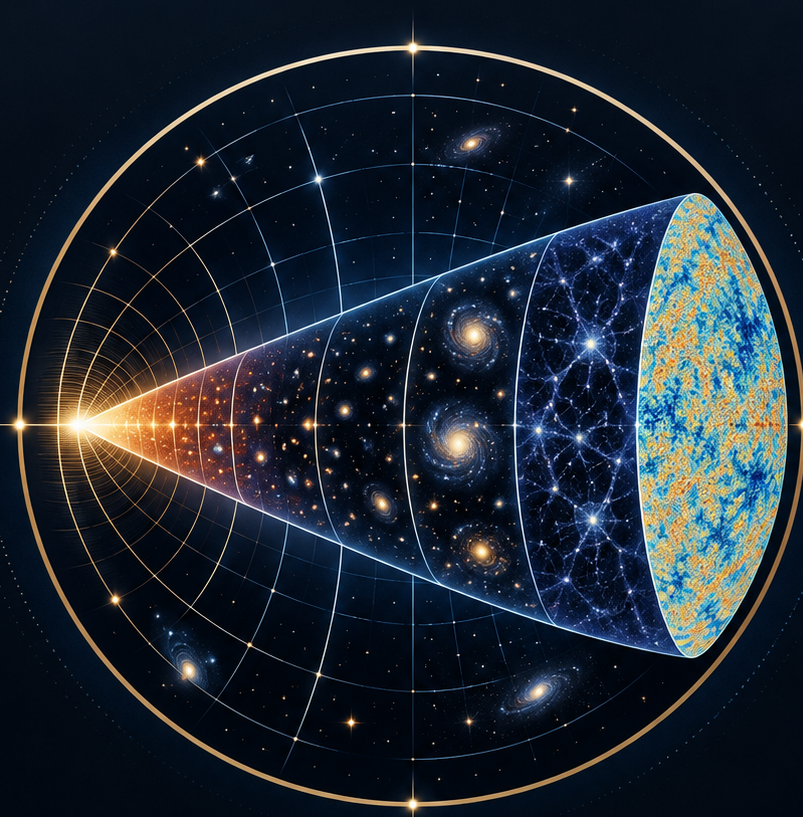
In the standard Lambda-CDM model, the universe began in a hot, dense state about 13.8 billion years ago. The expansion has been slowing due to gravity, but since the late 1990s we know it is accelerating due to dark energy. The Hubble constant is not truly constant over time; it changes as the universe evolves. The value measured today is denoted H₀.
The Expanding Universe
Hubble’s discovery built on Vesto Slipher’s measurements of galaxy redshifts and Hubble’s own distance estimates using Cepheid variables. The linear relationship between distance and velocity became the foundation of modern cosmology. The constant’s value is usually expressed in kilometers per second per megaparsec (km/s/Mpc).
Cosmic Epochs and the Hubble Constant
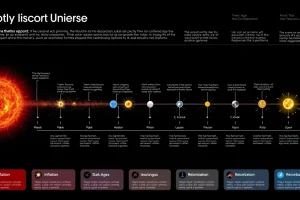
The Hubble constant is intimately linked to the history of the universe. Knowing its value allows us to estimate the age of the universe and to trace the sequence of epochs from the Planck epoch to the present. Below is a timeline of key epochs.
| Epoch | Time after Big Bang | Temperature | Key Events |
|---|---|---|---|
| Planck epoch | <10⁻⁴³ s | >10³² K | Quantum gravity effects dominate |
| Grand Unification epoch | 10⁻⁴³ – 10⁻³⁶ s | 10²⁷ – 10³² K | Strong and electroweak forces unify |
| Inflationary epoch | 10⁻³⁶ – 10⁻³² s | ~10²⁷ K | Rapid exponential expansion |
| Electroweak epoch | 10⁻³² – 10⁻¹² s | 10¹⁵ – 10²⁷ K | Electromagnetic and weak forces separate |
| Quark epoch | 10⁻¹² – 10⁻⁶ s | 10¹² – 10¹⁵ K | Quarks and gluons form quark-gluon plasma |
| Hadron epoch | 10⁻⁶ – 1 s | 10¹⁰ – 10¹² K | Protons and neutrons form |
| Lepton epoch | 1 – 10 s | 10⁹ – 10¹⁰ K | Leptons dominate; neutrinos decouple |
| Photon epoch | 10 s – 380,000 yr | 3,000 – 10⁹ K | Photons dominate; nucleosynthesis occurs |
| Recombination | ~380,000 yr | ~3,000 K | Atoms form; CMB released |
| Dark Ages | 380,000 yr – 150 million yr | ~3,000 – 60 K | No stars yet; neutral hydrogen |
| Reionization | 150 million – 1 billion yr | ~60 – 20 K | First stars and galaxies ionize gas |
| Structure Formation | 1 billion yr – present | ~20 K – 2.7 K | Galaxies, clusters, large-scale structure |
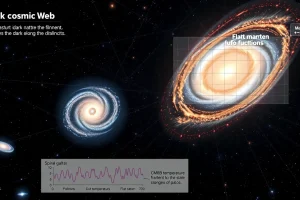
The cosmic microwave background (CMB) is the relic radiation from recombination. Missions like COBE, WMAP, and Planck have mapped its subtle temperature fluctuations, providing precise constraints on cosmological parameters including H₀.
Measurement of the Hubble Constant
Value
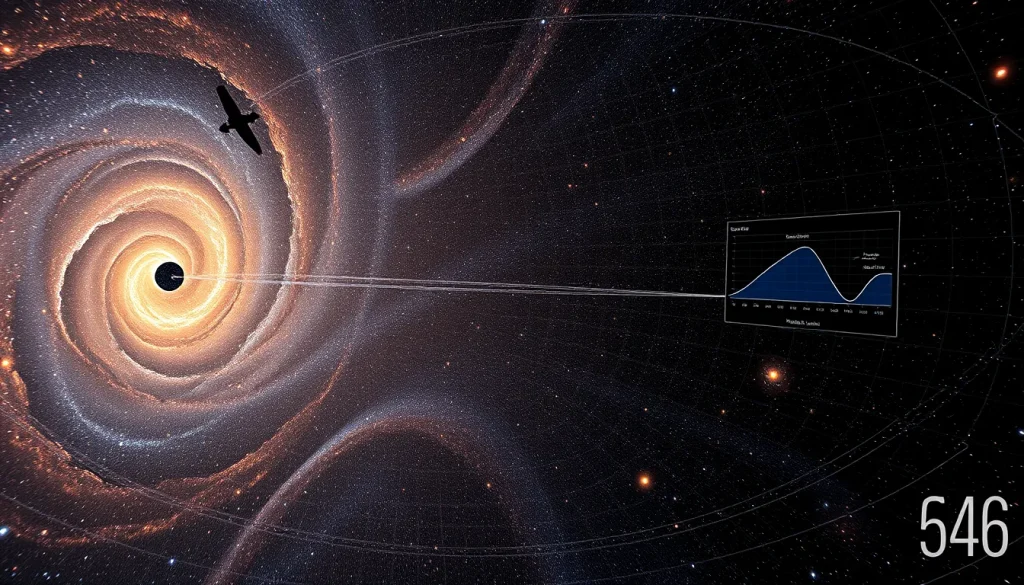
The currently accepted value is not a single number. Local measurements using Cepheid variables and Type Ia supernovae give H₀ ≈ 72–74 km/s/Mpc, while measurements from the CMB using the Planck satellite yield H₀ ≈ 67.4 km/s/Mpc. This discrepancy is known as the “Hubble tension.”
Units
km/s per megaparsec (km/s/Mpc). One megaparsec is 3.26 million light-years.
Instrument
Various: Hubble Space Telescope, ground-based telescopes, Planck satellite, James Webb Space Telescope, etc.
Method
Two main methods: distance ladder (using standard candles like Cepheids and supernovae) and cosmic microwave background (fitting the angular scale of acoustic peaks).
Uncertainty
Local measurements have typical errors of 2–3 km/s/Mpc; CMB-based errors are smaller (~0.5 km/s/Mpc).
Dataset
SH0ES (Supernovae H₀ for the Equation of State), Planck 2018, etc.
Latest/Reference Measurement
Planck 2018 gives 67.4 ± 0.5 km/s/Mpc; SH0ES gives 73.0 ± 1.0 km/s/Mpc.
Why Measurements Differ
Possible reasons: systematic errors in distance ladder, new physics like early dark energy, or unknown systematic effects in CMB analysis.
Why It Matters
The Hubble constant determines the age of the universe, the size of the observable universe, and the nature of dark energy. A precise value is essential for testing models of cosmic evolution. The tension between measurements may point to new physics beyond the standard model.
Evidence / Sources
Key evidence includes the CMB, supernova surveys, baryon acoustic oscillations, and the large-scale structure of galaxies. Missions like COBE, WMAP, and Planck have provided high-precision data. The Hubble Space Telescope and JWST continue to refine distance measurements.
Related Registry Entries
- Cosmic Microwave Background
- Inflation
- Big Bang Nucleosynthesis
- Dark Energy
- Recombination
- Large-Scale Structure
FAQ
What is the Hubble constant?
The Hubble constant (H₀) is the rate at which the universe is expanding today, relating the recession velocity of distant galaxies to their distance. It is a fundamental parameter in cosmology that helps determine the age and scale of the universe.
Why is there a Hubble tension?
The Hubble tension refers to the discrepancy between local measurements of H₀ (using Cepheids and supernovae, giving ~73 km/s/Mpc) and early-universe measurements from the cosmic microwave background (giving ~67 km/s/Mpc). The cause is unknown and may indicate new physics or systematic errors.
How does the Hubble constant relate to the age of the universe?
The Hubble constant sets the expansion rate, which, combined with the matter and energy densities, determines the age of the universe. A higher H₀ implies a younger universe, while a lower H₀ implies an older one. The current best estimate is about 13.8 billion years.
Leave a Reply