Short Answer
Main Explanation
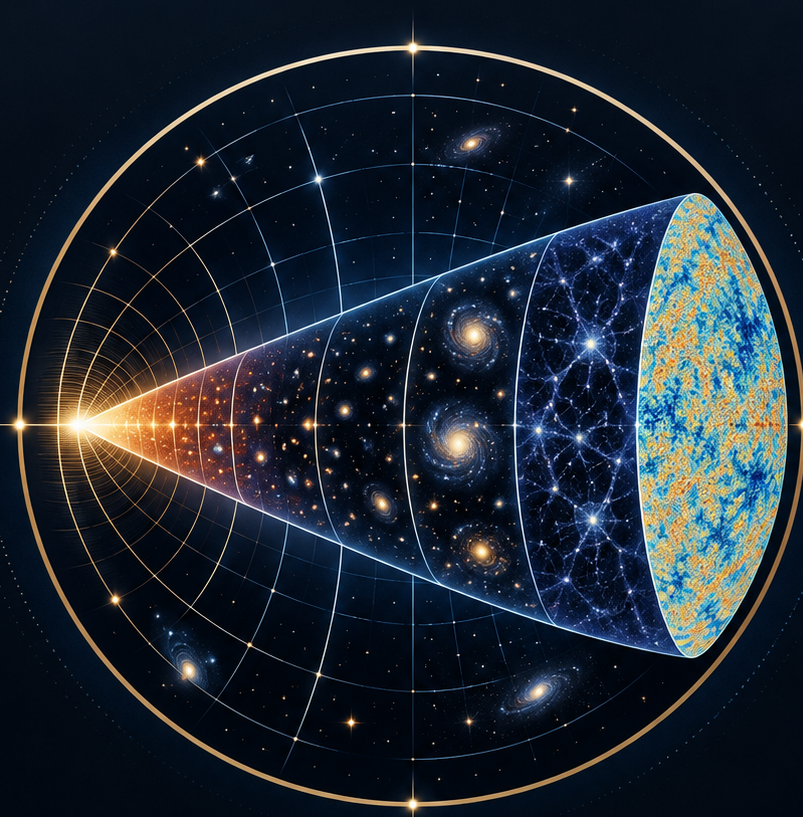
The expansion of the universe is the increase in distance between gravitationally unbound parts of the observable universe with time. It is an intrinsic expansion, meaning it does not occur into any pre-existing space; rather, space itself stretches. To any observer within the universe, all but the nearest galaxies appear to recede at speeds proportional to their distance, a relationship known as the Hubble–Lemaître law. This discovery, made through theoretical work in general relativity and observational redshift measurements in the 1920s, transformed 20th-century cosmology and led to the development of the Big Bang model.
In the standard cosmological model, known as Lambda-CDM (ΛCDM), the universe began in an extremely hot, dense state approximately 13.8 billion years ago. Since then, it has expanded and cooled, passing through a series of distinct epochs that shaped its composition and structure. The expansion is not an explosion in space but an expansion of space itself, as described by the Friedmann equations derived from general relativity.
Hubble–Lemaître Law
The Hubble–Lemaître law states that the recession velocity of a galaxy is directly proportional to its distance from the observer: v = H₀d, where H₀ is the Hubble constant. This linear relationship, first observed by Edwin Hubble and Georges Lemaître, is the key evidence for cosmic expansion. While objects cannot move faster than light in local reference frames, cosmologically distant galaxies can recede at superluminal speeds because the expansion of space itself is not constrained by the speed limit.
The Big Bang Model and ΛCDM
The Big Bang model describes the universe’s evolution from an initial singularity through a period of rapid inflation, nucleosynthesis, recombination, and structure formation. The ΛCDM model incorporates dark energy (Λ) and cold dark matter (CDM) to explain the observed acceleration of expansion and the formation of large-scale structures. This model is the current consensus, supported by multiple independent observations including the cosmic microwave background (CMB), the abundance of light elements, and the distribution of galaxies.
Cosmic Epochs: A Timeline
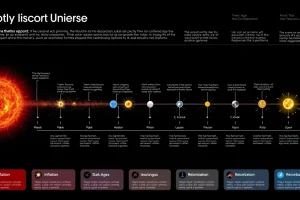
The history of the universe is divided into epochs, each characterized by distinct physical conditions and dominant particles. The following table summarizes the major epochs from the Planck epoch to the present day.
| Epoch | Time After Big Bang | Temperature | Approximate Redshift | Key Events |
|---|---|---|---|---|
| Planck Epoch | 0 to 10⁻⁴³ s | >10³² K | >10³² | Quantum gravity effects dominate; all forces unified |
| Grand Unification Epoch | 10⁻⁴³ to 10⁻³⁶ s | 10²⁷–10³² K | 10²⁷–10³² | Strong force separates from electroweak force |
| Inflationary Epoch | 10⁻³⁶ to 10⁻³² s | ~10²⁷ K | ~10²⁷ | Exponential expansion; quantum fluctuations seeded structure |
| Electroweak Epoch | 10⁻³² to 10⁻¹² s | 10¹⁵–10²⁷ K | 10¹⁵–10²⁷ | Electromagnetic and weak forces separate |
| Quark Epoch | 10⁻¹² to 10⁻⁶ s | 10¹²–10¹⁵ K | 10¹²–10¹⁵ | Quarks and gluons exist in a quark–gluon plasma |
| Hadron Epoch | 10⁻⁶ to 1 s | 10¹⁰–10¹² K | 10¹⁰–10¹² | Protons and neutrons form; matter–antimatter annihilation |
| Lepton Epoch | 1 to 10 s | 10⁹–10¹⁰ K | 10⁹–10¹⁰ | Leptons dominate; neutrinos decouple |
| Photon Epoch | 10 s to 380,000 yr | 3,000–10⁹ K | 3,000–10⁹ | Photons dominate; nucleosynthesis occurs |
| Recombination | ~380,000 yr | ~3,000 K | ~1,100 | Electrons combine with nuclei; CMB released |
| Dark Ages | 380,000 yr to ~150 million yr | ~3,000 K to ~50 K | 1,100 to ~20 | No stars yet; universe is dark and neutral |
| Reionization | ~150 million yr to ~1 billion yr | ~50 K to ~10 K | 20 to ~6 | First stars and galaxies ionize neutral hydrogen |
| Structure Formation | ~1 billion yr to present | ~10 K to 2.7 K | 6 to 0 | Galaxies, clusters, and large-scale structure form |
Planck Epoch
When It Happened: 0 to 10⁻⁴³ seconds after the Big Bang.
Temperature: Greater than 10³² K.
Approximate Redshift: Greater than 10³².
Dominant Particles/Physics: Quantum gravity effects dominate; all four fundamental forces are unified.
What Happened: The universe existed in an extremely hot, dense state where the laws of physics as we know them break down. General relativity and quantum mechanics must be combined to describe this era, but a complete theory of quantum gravity remains elusive.
What Came Before: The initial singularity, a point of infinite density and temperature, though the concept is likely modified by quantum effects.
What Came Next: The Grand Unification Epoch, when gravity separated from the other forces.
Evidence: Direct evidence is lacking, but the observed uniformity of the CMB and the flatness of the universe suggest an early period of rapid expansion (inflation) that smoothed initial conditions.
Grand Unification Epoch
When It Happened: 10⁻⁴³ to 10⁻³⁶ seconds.
Temperature: 10²⁷ to 10³² K.
Approximate Redshift: 10²⁷ to 10³².
Dominant Particles/Physics: The strong nuclear force separates from the electroweak force; grand unified theories (GUTs) describe this transition.
What Happened: As the universe cooled, the strong force became distinct, leading to a period of symmetry breaking. This epoch is associated with the generation of matter–antimatter asymmetry (baryogenesis).
What Came Before: The Planck epoch.
What Came Next: The Inflationary Epoch.
Evidence: Indirect evidence comes from the observed matter–antimatter asymmetry and the absence of magnetic monopoles, which inflation would dilute.
Inflationary Epoch
When It Happened: 10⁻³⁶ to 10⁻³² seconds.
Temperature: ~10²⁷ K.
Approximate Redshift: ~10²⁷.
Dominant Particles/Physics: A scalar field (inflaton) drives exponential expansion; quantum fluctuations are stretched to cosmic scales.
What Happened: The universe expanded by a factor of at least 10²⁶ in a fraction of a second, smoothing out any initial irregularities and flattening spacetime. Quantum fluctuations seeded the density perturbations that later grew into galaxies and clusters.
What Came Before: The Grand Unification Epoch.
What Came Next: The Electroweak Epoch.
Evidence: The near-uniformity of the CMB, the flatness of the universe, and the absence of magnetic monopoles are all consistent with inflation. The detailed pattern of CMB anisotropies matches predictions from inflationary models.
Electroweak Epoch
When It Happened: 10⁻³² to 10⁻¹² seconds.
Temperature: 10¹⁵ to 10²⁷ K.
Approximate Redshift: 10¹⁵ to 10²⁷.
Dominant Particles/Physics: Electromagnetic and weak forces are unified; W and Z bosons are massless.
What Happened: As the universe cooled below ~10¹⁵ K, the electroweak symmetry broke, giving mass to W and Z bosons and separating the electromagnetic and weak forces. This process is described by the Standard Model of particle physics.
What Came Before: Inflation.
What Came Next: The Quark Epoch.
Evidence: The Standard Model successfully predicts the observed particle masses and interactions, and the electroweak transition is a key component of early-universe models.
Quark Epoch
When It Happened: 10⁻¹² to 10⁻⁶ seconds.
Temperature: 10¹² to 10¹⁵ K.
Approximate Redshift: 10¹² to 10¹⁵.
Dominant Particles/Physics: Quarks, antiquarks, and gluons exist in a quark–gluon plasma; quarks are not yet confined into hadrons.
What Happened: The universe was a hot, dense soup of quarks and gluons. As it expanded and cooled, quarks combined to form protons and neutrons (hadrons) at the end of this epoch.
What Came Before: Electroweak Epoch.
What Came Next: Hadron Epoch.
Evidence: Relativistic heavy-ion collisions at particle accelerators (e.g., RHIC and LHC) recreate quark–gluon plasma conditions, confirming the existence of this state.
Hadron Epoch
When It Happened: 10⁻⁶ to 1 second.
Temperature: 10¹⁰ to 10¹² K.
Approximate Redshift: 10¹⁰ to 10¹².
Dominant Particles/Physics: Protons, neutrons, and their antiparticles; strong force dominates.
What Happened: Quarks became confined into hadrons. Matter–antimatter annihilation reduced the number of baryons, leaving a small excess of matter over antimatter (baryogenesis).
What Came Before: Quark Epoch.
What Came Next: Lepton Epoch.
Evidence: The observed baryon-to-photon ratio (~6×10⁻¹⁰) is consistent with baryogenesis during this epoch.
Lepton Epoch
When It Happened: 1 to 10 seconds.
Temperature: 10⁹ to 10¹⁰ K.
Approximate Redshift: 10⁹ to 10¹⁰.
Dominant Particles/Physics: Leptons (electrons, muons, neutrinos) and their antiparticles; neutrinos decouple from matter.
What Happened: Leptons and antileptons annihilated, leaving a small excess of electrons. Neutrinos decoupled, forming the cosmic neutrino background that still exists today.
What Came Before: Hadron Epoch.
What Came Next: Photon Epoch.
Evidence: The cosmic neutrino background has not been directly detected, but its existence is inferred from Big Bang nucleosynthesis and the CMB.
Photon Epoch
When It Happened: 10 seconds to 380,000 years.
Temperature: 3,000 to 10⁹ K.
Approximate Redshift: 3,000 to 10⁹.
Dominant Particles/Physics: Photons dominate the energy density; electrons, protons, and nuclei form a hot plasma.
What Happened: During the first few minutes, Big Bang nucleosynthesis produced light elements (hydrogen, helium, lithium). The universe remained opaque because photons constantly scattered off free electrons.
What Came Before: Lepton Epoch.
What Came Next: Recombination.
Evidence: The observed primordial abundances of light elements match predictions from nucleosynthesis calculations.
Recombination
When It Happened: ~380,000 years after the Big Bang.
Temperature: ~3,000 K.
Approximate Redshift: ~1,100.
Dominant Particles/Physics: Electrons combine with protons and helium nuclei to form neutral atoms; photons decouple.
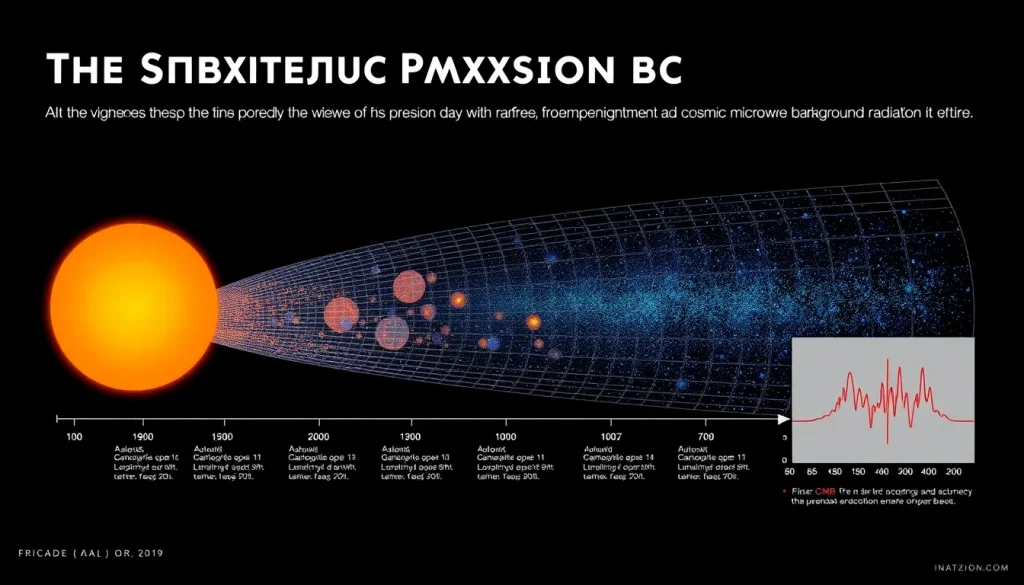
What Happened: As the universe cooled to about 3,000 K, electrons and nuclei combined to form neutral hydrogen and helium. Photons were no longer scattered, and the universe became transparent. These photons are observed today as the cosmic microwave background (CMB).
What Came Before: Photon Epoch.
What Came Next: Dark Ages.
Evidence: The CMB, discovered in 1965, is a near-perfect blackbody spectrum at 2.725 K, with tiny anisotropies that match predictions from inflation and structure formation.
Dark Ages
When It Happened: 380,000 to ~150 million years.
Temperature: ~3,000 K to ~50 K.
Approximate Redshift: 1,100 to ~20.
Dominant Particles/Physics: Neutral hydrogen and helium; no stars or galaxies yet.
What Happened: The universe was dark and filled with neutral gas. Gravity slowly amplified density fluctuations, setting the stage for the formation of the first stars and galaxies.
What Came Before: Recombination.
What Came Next: Reionization.
Evidence: Observations of the 21-cm hydrogen line and the lack of early galaxies in deep surveys are beginning to probe this era.
Reionization
When It Happened: ~150 million to ~1 billion years.
Temperature: ~50 K to ~10 K.
Approximate Redshift: 20 to ~6.
Dominant Particles/Physics: First stars (Population III) and galaxies emit ultraviolet radiation that ionizes neutral hydrogen.
What Happened: The first stars and galaxies formed, producing enough UV radiation to reionize the intergalactic medium. This epoch marks the end of the Dark Ages and the beginning of cosmic dawn.
What Came Before: Dark Ages.
What Came Next: Structure Formation.
Evidence: The Gunn–Peterson trough in quasar spectra and the optical depth of the CMB indicate that reionization occurred around redshift 6–20.
Structure Formation
When It Happened: ~1 billion years to present.
Temperature: ~10 K to 2.7 K.
Approximate Redshift: 6 to 0.
Dominant Particles/Physics: Dark matter halos attract baryonic matter; galaxies, clusters, and superclusters form under gravity.
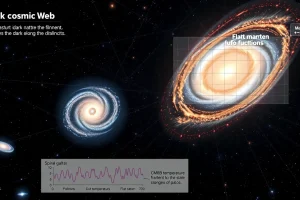
What Happened: Over billions of years, small density fluctuations grew into the cosmic web of galaxies and clusters we observe today. Dark energy began to dominate the expansion rate about 5 billion years ago, causing the expansion to accelerate.
What Came Before: Reionization.
What Came Next: The present era, with ongoing structure formation and accelerated expansion.
Evidence: Galaxy surveys (e.g., SDSS, DESI) map the large-scale structure, while supernova observations reveal the accelerated expansion.
Why It Matters
Understanding the expansion of the universe is fundamental to cosmology. It provides the framework for the Big Bang model, explains the origin of the CMB, and allows us to trace the evolution of cosmic structure. The expansion also reveals the presence of dark energy, which drives the current acceleration and determines the ultimate fate of the universe. By studying the epochs described above, scientists can test fundamental physics, probe the nature of dark matter and dark energy, and refine our understanding of gravity on cosmic scales.
Evidence / Sources
The expansion of the universe is supported by multiple independent lines of evidence:
- Galactic redshifts: The Hubble–Lemaître law, observed across thousands of galaxies, shows that recession velocity increases with distance.
- Cosmic microwave background: The CMB is a relic of recombination, with a near-perfect blackbody spectrum and anisotropies that match inflationary predictions.
- Big Bang nucleosynthesis: The observed abundances of hydrogen, helium, and lithium match predictions from the first few minutes of the universe.
- Large-scale structure: The distribution of galaxies and clusters is consistent with the growth of primordial density fluctuations.
- Accelerated expansion: Type Ia supernovae and BAO measurements show that the expansion is accelerating, implying dark energy.
Key missions and instruments have provided crucial data:
- COBE (1989–1993) measured the CMB spectrum and discovered its anisotropies.
- WMAP (2001–2010) produced high-resolution maps of CMB temperature fluctuations, pinning down cosmological parameters.
- Planck (2009–2013) provided even more precise measurements, confirming the ΛCDM model.
- JWST (2021–present) is observing the first galaxies and probing the epoch of reionization.
Related Registry Entries
Explore related topics in the cosmic registry:
- Cosmic Microwave Background Explained
- Inflation and the Early Universe
- Big Bang Nucleosynthesis
- Dark Energy and the Accelerating Universe
FAQ
What does it mean that the universe is expanding?
The expansion of the universe means that the distance between gravitationally unbound parts of the cosmos increases over time. It is an intrinsic expansion of space itself, not an explosion into a pre-existing void. Galaxies appear to recede from us at speeds proportional to their distance, as described by the Hubble–Lemaître law.
How fast is the universe expanding?
The expansion rate is quantified by the Hubble constant (H₀), which is approximately 70 km/s per megaparsec, though there is a slight tension between different measurement methods. The exact value is still being refined by missions like Planck and Hubble.
What is the cosmic microwave background?
The cosmic microwave background (CMB) is the oldest light in the universe, emitted about 380,000 years after the Big Bang when electrons combined with protons to form neutral atoms. It is a near-perfect blackbody radiation at 2.725 K and contains tiny temperature fluctuations that reveal the seeds of cosmic structure.
Will the universe expand forever?
According to the ΛCDM model, the expansion is accelerating due to dark energy. The most likely fate is that the universe will continue expanding indefinitely, leading to a 'Big Freeze' where galaxies drift apart and stars eventually burn out. However, the ultimate fate depends on the properties of dark energy, which are still not fully understood.
Leave a Reply