Short Answer
Short Answer: One second after the Big Bang, the universe had expanded and cooled to about 10 billion kelvin, allowing neutrinos to decouple from matter and radiation. The quark–hadron transition had already occurred at 10 microseconds, leaving a hot plasma of protons, neutrons, electrons, and photons. This moment marks the beginning of the lepton epoch, setting the stage for primordial nucleosynthesis.
| Property | Value at t = 1 second |
|---|---|
| Time after Big Bang | 1 second |
| Temperature | ~1010 K (≈1 MeV) |
| Redshift | z ≈ 109 |
| Dominant particles | Neutrinos, electrons, positrons, photons, protons, neutrons |
| Key event | Neutrino decoupling |
Main Explanation
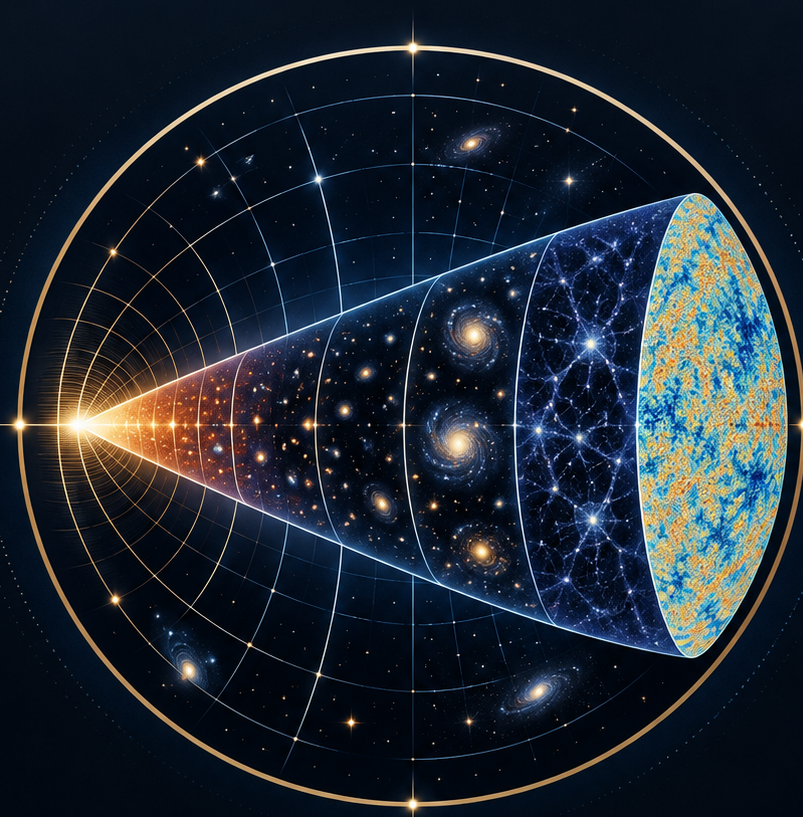
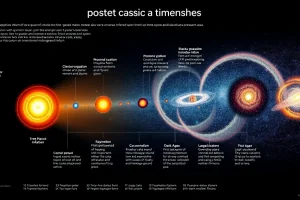
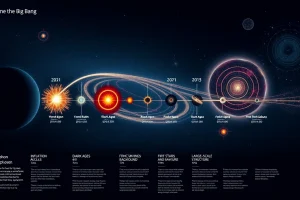
The history of the universe is a story of expansion and cooling. According to the standard Lambda-CDM model, the cosmos began as an infinitely hot, dense point about 13.787 billion years ago. In the first fraction of a second, a period of exponential expansion called inflation enlarged the universe by a factor of at least 1026 — more than 100,000 times the number of grains of sand on Earth (New Scientist, 2026). After inflation, the universe continued to expand and cool, passing through a series of distinct epochs that shaped the matter and energy we observe today.
The Planck Epoch (0 to 10−43 s)
At the very beginning, the four fundamental forces — gravity, electromagnetism, and the strong and weak nuclear forces — were unified. Our current physics cannot describe this era because quantum effects of gravity become significant. This is the most speculative period, with no direct observational constraints (ESA, 2026).
Grand Unification and Inflation (10−43 to 10−32 s)
As the universe cooled, gravity separated first, then the strong force. The remaining electroweak force unified. Around 10−36 seconds, inflation began, driven by a hypothetical scalar field. During this phase, the universe expanded exponentially, smoothing out irregularities and setting the initial conditions for structure formation. Inflation ended when the field decayed, reheating the universe and creating a quark–gluon plasma (Wikipedia, 2026).
The Electroweak and Quark Epochs (10−32 to 10−6 s)
After inflation, the universe was filled with a hot plasma of quarks, gluons, and leptons. At about 1000 GeV (1016 K), the forces assumed their present properties (ESA, 2026). Quarks and gluons roamed freely until the quark–hadron transition at about 10 microseconds, when they condensed into protons and neutrons (Schwarz, 2003).
The Hadron and Lepton Epochs (10−6 to 10 s)
During the hadron epoch, protons and neutrons formed, and matter–antimatter annihilation left a small excess of matter. By 1 second, the temperature had dropped to about 1010 K, and neutrinos decoupled from the radiation fluid — they have been streaming freely ever since (Wikipedia, 2026). This is the moment highlighted in this article. The lepton epoch continued until about 10 seconds, when electrons and positrons annihilated, producing a pulse of energy.
Nucleosynthesis and the Photon Epoch (10 s to 380,000 years)
Between 10 seconds and about 20 minutes, protons and neutrons fused into the first nuclei — primarily hydrogen and helium, with trace amounts of lithium. This process, Big Bang nucleosynthesis, is confirmed by observed light-element abundances. The universe then entered the photon epoch, dominated by radiation. As it expanded and cooled, electrons combined with nuclei at recombination (about 380,000 years), releasing the cosmic microwave background (CMB) — a relic we observe today (Wikipedia, 2026).
Dark Ages, Reionization, and Structure Formation
After recombination, the universe was dark and filled with neutral hydrogen. Gravity slowly amplified density fluctuations, leading to the first stars and galaxies during the Cosmic Dawn. Their ultraviolet light reionized the intergalactic medium (reionization). Over billions of years, these structures merged into the large-scale cosmic web we see today. The CMB, measured precisely by COBE, WMAP, and Planck, provides a snapshot of the universe at 380,000 years and confirms the predictions of the Lambda-CDM model (ESA, 2026).
The First Second: A Closer Look
Using the Cosmic Epoch framework, we can detail the state of the universe exactly one second after the Big Bang.
When It Happened
1 second after the Big Bang, at the boundary between the hadron and lepton epochs.
Temperature
Approximately 1010 K (about 1 MeV), cool enough for neutrinos to decouple.
Approximate Redshift
z ≈ 109.
Dominant Particles/Physics
Neutrinos, electrons, positrons, photons, protons, and neutrons. The weak interaction is no longer in equilibrium, so neutrinos stream freely.
What Happened
Neutrino decoupling: neutrinos stopped interacting with matter, leaving a cosmic neutrino background that still exists today. The quark–hadron transition had already occurred, so matter existed as a gas of nucleons.
What Came Before
The hadron epoch, where quarks and gluons condensed into protons and neutrons.
What Came Next
The lepton epoch, followed by electron–positron annihilation and then nucleosynthesis.
Evidence
Indirect evidence comes from the observed light-element abundances and the cosmic neutrino background (not yet directly detected, but consistent with CMB data). Particle accelerator experiments at CERN and RHIC probe the quark–gluon plasma conditions.
Why It Matters
Understanding the first second is crucial because it sets the initial conditions for everything that follows. The slight excess of matter over antimatter, the density fluctuations that seeded galaxies, and the abundance of light elements all trace back to this epoch. The CMB, which we can measure with extraordinary precision, encodes the physics of the early universe and confirms the standard model. Missions like COBE, WMAP, and Planck have mapped the CMB to exquisite detail, while JWST is now probing the first galaxies, connecting the early universe to our cosmic history.
Evidence / Sources
The timeline presented here is based on the standard Lambda-CDM model, supported by multiple lines of evidence:
- Cosmic microwave background anisotropies measured by COBE, WMAP, and Planck.
- Primordial abundances of hydrogen, helium, and lithium from Big Bang nucleosynthesis.
- Large-scale structure surveys (e.g., SDSS, DES) that match predictions from inflation.
- Particle accelerator experiments that reproduce quark–gluon plasma conditions.
Key references include ESA’s overview of the early universe, Schwarz’s review of the first second, and the Wikipedia chronology of the universe.
Related Registry Entries
- Cosmic Microwave Background
- Big Bang Nucleosynthesis
- Inflation
- Recombination
- Dark Ages and Reionization
FAQ
What exactly happened at the one-second mark?
At one second after the Big Bang, the universe had cooled to about 10 billion kelvin, allowing neutrinos to decouple from matter. This means neutrinos stopped interacting with other particles and have been streaming freely ever since. The quark–hadron transition had already occurred, so matter existed as protons and neutrons.
How do we know what happened in the first second if we can't observe it directly?
We infer the conditions from particle physics experiments (e.g., at CERN) that recreate quark–gluon plasmas, and from the observed abundances of light elements and the cosmic microwave background, which depend on the early universe's physics.
What is the cosmic microwave background and why is it important?
The CMB is the oldest light in the universe, emitted about 380,000 years after the Big Bang when electrons combined with protons. It provides a snapshot of the early universe and confirms the predictions of the Big Bang model, including the flatness and homogeneity of space.

Leave a Reply