Short Answer
Main Explanation
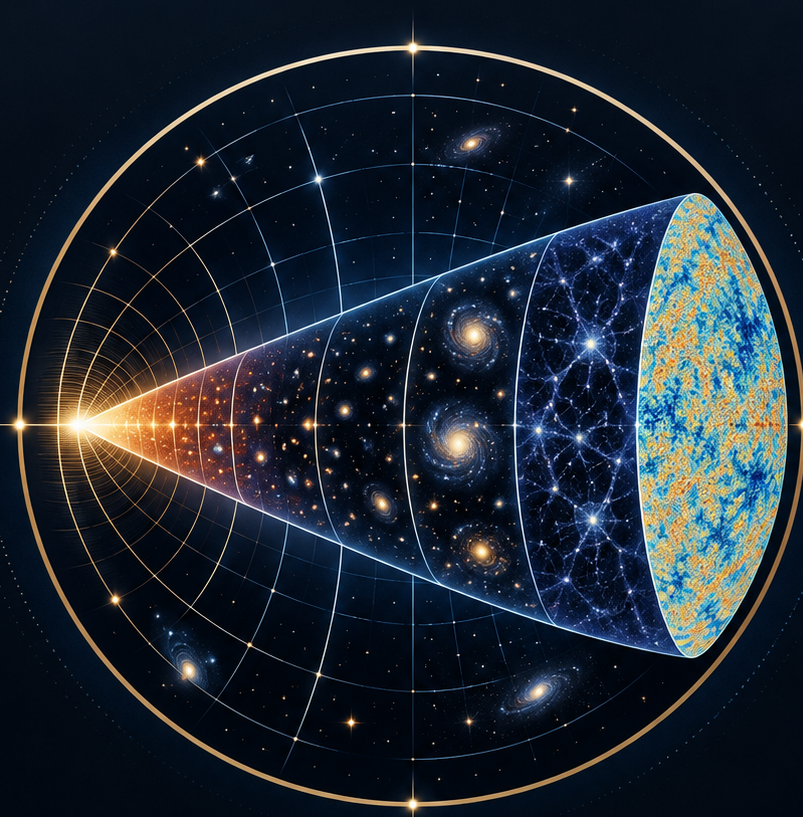
In the first moments after the Big Bang, the universe was a hot, dense plasma of electrons, protons, and photons. Pressure waves—acoustic oscillations—rippled through this primordial soup, compressing and rarefying matter. When the universe cooled enough for electrons and protons to combine into neutral hydrogen (the epoch of recombination, about 380,000 years after the Big Bang), these waves froze into the distribution of matter. The result is a subtle, periodic clustering of galaxies on a characteristic scale: the baryon acoustic oscillation (BAO) signal.
BAO provide an independent “standard ruler” for cosmology. Just as supernovae serve as standard candles, BAO serve as a standard ruler because the physical length of the sound horizon at recombination is known from the physics of the early universe. By measuring the apparent size of this ruler at different redshifts, astronomers can trace the expansion history of the universe and constrain the properties of dark energy.
Definition
Baryon acoustic oscillations are fluctuations in the density of visible baryonic matter caused by acoustic density waves in the primordial plasma. They are imprinted on the large-scale structure of the universe as a characteristic clustering scale of galaxies and other matter.
How It Works
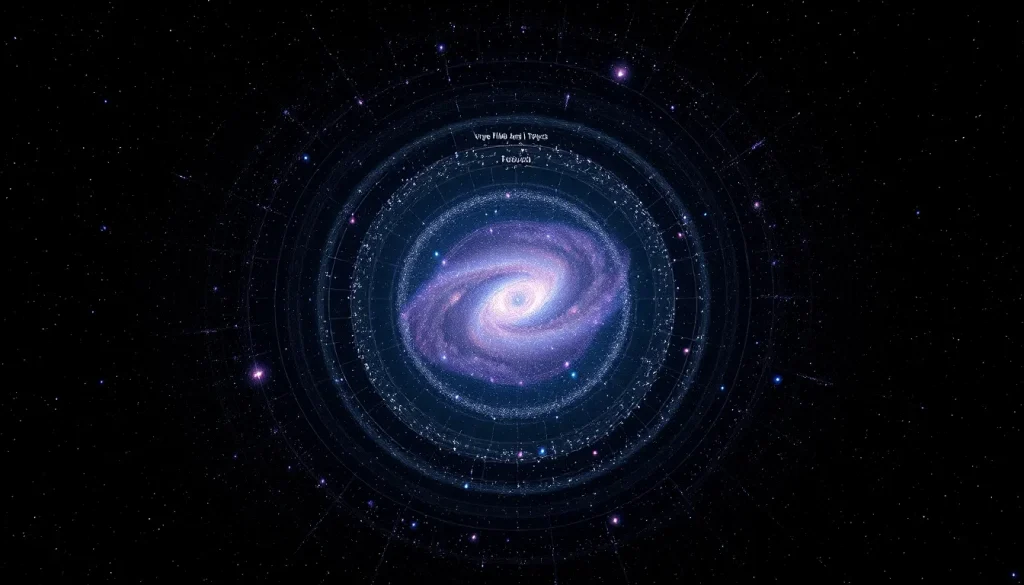
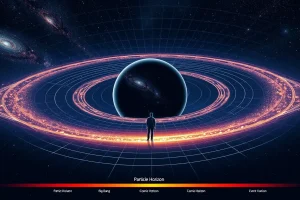
In the early universe, gravity pulled matter into overdense regions while radiation pressure pushed it outward, creating a tug-of-war that generated spherical sound waves. These waves traveled outward at about half the speed of light until recombination, when the plasma became neutral and the waves stopped propagating. The result is a shell of enhanced density at a fixed radius from each initial overdensity—the sound horizon—which today appears as a slight excess of galaxies at a separation of roughly 490 million light-years.
Equation
The characteristic scale is the comoving sound horizon at recombination, given by the integral of the sound speed divided by the scale factor over time. In practice, cosmologists measure the BAO scale in the galaxy correlation function or power spectrum and compare it to the predicted value.
Example
Imagine dropping a pebble into a pond: ripples expand outward at a known speed. If you freeze the pond at a fixed time, the distance between the center and the first ripple tells you the speed and time. Similarly, BAO give a fixed comoving scale that can be used to measure distances. Surveys like SDSS, BOSS, and DESI have detected this scale in the distribution of hundreds of thousands of galaxies.
Observable Consequences
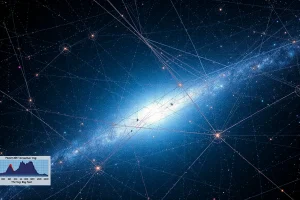
BAO appear as a bump in the two-point correlation function of galaxies at a separation corresponding to the sound horizon. They also produce oscillations in the galaxy power spectrum. Measurements of BAO at multiple redshifts allow cosmologists to constrain the Hubble parameter and the angular diameter distance, providing a direct probe of dark energy.
Common Misconceptions
BAO are not sound waves that still exist today; they are fossilized patterns. They are also not the same as the acoustic peaks in the cosmic microwave background (CMB), though both arise from the same primordial oscillations. BAO are a low-redshift phenomenon observed in galaxy distributions, while the CMB peaks are seen in the temperature anisotropies of the early universe.
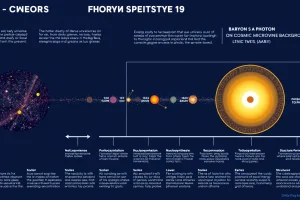
Timeline of the Universe
| Epoch | Time after Big Bang | Key Events |
|---|---|---|
| Planck Epoch | <10⁻⁴³ s | Quantum gravity effects dominate; all forces unified. |
| Grand Unification Epoch | 10⁻⁴³–10⁻³⁶ s | Strong force separates from electroweak force. |
| Inflationary Epoch | 10⁻³⁶–10⁻³² s | Exponential expansion; seeds for structure formed. |
| Electroweak Epoch | 10⁻³²–10⁻¹² s | Electromagnetic and weak forces separate; particles acquire mass. |
| Quark Epoch | 10⁻¹²–10⁻⁶ s | Quarks and gluons form quark-gluon plasma. |
| Hadron Epoch | 10⁻⁶–1 s | Quarks combine into protons and neutrons. |
| Lepton Epoch | 1–10 s | Leptons dominate; electron-positron annihilation. |
| Photon Epoch | 10 s–380,000 yr | Photons dominate; nucleosynthesis occurs. |
| Recombination | ~380,000 yr | Electrons and protons form hydrogen; CMB released. |
| Dark Ages | 380,000–~150 million yr | No stars yet; universe dark and neutral. |
| Reionization | ~150 million–1 billion yr | First stars and galaxies ionize hydrogen. |
| Structure Formation | 1 billion yr–present | Galaxies cluster; large-scale structure evolves. |
Why It Matters
BAO are one of the most powerful tools in modern cosmology. They provide a geometric measurement of the expansion rate of the universe at different epochs, independent of other probes. By combining BAO data with CMB measurements and supernovae, cosmologists can tightly constrain the equation of state of dark energy and test the standard ΛCDM model. The upcoming surveys, such as DESI and Euclid, will map millions of galaxies to measure BAO with unprecedented precision, potentially revealing deviations from Einstein’s cosmological constant.
Evidence / Sources
BAO were first detected in 2005 in the Sloan Digital Sky Survey (SDSS) and the Two-Degree Field Galaxy Redshift Survey (2dFGRS). Subsequent measurements from BOSS, eBOSS, and the Dark Energy Survey have refined the scale. The Planck satellite’s CMB measurements provide the precise sound horizon scale, which anchors the BAO ruler.
Related Registry Entries
Related concepts include the cosmic microwave background, dark energy, the expansion of the universe, and the large-scale structure of the cosmos. See also the entries on recombination, inflation, and the standard model of cosmology (ΛCDM).
FAQ
What causes baryon acoustic oscillations?
BAO arise from acoustic density waves in the hot plasma of the early universe. Gravity pulled matter into overdense regions while radiation pressure pushed it outward, creating spherical waves that froze at recombination.
How do BAO act as a standard ruler?
The physical size of the sound horizon at recombination is known from the physics of the early universe. By measuring the apparent size of this scale in galaxy surveys at different redshifts, astronomers can determine cosmic distances and the expansion rate.
What do BAO tell us about dark energy?
BAO measurements at different cosmic epochs trace the expansion history of the universe. The rate of expansion depends on the properties of dark energy, so BAO data constrain its equation of state and help distinguish between a cosmological constant and dynamical dark energy models.
Leave a Reply