Short Answer
Main Explanation
The Grand Unification Epoch is a critical but poorly understood chapter in the history of the universe. It occurred between approximately 10−43 seconds and 10−35 seconds after the Big Bang, when the universe was so hot and dense that three of the four fundamental forces—electromagnetism, the strong nuclear force, and the weak nuclear force—were unified into a single electronuclear force. Gravity had already separated from this unified force at the end of the Planck epoch. This epoch is named after grand unified theories (GUTs), which attempt to describe this unification, though these theories have not yet been confirmed by experiment.
During this epoch, the universe was a seething plasma of energy and particles, with temperatures exceeding 1027 K (if the grand unification energy is taken as 1015 GeV). Physical properties such as mass, charge, flavor, and color charge were not yet distinct; they emerged only as the universe cooled and symmetries broke. The Grand Unification Epoch ended at about 10−36 seconds, when the strong force separated from the electroweak force, triggering a cascade of symmetry-breaking events that led to the familiar four forces we observe today.
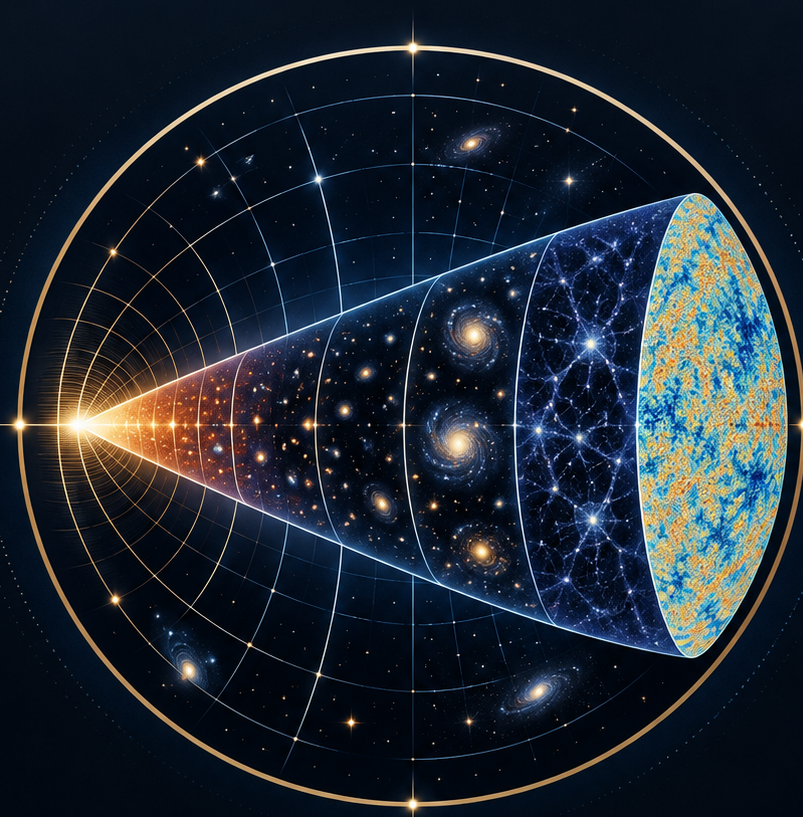
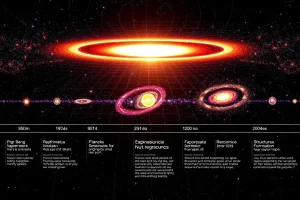
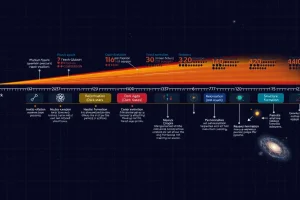
This epoch is part of the standard Big Bang chronology, which describes the evolution of the universe from an initial singularity to the present day. The timeline includes the Planck epoch, Grand Unification Epoch, Inflationary Epoch, Electroweak Epoch, Quark Epoch, Hadron Epoch, Lepton Epoch, Photon Epoch, Recombination, Dark Ages, Reionization, and Structure Formation. Each of these periods is defined by the dominant physical processes and particle content of the universe.
Cosmic Epoch Module
When It Happened
The Grand Unification Epoch began at the end of the Planck epoch, around 10−43 seconds after the Big Bang, and lasted until approximately 10−35 seconds. This is an incredibly short span—less than a trillionth of a trillionth of a second—but it set the stage for all subsequent cosmic evolution.
Temperature
During this epoch, the universe had a temperature higher than 1027 K, corresponding to energies around 1015 GeV. At such extreme temperatures, the fundamental forces were indistinguishable in their actions on particles.
Approximate Redshift
Redshift is not typically used for such early times because the universe was radiation-dominated and the concept of redshift becomes less intuitive. However, the scale factor was extremely small, and the universe was far denser than any later epoch. For reference, the redshift at the end of the Grand Unification Epoch would be unimaginably large, far exceeding 1030.
Dominant Particles/Physics
All particle types—quarks, leptons, gauge bosons, and hypothetical particles like Higgs bosons, gravitons, and possibly superpartners—were in thermal equilibrium, created and annihilated at equal rates. The universe was a hot, dense soup of radiation and matter, with no distinct particles yet having acquired mass through symmetry breaking.
What Happened
During the Grand Unification Epoch, the strong, weak, and electromagnetic forces were unified as the electronuclear force. Gravity had already separated. As the universe expanded and cooled, the grand unified symmetry broke, causing the strong force to become distinct from the electroweak force. This symmetry breaking is analogous to the way water freezes into ice, releasing latent heat and potentially generating topological defects (though none have been observed). This event also may have contributed to the matter–antimatter asymmetry via processes like baryogenesis, though the exact mechanism remains speculative.
What Came Before
The Grand Unification Epoch was preceded by the Planck epoch, the earliest period for which our current physical theories can be applied. At the Planck time (10−43 s), gravity separated from the other forces, and quantum gravitational effects were dominant. The universe was at the Planck temperature (~1032 K) and had a size comparable to the Planck length.
What Came Next
The Grand Unification Epoch ended with the onset of cosmic inflation, a period of exponential expansion that lasted from about 10−36 to 10−32 seconds. Inflation stretched the universe to enormous scales, smoothing out any irregularities and setting the initial conditions for structure formation. After inflation, the universe entered the Electroweak Epoch, during which the electromagnetic and weak forces separated.
Evidence
Direct evidence for the Grand Unification Epoch is elusive because the energies involved are far beyond the reach of particle accelerators. However, indirect evidence comes from the observed matter–antimatter asymmetry, the existence of cosmic microwave background (CMB) anisotropies, and the large-scale structure of the universe. Grand unified theories predict phenomena like proton decay, which has not been observed, and magnetic monopoles, which are also absent. The lack of these signatures constrains but does not rule out GUTs.
Timeline of Cosmic Epochs
| Epoch | Time After Big Bang | Key Events |
|---|---|---|
| Planck Epoch | < 10−43 s | Quantum gravity dominates; all forces unified |
| Grand Unification Epoch | 10−43 – 10−35 s | Strong, weak, and EM forces unified; GUT symmetry breaks |
| Inflationary Epoch | 10−36 – 10−32 s | Exponential expansion; seeds of structure formed |
| Electroweak Epoch | 10−32 – 10−12 s | EM and weak forces separate; particles acquire mass |
| Quark Epoch | 10−12 – 10−6 s | Quarks and gluons form quark-gluon plasma |
| Hadron Epoch | 10−6 – 1 s | Quarks combine into hadrons; protons and neutrons form |
| Lepton Epoch | 1 – 10 s | Leptons dominate; neutrinos decouple |
| Photon Epoch | 10 s – 380,000 yr | Photons dominate; nuclei form (BBN) |
| Recombination | ~380,000 yr | Electrons combine with nuclei; CMB released |
| Dark Ages | 380,000 yr – ~150 million yr | No stars; universe dark and neutral |
| Reionization | ~150 million – 1 billion yr | First stars and galaxies ionize hydrogen |
| Structure Formation | 1 billion yr – present | Galaxies, clusters, and large-scale structure form |
Why It Matters
The Grand Unification Epoch is not just a historical curiosity; it holds the key to understanding the deepest laws of nature. By studying this epoch, physicists hope to unify quantum mechanics and general relativity, explain the matter–antimatter asymmetry, and understand the initial conditions that led to the universe we observe today. The epoch also connects particle physics to cosmology: the same symmetry-breaking processes that occurred in the early universe are being probed at particle accelerators like the LHC, albeit at much lower energies. Moreover, the Grand Unification Epoch set the stage for inflation, which in turn shaped the cosmic microwave background and the large-scale structure of galaxies. Missions like COBE, WMAP, and Planck have measured the CMB with exquisite precision, confirming the predictions of inflation and the ΛCDM model, which includes the Grand Unification Epoch as a foundational element.
Evidence / Sources
The information in this article is based on established cosmological models and observations. Key sources include:
- Wikipedia: Grand unification epoch
- HandWiki: Grand unification epoch
- Wikipedia: Chronology of the universe
- CERN: Story of the Universe
Related Registry Entries
Explore other cosmic epochs and concepts in this registry:
- Planck Epoch
- Inflationary Epoch
- Electroweak Epoch
- Recombination
- Cosmic Microwave Background
FAQ
Why is the Grand Unification Epoch called 'grand unification'?
It is named after grand unified theories (GUTs), which propose that the strong, weak, and electromagnetic forces were unified into a single force at high energies. The epoch is the period when this unification existed in the early universe.
Have grand unified theories been confirmed?
No. GUTs have not been experimentally confirmed. They predict phenomena like proton decay and magnetic monopoles, which have not been observed. However, the concept remains a key part of theoretical physics.
What happened at the end of the Grand Unification Epoch?
The strong force separated from the electroweak force, breaking the grand unified symmetry. This event is thought to have triggered cosmic inflation, which then led to the subsequent epochs of the universe.
How do we know about the Grand Unification Epoch if we can't observe it directly?
We infer its existence from theoretical models that successfully explain later observations, such as the cosmic microwave background, the matter–antimatter asymmetry, and the large-scale structure. The energies involved are far beyond current experiments, so direct evidence is lacking.
Leave a Reply