Short Answer
Main Explanation
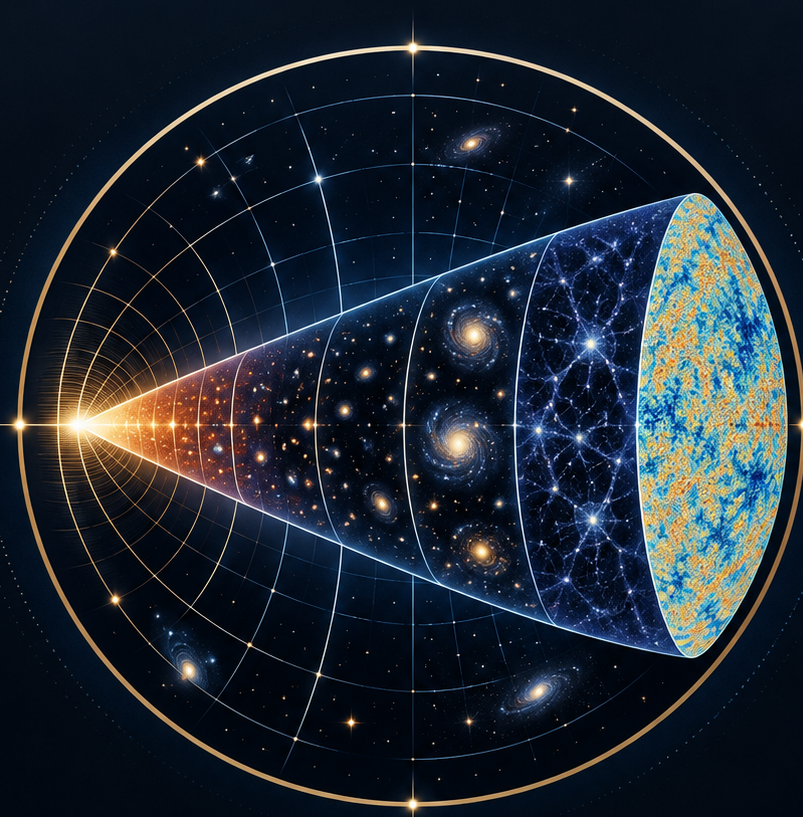
In cosmology, recombination refers to the epoch in the early universe when free electrons and protons combined to form neutral hydrogen atoms. This occurred approximately 380,000 years after the Big Bang, at a temperature of about 3,000 K and a redshift of roughly z = 1,100. Before recombination, the universe was a hot, opaque plasma of baryons, electrons, and photons. After recombination, photons decoupled from matter and have been traveling freely ever since, forming the cosmic microwave background (CMB) we observe today.
Recombination is a pivotal moment in cosmic history because it marks the transition from a plasma universe to a neutral one, allowing light to travel unimpeded. It set the stage for the formation of the first atoms, and later, the first stars and galaxies during the epoch of reionization. Understanding recombination is essential for interpreting the CMB, which provides a snapshot of the universe at that moment and encodes information about its composition, geometry, and evolution.
The Cosmic Epoch of Recombination
When It Happened
Recombination began around 380,000 years after the Big Bang. This is a well-established figure from both theoretical modeling and precise measurements of the CMB by the Planck satellite.
Temperature
At the onset of recombination, the universe had cooled to approximately 3,000 K (about 2,700°C). This temperature corresponds to the energy at which photons can no longer ionize hydrogen (13.6 eV). As the universe expanded, the temperature dropped below this threshold, allowing electrons and protons to bind.
Approximate Redshift
The redshift of recombination is roughly z = 1,100. This means that light emitted at recombination has been stretched by a factor of about 1,100 due to cosmic expansion, shifting it from visible wavelengths to microwaves today.
Dominant Particles/Physics
Before recombination, the universe was filled with a hot, dense plasma of protons, electrons, and photons, along with small amounts of helium nuclei and dark matter. The physics is governed by quantum electrodynamics and the Saha equation, which describes the ionization equilibrium of hydrogen.
What Happened
As the universe expanded and cooled, the average photon energy dropped below the hydrogen ionization energy. Electrons and protons combined to form neutral hydrogen atoms. This process released photons, which then decoupled from matter. The universe became transparent, and the photons have been traveling ever since, now observed as the CMB.
What Came Before
Before recombination was the photon epoch, where the universe was dominated by photons and still opaque. Earlier epochs include the lepton epoch, quark epoch, and the inflationary period. The sequence of cosmic epochs is a core part of the standard Big Bang model.
What Came Next
After recombination, the universe entered the Dark Ages—a period with no luminous sources, lasting until the first stars formed. Then came reionization, when ultraviolet light from early stars and galaxies re-ionized the intergalactic medium. Finally, structure formation led to the large-scale cosmic web we see today.
Evidence
The primary evidence for recombination is the cosmic microwave background itself. The CMB is a nearly perfect blackbody spectrum at 2.725 K, with tiny anisotropies that match predictions from recombination and later evolution. Missions like COBE, WMAP, and Planck have mapped these anisotropies in exquisite detail, confirming the standard cosmological model.
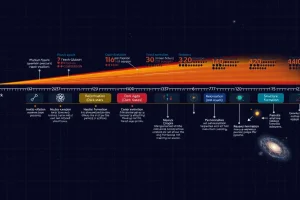
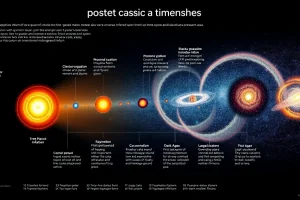
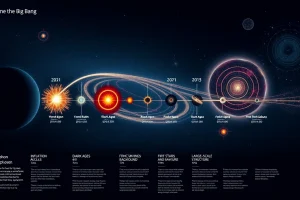
Timeline of the Universe
| Epoch | Time After Big Bang | Redshift | Key Events |
|---|---|---|---|
| Planck Epoch | < 10⁻⁴³ s | > 10³² | Quantum gravity effects dominate; no current theory |
| Grand Unification Epoch | 10⁻⁴³ to 10⁻³⁶ s | ~10³² to 10²⁸ | Strong and electroweak forces unify |
| Inflationary Epoch | 10⁻³⁶ to 10⁻³² s | ~10²⁸ to 10²⁵ | Rapid exponential expansion; seeds of structure |
| Electroweak Epoch | 10⁻³² to 10⁻¹² s | ~10²⁵ to 10¹⁵ | Electromagnetic and weak forces separate |
| Quark Epoch | 10⁻¹² to 10⁻⁶ s | ~10¹⁵ to 10¹⁰ | Quarks and gluons form quark-gluon plasma |
| Hadron Epoch | 10⁻⁶ to 1 s | ~10¹⁰ to 10¹⁰ | Protons and neutrons form; baryogenesis |
| Lepton Epoch | 1 to 10 s | ~10¹⁰ to 10⁹ | Leptons dominate; neutrinos decouple |
| Photon Epoch | 10 s to 380,000 yr | ~10⁹ to 1,100 | Photons dominate; nucleosynthesis occurs |
| Recombination | ~380,000 yr | ~1,100 | Neutral atoms form; CMB released |
| Dark Ages | 380,000 yr to ~150 million yr | 1,100 to 20 | No luminous sources; hydrogen remains neutral |
| Reionization | ~150 million yr to ~1 billion yr | 20 to 6 | First stars and galaxies re-ionize hydrogen |
| Structure Formation | ~1 billion yr to present | < 6 | Galaxies, clusters, and large-scale structure form |
Why It Matters
Recombination is the reason we can observe the universe’s earliest light. The CMB is a treasure trove of information: its temperature and polarization patterns reveal the initial conditions for structure formation, the composition of the universe (baryons, dark matter, dark energy), and the geometry of spacetime. Without recombination, the universe would remain opaque, and we would have no direct view of its infancy.
Moreover, recombination marks the beginning of the matter-dominated era, where gravitational instabilities could grow. The slight overdensities imprinted in the CMB later seeded the formation of galaxies and galaxy clusters. Thus, recombination is directly linked to the large-scale structure we observe today.
Evidence / Sources
The standard model of recombination is supported by multiple lines of evidence:
- COBE (1989-1993) measured the CMB spectrum, confirming it is a near-perfect blackbody at 2.725 K, and discovered the first anisotropies.
- WMAP (2001-2010) provided high-resolution maps of CMB temperature and polarization, pinning down cosmological parameters with unprecedented precision.
- Planck (2009-2013) further refined these measurements, constraining the Hubble constant, matter density, and the spectral index of primordial fluctuations.
- JWST (2021-present) is now probing reionization and the first galaxies, offering indirect constraints on the end of the Dark Ages.
These observations are consistent with the Lambda-CDM model, which successfully predicts the CMB power spectrum, nucleosynthesis abundances, and the distribution of galaxies.
Related Registry Entries
Last Reviewed / Updated: September 5, 2026
FAQ
Why is recombination called 'recombination' if atoms were forming for the first time?
The term is historical; it was coined before it was fully understood that the universe had a hot, ionized phase. In modern cosmology, it refers to the combination of electrons and protons into neutral hydrogen, even though it was the first time atoms formed.
What is the cosmic microwave background?
The CMB is the leftover radiation from recombination. After photons decoupled from matter, they have been traveling through the expanding universe, cooling to a temperature of 2.725 K today. It provides a snapshot of the universe when it was about 380,000 years old.
How do we know recombination happened?
The existence of the CMB, its blackbody spectrum, and its tiny anisotropies are direct evidence. Additionally, the predicted abundance of light elements from Big Bang nucleosynthesis matches observations, and the timing of recombination is consistent with the measured CMB properties.
What came after recombination?
After recombination, the universe entered the Dark Ages, a period with no stars or galaxies. Eventually, gravity amplified density fluctuations, leading to the first stars and galaxies, which reionized the universe and made it transparent to ultraviolet light again.
Leave a Reply