
Short Answer
Main Explanation
The horizon problem is a fine-tuning puzzle in the standard hot Big Bang model. The universe has a finite age, so light and other causal influences have traveled only a finite distance since the Big Bang. This defines a particle horizon. Yet the cosmic microwave background (CMB) is nearly the same temperature in every direction. According to the standard expansion history, two patches of the CMB sky separated by more than about two degrees were outside each other’s particle horizons when the CMB was emitted. They had no time to exchange heat or information, so why do they look the same? This is the horizon problem, also called the homogeneity problem. It was first pointed out by Wolfgang Rindler in 1956.[1]
Definition
In cosmology, a particle horizon is the maximum comoving distance that a photon could have traveled from the Big Bang to a given time. Because the universe is only about 13.8 billion years old, this distance is finite. The horizon problem arises because the CMB, emitted when the universe was roughly 380,000 years old, shows temperature uniformity to about one part in 100,000 across the entire sky. Regions that are separated by more than about two degrees on the last scattering surface had non-overlapping past light cones, meaning no physical process operating at or below the speed of light could have connected them. The observed homogeneity therefore appears to require either extremely special initial conditions or a new mechanism.[3]
How It Works
Imagine two observers on opposite sides of a very large room who have never met and cannot communicate, yet both set their clocks to exactly the same time. You would suspect either a prior connection or a common cause. In the early universe, the CMB patches are like those observers. In a universe without inflation, their past light cones do not intersect before the Big Bang. The finite speed of light and the finite age of the universe prevent any causal contact. The standard Big Bang model therefore cannot explain the observed uniformity without assuming that the universe began in an already nearly uniform state — a fine-tuning problem.[2]

The most widely accepted solution is cosmic inflation: a brief, extremely rapid exponential expansion during the first tiny fraction of a second. Inflation takes a very small, causally connected patch and stretches it to a size much larger than the observable universe. All the regions we see today then share a common origin and had time to equilibrate before inflation. This removes the need for special initial conditions.[1]
Equation
The comoving distance traveled by a photon between times t1 and t2 in a flat universe is
dcomoving = ∫t1t2 c dt′ / a(t′),
where a(t) is the scale factor. The physical distance is a(t) times this comoving distance. In a matter-dominated universe, a(t) ∝ t2/3, and the comoving horizon size grows as the square root of the scale factor. The key point is that the integral is finite because the universe has a finite age. Without an early accelerated phase, the horizon at last scattering is much smaller than the observed CMB sky.[4]
Example
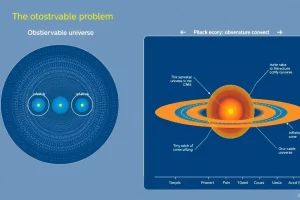
When we look at the CMB, the radiation has traveled for about 13.8 billion years. The CMB surface we see is now about 46 billion comoving light-years away. At the time the CMB was emitted, the universe was only about 380,000 years old, at a redshift of about 1100. Physical influences starting at the earliest time and moving at the speed of light could have reached only the smaller circles shown in standard horizon diagrams. Two points on opposite sides of the sky have spheres of causality that do not overlap. Yet their temperatures agree to better than one part in ten thousand after subtracting the dipole.[1][3]
Observable Consequences
The horizon problem is not just an abstract worry; it is written into the CMB. The near-perfect blackbody spectrum and the tiny temperature anisotropies of about one part in 100,000 are observed across the entire sky. Missions such as COBE first measured the blackbody spectrum and detected the anisotropies. WMAP and Planck then mapped the fluctuations with increasing precision, revealing acoustic peaks that match predictions from an inflationary early universe. The same initial perturbations grew into the large-scale structure of galaxies and clusters we see today. JWST is now observing the first galaxies that formed after the Dark Ages, testing the later stages of this story.
A useful way to organize the cosmic history is the standard timeline from the Planck epoch to structure formation:
| Epoch | Time after Big Bang | Temperature | Key events |
|---|---|---|---|
| Planck epoch | < 10−43 s | > 1032 K | Quantum gravity regime; all four forces possibly unified |
| Grand Unification epoch | 10−43–10−36 s | ~1029 K | Strong force separates; possible baryogenesis |
| Inflationary epoch | ~10−36–10−32 s | ~1027 K | Exponential expansion; solves horizon and flatness problems |
| Electroweak epoch | 10−32–10−12 s | ~1015 K | Electromagnetic and weak forces separate |
| Quark epoch | 10−12–10−6 s | ~1012 K | Quarks, leptons, and gluons form a hot plasma |
| Hadron epoch | 10−6–1 s | ~1010 K | Quarks bind into protons and neutrons |
| Lepton epoch | 1–10 s | ~109 K | Leptons and antileptons dominate; neutrinos decouple |
| Photon epoch | 10 s–380,000 yr | 109–3000 K | Radiation dominates; Big Bang nucleosynthesis creates light nuclei |
| Recombination | ~380,000 yr | ~3000 K | Protons and electrons form neutral hydrogen; CMB released at z~1100 |
| Dark Ages | 380,000 yr–~150 million yr | 3000–60 K | Universe neutral and dark; no stars yet; z~1100–20 |
| Reionization | ~150 million–1 billion yr | 60–20 K | First stars and galaxies ionize intergalactic gas; z~20–6 |
| Structure Formation | ~100 million yr–present | 20–2.7 K | Galaxies, clusters, and cosmic web grow under gravity; z<6 to 0 |
These epochs are not directly observable in their earliest stages, but their consequences are imprinted on the CMB and the distribution of matter.
Common Misconceptions
- “The horizon problem means the universe expanded faster than light.” Inflation is not a speed limit violation. It is an expansion of space itself, which can separate points faster than light without any information traveling faster than light.
- “The CMB is uniform because the universe started uniform.” That is exactly the fine-tuning the horizon problem highlights. Without a mechanism, it is an unexplained initial condition.
- “The horizon problem is solved by ordinary cosmic expansion.” Standard expansion after the Big Bang is too slow to bring distant CMB patches into causal contact. Only an early accelerated phase such as inflation provides the needed common past.
- “Inflation is proven.” Inflation is the leading explanation and is supported by many observations, but it is not directly observed. Alternatives and tests, including searches for primordial gravitational waves, continue.
Why It Matters
The horizon problem matters because it forced cosmologists to confront a deep flaw in the original Big Bang model. The observed uniformity of the CMB is not a trivial fact; it is a clue about the earliest moments. Inflation not only solves the horizon problem but also explains the flatness problem and provides a mechanism for generating the small density fluctuations that later became galaxies. In this sense, the horizon problem helped motivate the modern Lambda-CDM model, in which a brief inflationary phase sets the initial conditions for a universe dominated by dark energy and cold dark matter today.[1][3]
Evidence / Sources
The primary evidence for the horizon problem is the CMB itself. COBE confirmed the blackbody spectrum and found temperature anisotropies of about one part in 100,000. WMAP and Planck measured the angular power spectrum, including acoustic peaks, which are consistent with an inflationary early universe. The large-scale distribution of galaxies and the observed near-flatness of space also support the inflationary solution. However, the horizon problem is a theoretical puzzle; the evidence for inflation is indirect, and researchers continue to search for a direct signature such as primordial B-mode polarization in the CMB.[2][4]
Last reviewed: September 8, 2026.
Related Registry Entries
FAQ
What exactly is the horizon problem?
It is the puzzle that widely separated regions of the universe have nearly identical temperatures even though, in the standard Big Bang model, they could never have been in causal contact by the time the CMB was emitted. This requires either fine-tuned initial conditions or a mechanism such as inflation.
Why does the CMB's uniformity create a problem?
The CMB temperature is uniform to about one part in 100,000, but points on the sky separated by more than about two degrees were outside each other's particle horizons at last scattering. Without a shared past, there is no ordinary physical process to equalize their temperatures.
How does cosmic inflation solve the horizon problem?
Inflation posits a very early burst of exponential expansion. A tiny, causally connected region was stretched to become the entire observable universe, so all parts we see today share a common origin and could have equilibrated before inflation.
Is the horizon problem the same as the flatness problem?
No, but they are related fine-tuning puzzles. The flatness problem asks why the universe's density is so close to the critical value; inflation also addresses this by driving spatial curvature toward zero.
What evidence supports the inflationary solution?
The observed near-scale-invariant spectrum of CMB temperature fluctuations, the acoustic peaks, and the large-scale distribution of galaxies are broadly consistent with inflation, though direct evidence such as primordial gravitational waves is still sought.



Leave a Reply