Short Answer
Main Explanation
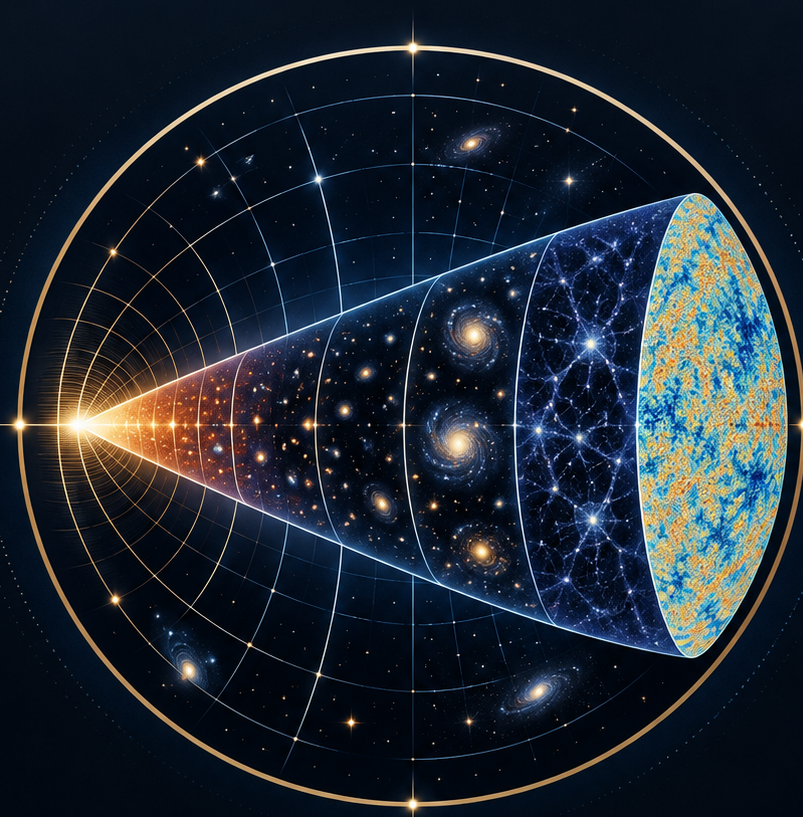
The horizon problem is one of the most puzzling features of the standard Big Bang model. Observations of the cosmic microwave background (CMB) show that the temperature of the universe is remarkably uniform—to better than one part in 10,000—across the entire sky. Yet in a universe that has always expanded at the rates we observe today, regions separated by more than about 1 degree on the sky have never been in causal contact. How can they share the same temperature?
Cosmic inflation, a brief period of exponential expansion in the first fraction of a second after the Big Bang, provides an elegant solution. By stretching a tiny, causally connected patch of space to enormous scales, inflation ensures that the entire observable universe originated from a region small enough for physical processes to have smoothed out any irregularities.
How Inflation Works
Inflation postulates that the early universe was dominated by a scalar field (the inflaton) with a negative pressure, causing the scale factor a(t) to grow exponentially. The acceleration equation ä/a = -4πG/3 (ρ + 3p/c²) requires p < -ρc²/3 for accelerated expansion. When this condition holds, the scale factor behaves as a(t) ∝ exp(Ht), where H is the Hubble parameter (source: [2]).
This exponential growth means that a region of space that was initially smaller than the Planck length could expand to become larger than the observable universe today. As a result, all points on the CMB sky were once in causal contact before inflation began, and any initial inhomogeneities were smoothed out.
Cosmic Epochs
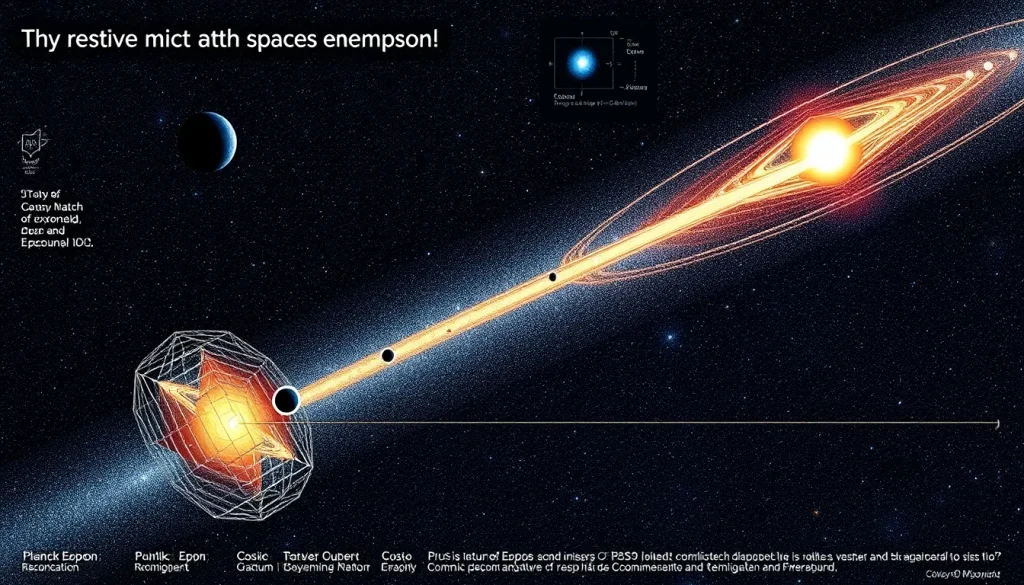
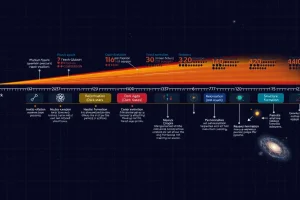
The universe has gone through a series of distinct epochs, each with its own physics. The table below summarizes the major milestones from the Planck epoch to the present day.
| Epoch | Time | Temperature | Key Events |
|---|---|---|---|
| Planck epoch | <10⁻⁴³ s | >10³² K | Quantum gravity dominates; no known physics. |
| Grand Unification epoch | 10⁻⁴³ – 10⁻³⁶ s | 10³² – 10²⁸ K | Strong and electroweak forces unified. |
| Inflationary epoch | ~10⁻³⁶ – 10⁻³² s | ~10²⁸ K | Exponential expansion; horizon problem solved. |
| Electroweak epoch | 10⁻³² – 10⁻¹² s | 10²⁸ – 10¹⁵ K | Electromagnetic and weak forces separate. |
| Quark epoch | 10⁻¹² – 10⁻⁶ s | 10¹⁵ – 10¹² K | Quarks and gluons form quark-gluon plasma. |
| Hadron epoch | 10⁻⁶ – 1 s | 10¹² – 10¹⁰ K | Protons and neutrons form; matter-antimatter annihilation. |
| Lepton epoch | 1 – 10 s | 10¹⁰ – 10⁹ K | Leptons dominate; neutrinos decouple. |
| Photon epoch | 10 s – 380,000 yr | 10⁹ – 3000 K | Photons dominate; nucleosynthesis occurs. |
| Recombination | ~380,000 yr | ~3000 K | Electrons combine with protons to form neutral hydrogen; CMB released. |
| Dark Ages | 380,000 yr – ~150 million yr | 3000 – 50 K | No stars; universe dark and neutral. |
| Reionization | ~150 million – 1 billion yr | ~50 – 10 K | First stars and galaxies ionize hydrogen. |
| Structure Formation | 1 billion yr – present | 10 K – 2.7 K | Galaxies, clusters, and large-scale structure form. |
The cosmic microwave background is the relic radiation from recombination, now redshifted to microwave wavelengths. Missions like COBE (1989), WMAP (2001), and Planck (2009) have measured its temperature and anisotropies with exquisite precision, confirming the predictions of inflation and the ΛCDM model. JWST is now probing the epoch of reionization and the first galaxies.
Concept
Definition
The horizon problem is the observation that regions of the universe that could never have been in causal contact have nearly identical physical properties, such as temperature. Inflation solves this by postulating a period of exponential expansion that stretched a small, causally connected region to encompass the entire observable universe.
How It Works
Before inflation, the universe was in a state of extremely high energy density. A scalar field, the inflaton, drove a phase of accelerated expansion. This expansion was so rapid that the scale factor increased by a factor of at least 10²⁶. As a result, a region that was initially in thermal equilibrium became the whole observable universe.
Equation
The key equation is the Friedmann equation with a cosmological constant or inflaton potential: H² = (8πG/3)ρ, where ρ is the energy density. During inflation, ρ is dominated by the inflaton potential, which behaves like a cosmological constant, giving a(t) = a₀ e^{Ht}.
Example
Imagine a balloon being inflated. If you draw two dots close together on a deflated balloon, they are in contact. When you inflate the balloon rapidly, those dots separate, but they were once touching. Similarly, all points on the CMB sky were once within a tiny, causally connected patch before inflation stretched them apart.
Observable Consequences
Inflation predicts a nearly scale-invariant spectrum of primordial density fluctuations, which seed the formation of galaxies and clusters. These fluctuations leave imprints in the CMB as temperature anisotropies, which have been measured by COBE, WMAP, and Planck. The observed flatness of the universe and the absence of magnetic monopoles are also consequences of inflation.
Common Misconceptions
One misconception is that inflation is a “force” that pushes things apart. In reality, it is a phase of accelerated expansion driven by a negative-pressure field. Another is that inflation happened “before” the Big Bang; rather, it is part of the Big Bang model, occurring about 10⁻³⁶ seconds after the initial singularity.
Why It Matters
Understanding inflation is crucial because it explains the observed uniformity of the universe, the origin of structure, and the flat geometry of space. It also connects cosmology with particle physics, as the inflaton may be related to high-energy physics beyond the Standard Model. The success of inflation in matching CMB observations makes it a cornerstone of modern cosmology.
Evidence / Sources
The predictions of inflation have been confirmed by multiple missions. COBE discovered the CMB anisotropies in 1992, WMAP mapped them in detail, and Planck provided the most precise measurements, supporting the ΛCDM model with a spectral index consistent with inflation. The flatness of the universe, measured to be within 0.4% of critical density, also aligns with inflation.
Key sources: [1] Pinto, “Inflation: From the Horizon Problem to Quantum Fluctuations”; [2] Lecture notes on inflation; [3] “Early Universe: Inflation and the generation of fluctuations”; [4] Heeck, “Introduction to Inflation”.
Related Registry Entries
Explore related topics: Cosmic Microwave Background, Recombination, Dark Ages, Structure Formation.
FAQ
What is the horizon problem?
The horizon problem is the observation that regions of the universe that are far apart and have never been in causal contact nevertheless share nearly identical physical properties, such as the temperature of the cosmic microwave background.
How does inflation solve the horizon problem?
Inflation proposes a period of exponential expansion that stretched a tiny, causally connected patch of space to encompass the entire observable universe. Since all points we see today were once in contact before inflation, they had time to reach thermal equilibrium.
What evidence supports inflation?
Evidence includes the near-uniformity of the CMB, the flat geometry of the universe, the absence of magnetic monopoles, and the nearly scale-invariant spectrum of density fluctuations observed by COBE, WMAP, and Planck.

Leave a Reply