
Short Answer
Short Answer: A redshift survey measures the redshift of galaxies—their light shifted toward longer wavelengths due to cosmic expansion—to estimate distances and map the three-dimensional distribution of matter. By combining redshift with angular position, these surveys reveal the large-scale structure of the universe, trace its expansion history, and provide key evidence for dark matter and dark energy.
| Feature | Detail |
|---|---|
| Definition | A systematic census of galaxy redshifts to map the 3D distribution of matter. |
| Method | Measure Doppler shift of spectral lines; use Hubble’s law to convert to distance. |
| Key Surveys | 2dFGRS, SDSS, VIPERS, DESI |
| Primary Result | Cosmic web of filaments, walls, and voids; constraints on cosmological parameters. |
| Connection to Cosmic Epochs | Redshift surveys probe the later universe, while the CMB reveals the earliest epochs. |
Main Explanation
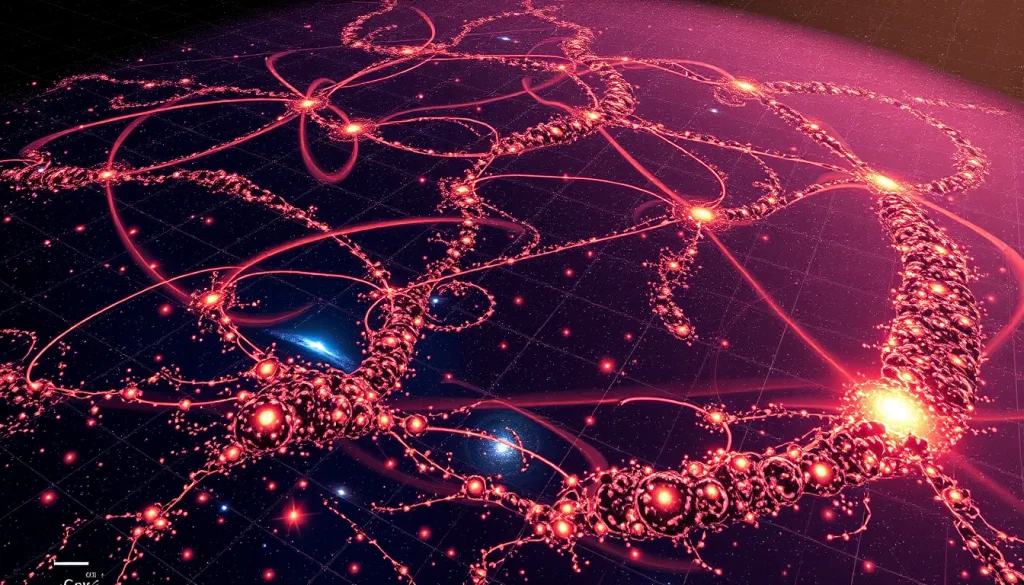
Redshift surveys are among the most powerful tools in modern cosmology. They work by measuring how much the light from distant galaxies has been stretched by the expansion of space—a phenomenon known as cosmological redshift. Using Hubble’s law, astronomers convert this redshift into a distance estimate. When combined with the galaxy’s position on the sky, this yields a three-dimensional map of the universe’s large-scale structure.
These maps reveal a vast cosmic web of galaxy clusters, filaments, and voids, stretching across hundreds of millions of light-years. The statistical properties of this web—such as the clustering of galaxies—encode information about the universe’s composition and its evolution. For example, the baryon acoustic oscillations (BAO) imprinted in the galaxy distribution provide a standard ruler that measures the expansion rate of the universe, helping to constrain dark energy. The growth of structure, traced by redshift surveys, also confirms the existence of dark matter, which gravitationally shapes the cosmic web.
Redshift surveys also connect to the earliest epochs of the universe. The cosmic microwave background (CMB) radiation, a relic from the photon epoch, provides a snapshot of the universe at recombination. By comparing the CMB’s temperature fluctuations with the large-scale structure observed today, cosmologists can trace the growth of density perturbations from quantum fluctuations during inflation to the galaxies we see now. This comprehensive picture aligns with the Lambda-CDM model, the current standard model of cosmology.
The Cosmic Epochs
The universe has passed through a series of distinct epochs, each characterized by different physical conditions and dominant particles. The table below outlines the major epochs from the Planck epoch to the present-day structure formation.
| Epoch | Time After Big Bang | Temperature | Redshift | Key Events |
|---|---|---|---|---|
| Planck Epoch | 0 – 10⁻⁴³ s | > 10³² K | Unlimited | Quantum gravity effects dominate; no known physics. |
| Grand Unification Epoch | 10⁻⁴³ – 10⁻³⁶ s | 10²⁷ – 10³² K | ~10³² | Strong and electroweak forces unified; inflation begins. |
| Inflationary Epoch | 10⁻³⁶ – 10⁻³² s | Dropping rapidly | ~10²⁸ | Exponential expansion; seeds of structure formed. |
| Electroweak Epoch | 10⁻³² – 10⁻¹² s | 10¹⁵ – 10²⁷ K | ~10¹⁵ | Electromagnetic and weak forces separate. |
| Quark Epoch | 10⁻¹² – 10⁻⁶ s | 10¹² – 10¹⁵ K | ~10¹² | Quarks and gluons form quark-gluon plasma. |
| Hadron Epoch | 10⁻⁶ – 1 s | 10¹⁰ – 10¹² K | ~10¹⁰ | Protons and neutrons form; matter-antimatter asymmetry. |
| Lepton Epoch | 1 – 10 s | 10⁹ – 10¹⁰ K | ~10⁹ | Leptons dominate; neutrinos decouple. |
| Photon Epoch | 10 s – 380,000 yr | 3,000 – 10⁹ K | ~10⁹ to ~1100 | Photons dominate; nucleosynthesis creates light elements. |
| Recombination | ~380,000 yr | ~3,000 K | ~1100 | Electrons combine with nuclei; universe becomes transparent; CMB released. |
| Dark Ages | 380,000 yr – ~150 million yr | ~3,000 K to ~50 K | ~1100 to ~20 | No stars yet; only dark matter and neutral hydrogen. |
| Reionization | ~150 million – 1 billion yr | ~50 K to ~20 K | ~20 to ~6 | First stars and galaxies ionize neutral hydrogen. |
| Structure Formation | 1 billion yr – present | ~20 K to 2.7 K | ~6 to 0 | Galaxies cluster into the cosmic web; dark energy accelerates expansion. |
Planck Epoch and Inflation: The universe began with the Planck epoch, where quantum effects of gravity were as important as particle interactions. Inflation, a brief period of exponential expansion, flattened space and magnified quantum fluctuations into the seeds of galaxies. These fluctuations later imprinted on the CMB and are observed as temperature anisotropies.
From Quarks to Atoms: As the universe cooled, quarks combined into protons and neutrons, then into light nuclei during nucleosynthesis. After about 380,000 years, electrons joined nuclei to form neutral atoms—recombination—releasing the CMB. This relic radiation, first detected by Penzias and Wilson and precisely mapped by COBE, WMAP, and Planck, provides a direct snapshot of the universe at that epoch.
Dark Ages and Reionization: After recombination, the universe entered the Dark Ages—a period without luminous sources. Gravity slowly amplified density fluctuations, leading to the first stars and galaxies. Their ultraviolet light reionized the neutral hydrogen, marking the end of the Dark Ages and the beginning of structure formation.
Structure Formation and Redshift Surveys: Over billions of years, galaxies assembled into clusters, filaments, and voids—the cosmic web. Redshift surveys map this web, revealing the distribution of dark matter (via gravitational lensing and galaxy clustering) and measuring the expansion history. Observations of distant supernovae and BAO in surveys like SDSS have led to the discovery of dark energy, which is accelerating cosmic expansion.
Why It Matters
Redshift surveys are not just maps—they are time machines that let us probe the universe’s evolution. By measuring the clustering of galaxies at different redshifts, we can trace how structure grew over time, testing models of dark matter and dark energy. They also provide precise measurements of cosmological parameters, such as the Hubble constant and the matter density, which are essential for understanding the fate of the cosmos. Moreover, the combination of redshift surveys with CMB data offers a robust confirmation of the Lambda-CDM model, the current standard paradigm.
Evidence / Sources
The scientific basis for redshift surveys is well documented in the literature. The Living Reviews in Relativity article by Lahav and Suto (2004) provides a comprehensive overview of methodologies and results. The Wikipedia article on redshift surveys offers a concise definition and history. The Shaw Lecture essay by Cole, Eisenstein, and Peacock (2014) discusses the cosmic web and its implications for cosmology. The early survey review by da Costa (1998) highlights the progress made in the first 20 years.
Related Registry Entries
- Cosmic Microwave Background
- Large-Scale Structure
- Inflation
- Dark Matter
- Dark Energy
FAQ
How do redshift surveys measure distances?
By measuring the redshift of a galaxy's spectral lines, astronomers calculate its recession velocity. Using Hubble's law (v = H₀d), they then estimate the distance. For large redshifts, a more detailed cosmological model is required, but the principle remains the same.
What is the cosmic web?
The cosmic web is the large-scale structure of the universe, composed of galaxy filaments, walls, clusters, and voids. It is the result of gravitational collapse of dark matter and baryonic matter, shaped by primordial density fluctuations from inflation.
How do redshift surveys support the Big Bang model?
Redshift surveys reveal that the universe's structure is consistent with the growth of small seed fluctuations observed in the CMB. The measured clustering and expansion history match predictions of the Lambda-CDM model, confirming the Big Bang framework and the presence of dark matter and dark energy.

Leave a Reply