
Short Answer
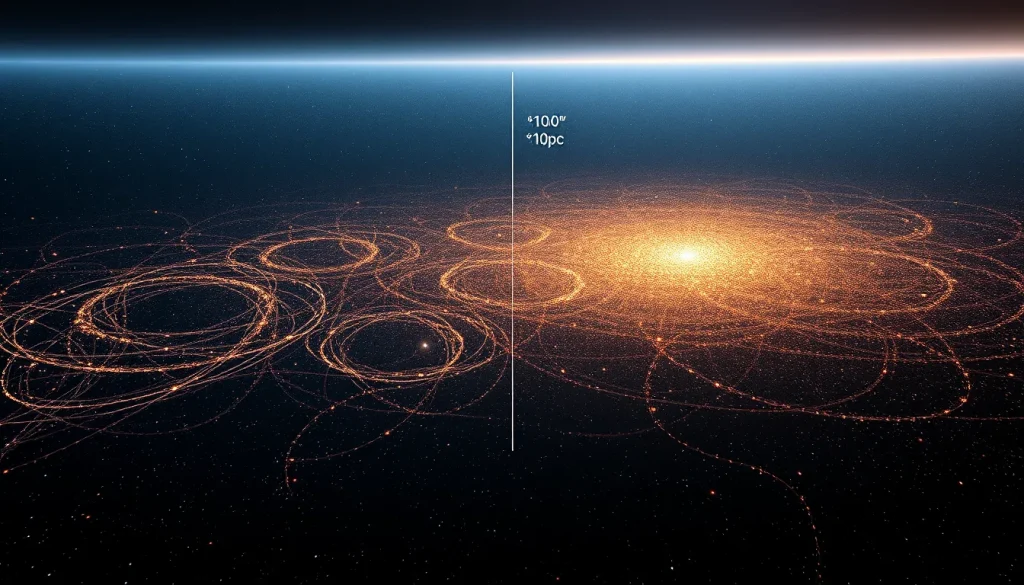
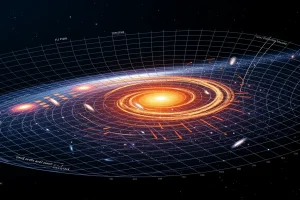
The universe is a tapestry of clusters, filaments, and voids on small scales, but when you zoom out far enough, it becomes remarkably smooth and uniform. This transition point is known as the End of Greatness—a term coined by Harvard astronomer Robert Kirshner to describe the scale at which the large-scale structure of the cosmos gives way to homogeneity, as required by the Cosmological Principle.
| Scale | ~100 Mpc (megaparsecs) |
|---|---|
| First described by | Robert Kirshner |
| Key concept | Homogeneity and isotropy of the universe on large scales |
| Related missions | COBE, WMAP, Planck, JWST |
| Consensus model | Lambda-CDM (standard cosmological model) |
Main Explanation
Definition
The End of Greatness is an observational scale, roughly 100 megaparsecs (Mpc), beyond which the clumpy distribution of galaxies—superclusters, filaments, and voids—averages out into a smooth, uniform cosmos. On smaller scales, the universe exhibits a complex “cosmic web,” but on larger scales, the matter distribution becomes statistically homogeneous and isotropic, aligning with the Cosmological Principle that no place in the universe is special.
How It Works
The universe’s structure formed from tiny quantum fluctuations seeded during cosmic inflation. Over billions of years, gravity amplified these fluctuations, pulling matter into dense regions (clusters and superclusters) and leaving underdense voids. However, the scale of these structures is limited. The largest known structures—like the Sloan Great Wall or the Hercules–Corona Borealis Great Wall—span hundreds of Mpc, but careful statistical analyses of galaxy surveys (e.g., WiggleZ, SDSS) show that beyond ~100 Mpc, the density fluctuations drop below 1%, and the universe becomes effectively uniform. This transition is the End of Greatness.

Example
Imagine looking at a forest from above: close up, you see individual trees, clumps, and clearings. But from an airplane at high altitude, the forest appears as a continuous green blanket. Similarly, within 100 Mpc, we see galaxy clusters and voids, but beyond that, the distribution of galaxies becomes statistically indistinguishable from a uniform fog.
Observable Consequences
The End of Greatness is not just a theoretical curiosity; it has measurable consequences. It validates the Cosmological Principle, which underpins the Friedmann–Lemaître–Robertson–Walker metric used in the standard Big Bang model. It also allows astronomers to treat the universe as homogeneous when analyzing the cosmic microwave background (CMB) and large-scale structure, simplifying calculations of dark energy and dark matter densities.
Common Misconceptions
A common misconception is that the End of Greatness implies a physical boundary or edge. It does not—it is merely a statistical threshold. Another misconception is that the universe is perfectly homogeneous on all scales; in reality, the End of Greatness is approximate, and small fluctuations (the seeds of future structure) persist at all scales. Finally, some popular articles claim that “structures larger than the End of Greatness” challenge the Cosmological Principle; such claims are usually based on misinterpretations of statistical significance.
Cosmic Epochs: The Road to Homogeneity
To understand why the End of Greatness exists, we must trace the universe’s evolution from its earliest moments. The standard Lambda-CDM model describes a sequence of epochs:
| Epoch | Time After Big Bang | Temperature | Key Events |
|---|---|---|---|
| Planck Epoch | 0 to 10−43 s | >1032 K | Quantum gravity dominates; no current theory explains this era. |
| Grand Unification Epoch | 10−43 to 10−36 s | 1028–1032 K | Strong and electroweak forces unify; inflation begins at the end. |
| Inflationary Epoch | 10−36 to 10−32 s | Dropping rapidly | Exponential expansion flattens spacetime and magnifies quantum fluctuations. |
| Electroweak Epoch | 10−32 to 10−12 s | 1028 to 1015 K | Electromagnetic and weak forces separate; quarks and leptons form. |
| Quark Epoch | 10−12 to 10−6 s | 1015 to 1012 K | Quarks and gluons exist as a quark–gluon plasma. |
| Hadron Epoch | 10−6 to 1 s | 1012 to 1010 K | Protons and neutrons form; matter–antimatter annihilation leaves net matter. |
| Lepton Epoch | 1 to 10 s | 1010 to 109 K | Leptons dominate; neutrinos decouple. |
| Photon Epoch | 10 s to 380,000 yr | 109 to 3000 K | Photons are coupled to matter; Big Bang nucleosynthesis occurs (first elements form). |
| Recombination | ~380,000 yr | ~3000 K | Electrons combine with protons to form neutral hydrogen; photons decouple, releasing the CMB. |
| Dark Ages | 380,000 to ~150 million yr | 3000 to ~60 K | The universe is dark and neutral; no stars yet. |
| Reionization | ~150 million to ~1 billion yr | ~60 to ~20 K | First stars and galaxies form, emitting UV radiation that reionizes neutral hydrogen. |
| Structure Formation | ~1 billion yr to present | ~20 K to 2.7 K | Gravity amplifies initial fluctuations, building clusters, superclusters, and the cosmic web. |
The End of Greatness emerges from this process: the initial fluctuations, stretched by inflation, had a finite spectrum. On scales larger than ~100 Mpc, the fluctuations are suppressed, so gravity has not had enough time to build coherent structures. Thus, the universe appears homogeneous.
Why It Matters
The End of Greatness is a cornerstone of modern cosmology. It justifies using the Friedmann equations to describe the universe’s expansion and underpins the interpretation of the CMB as a near-perfect blackbody with tiny anisotropies. It also guides the design of galaxy surveys: knowing where homogeneity begins allows astronomers to distinguish true cosmic variance from observational artifacts. Moreover, the scale itself is a sensitive probe of inflationary physics—the amplitude and tilt of the primordial power spectrum determine the exact location of this transition.
Evidence / Sources
Evidence for the End of Greatness comes from several large galaxy surveys. The WiggleZ Dark Energy Survey (Scrimgeour et al., 2012) measured the transition to homogeneity at ~100 Mpc using the galaxy correlation function. The Sloan Digital Sky Survey (SDSS) Data Release 14, analyzed by Sarkar and Pandley (2019), confirmed this scale with the local dimension method. Additionally, the COBE, WMAP, and Planck satellites mapped the CMB, showing that the universe’s temperature fluctuations are only about 1 part in 100,000 on large angular scales, consistent with homogeneity. The James Webb Space Telescope (JWST) is now probing the epoch of reionization, revealing the first galaxies that seeded large-scale structure.
Related Registry Entries
Explore more about the cosmic web, the Cosmological Principle, and the missions that revealed the universe’s large-scale properties.
FAQ
Is the End of Greatness a physical boundary?
No, it is a statistical threshold. It marks the scale beyond which the clumpiness of galaxy distribution falls below detectable levels, not a physical edge of the universe.
What causes the End of Greatness?
It arises from the initial conditions set by cosmic inflation. Quantum fluctuations were stretched to super-horizon scales, but on very large scales, the fluctuations are suppressed, so gravity has not had enough time to form coherent structures.
How was the End of Greatness measured?
Astronomers use galaxy redshift surveys like WiggleZ and SDSS to compute correlation functions and fractal dimensions. The scale at which the correlation function approaches zero or the fractal dimension approaches 3 is the End of Greatness.
Leave a Reply