
Short Answer
Main Explanation
The Hubble parameter, denoted H, is a fundamental quantity in physical cosmology that measures the rate at which the universe expands at any given time. It is named after Edwin Hubble, whose 1929 observations revealed that galaxies recede from us at speeds proportional to their distances—a relationship now known as Hubble’s law (or the Hubble–Lemaître law). The parameter itself is time-dependent; its present-day value, the Hubble constant H₀, is approximately 70 km/s/Mpc, though measurements from different techniques yield slightly different values, a tension that remains an active area of research.
In the framework of the Friedmann–Lemaître–Robertson–Walker (FLRW) metric, the expansion of space is described by the scale factor a(t). The Hubble parameter is defined as the fractional rate of change of the scale factor: H(t) = (da/dt) / a. This parameter evolves with cosmic time, governed by the Friedmann equations, which incorporate the energy density of matter, radiation, dark energy, and spatial curvature. In the standard Lambda-CDM model, the expansion history is given by H(z) = H₀ √(Ωm(1+z)³ + ΩΛ + Ωk(1+z)²), where Ωm, ΩΛ, and Ωk are the density parameters for matter, dark energy, and curvature, respectively.
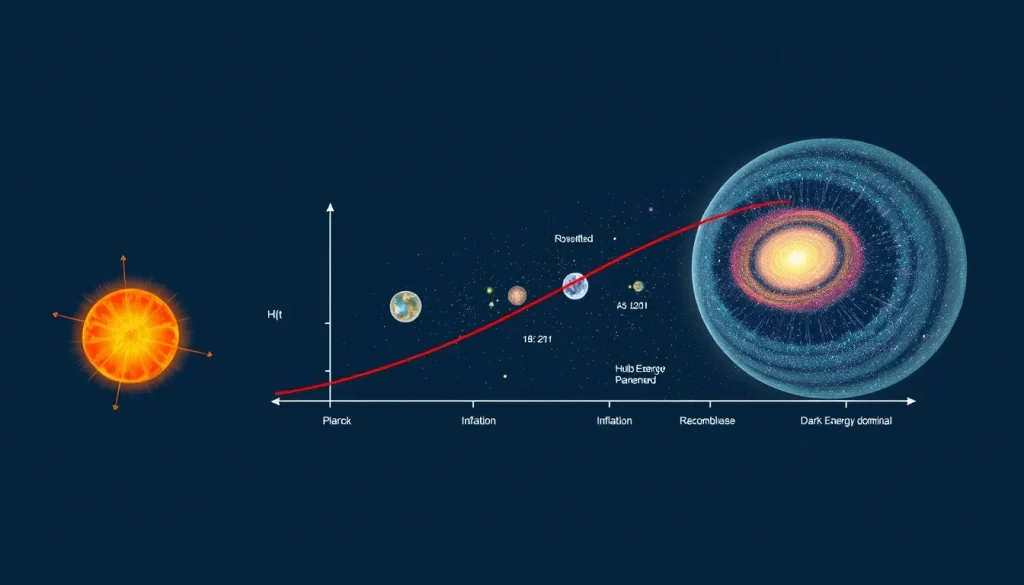
The Hubble parameter is not just a number; it encodes the entire expansion history of the universe. From the intense, hot early phases to the current epoch of accelerated expansion driven by dark energy, H(t) traces the cosmic story. Its measurement and interpretation underpin our understanding of the universe’s age, size, and ultimate fate.
Definition
Formally, the Hubble parameter is the ratio of the time derivative of the scale factor to the scale factor itself. At a given redshift z, it gives the expansion rate at that epoch. The present-day value, H₀, is usually expressed in kilometres per second per megaparsec (km/s/Mpc), indicating how fast a galaxy at a distance of 1 Mpc recedes from us.
How It Works
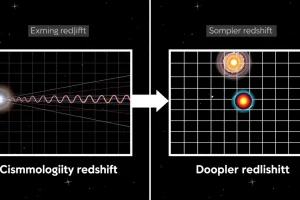
Hubble’s law states that the recessional velocity v of a distant galaxy is proportional to its distance d: v = H₀ d. This linear relation arises because space itself expands uniformly. A useful analogy is a loaf of raisin bread rising in the oven: each raisin sees every other raisin move away, with more distant raisins receding faster. In the real universe, light from distant galaxies is stretched to longer wavelengths (redshifted) by the expansion, providing a direct observable measure of H.
The expansion rate changes over time. In the early universe, radiation dominated, causing H to decrease as 1/t. Later, matter domination led to a different scaling, and now dark energy is causing the expansion to accelerate. The Hubble parameter is thus a key input for models of cosmic evolution.
Equation
The Hubble parameter is defined as:
H(t) = (da/dt) / a
In terms of redshift, the Friedmann equation gives:
H(z) = H₀ √(Ωm(1+z)³ + ΩΛ + Ωk(1+z)²)
where Ωm includes both baryonic and dark matter, ΩΛ is the dark energy density parameter, and Ωk accounts for spatial curvature.
Example
If a galaxy is 100 Mpc away and H₀ = 70 km/s/Mpc, its recessional velocity is 7,000 km/s. This means the galaxy’s light is redshifted by a factor of about 2.3% (z ≈ 0.023). The Hubble constant also sets the characteristic time scale of the universe: the inverse of H₀, the Hubble time, is roughly 14 billion years, close to the actual age of the universe.
Observable Consequences
The Hubble parameter governs the observed redshift–distance relation, the cosmic microwave background (CMB) anisotropies, the abundance of light elements from Big Bang nucleosynthesis, and the growth of large-scale structure. Precise measurements of H₀ from CMB experiments (e.g., Planck) and from local distance ladder observations (e.g., Cepheids and supernovae) currently disagree by about 5–10 km/s/Mpc—the so-called Hubble tension—which may point to new physics beyond the standard model.
Common Misconceptions
One misconception is that the universe is expanding into something. In reality, space itself is expanding; there is no center or edge. Another is that galaxies are moving through space at speeds exceeding light—while recession velocities can exceed the speed of light for very distant objects, this is not a violation of relativity because it is space expanding, not motion through space. Finally, the Hubble constant is not constant in time; it changes as the universe evolves, though its present-day value is often simply called the Hubble constant.
Why It Matters
The Hubble parameter is the single most important number in cosmology after the density parameters. It determines the age of the universe, the distance scale to galaxies, and the dynamics of expansion. By measuring H(z) at different redshifts, astronomers can probe the nature of dark energy, the density of matter, and the geometry of space. The Hubble tension, if real, could indicate that our standard model is incomplete, motivating new theories such as early dark energy or modified gravity.
Moreover, the Hubble parameter is intimately tied to the cosmic timeline. From the Planck epoch to the present, the expansion rate dictates how quickly the universe cooled, allowing the formation of fundamental particles, nuclei, atoms, and eventually stars and galaxies. Understanding H is essential for interpreting observations from missions like COBE, WMAP, Planck, and JWST, which have mapped the CMB and distant galaxies, confirming the Lambda-CDM model with remarkable precision.
Evidence / Sources
The empirical basis for the Hubble parameter comes from multiple independent observations:
- Redshift surveys: Measurements of galaxy redshifts and distances (using Cepheid variables, Type Ia supernovae, and the Tully–Fisher relation) establish the local value of H₀.
- Cosmic Microwave Background: The angular scale of acoustic peaks in the CMB power spectrum, as measured by WMAP and Planck, provides a high-precision value of H₀ assuming the Lambda-CDM model.
- Baryon Acoustic Oscillations: The characteristic scale of density fluctuations in the large-scale distribution of galaxies yields a geometric distance measure that constrains H(z) at various redshifts.
- Big Bang Nucleosynthesis: The predicted and observed abundances of light elements (e.g., deuterium, helium-4) depend on the expansion rate during the first minutes, providing an early-universe probe.
The historical development from Friedmann’s 1922 equations to Hubble’s 1929 discovery, and later refinements by Lemaître and others, is well documented in the literature. The current consensus value is near 70 km/s/Mpc, but the tension between early- and late-universe measurements remains unresolved.
Related Registry Entries
FAQ
What is the difference between the Hubble parameter and the Hubble constant?
The Hubble constant H₀ is the present-day value of the Hubble parameter H(t). The parameter changes over time as the universe expands, while the constant refers specifically to the rate today.
Why is the Hubble constant measured in km/s/Mpc?
It describes how fast a galaxy recedes (in km/s) for every megaparsec (Mpc) of distance. For example, H₀ = 70 km/s/Mpc means a galaxy 1 Mpc away recedes at 70 km/s, one 2 Mpc away at 140 km/s, and so on.
What is the Hubble tension?
The Hubble tension is the discrepancy between the value of H₀ derived from cosmic microwave background observations (early universe, ~67.4 km/s/Mpc from Planck) and that from local distance ladder measurements (late universe, ~73 km/s/Mpc). This disagreement may indicate new physics beyond the standard model.
How does the Hubble parameter relate to the age of the universe?
The inverse of the Hubble constant, the Hubble time (1/H₀), gives a rough estimate of the universe's age. For H₀ = 70 km/s/Mpc, the Hubble time is about 14 billion years, close to the actual age of 13.8 billion years when including matter and dark energy effects.
Leave a Reply