
Short Answer
Short Answer / Definition
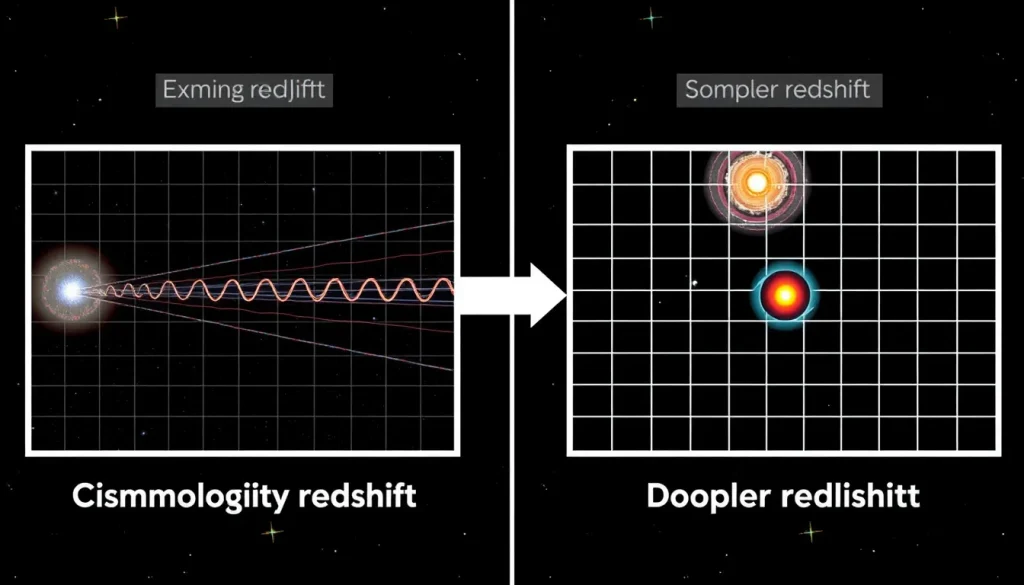
Cosmological redshift is the lengthening of light’s wavelength caused by the expansion of the universe itself: as photons travel through expanding space, their wavelengths stretch with the fabric of space. Doppler redshift, on the other hand, is the lengthening of light’s wavelength due to the relative motion of the source and observer through a static (or locally flat) spacetime, such as when a galaxy moves away from us at high speed. Both produce a shift toward longer (redder) wavelengths, but they have different physical origins and are described by different equations.
Main Explanation
When astronomers observe light from distant objects, they notice that spectral lines are shifted toward longer wavelengths. This phenomenon is called redshift. But not all redshifts are alike. The two primary types—cosmological and Doppler—are often conflated, yet they stem from fundamentally different physical mechanisms.
Doppler redshift is the familiar effect from everyday life: a siren moving away from you has a lower pitch. For light, if a source moves away from an observer, the wavelength is stretched. This is described by special relativity and depends only on the relative velocity between source and observer. In astronomy, Doppler redshift is seen in the motion of stars within galaxies, binary systems, and nearby galaxies where the expansion of space is negligible.
Cosmological redshift, however, arises from the expansion of the universe itself. According to general relativity, space is dynamic. As photons travel through expanding space, their wavelengths are stretched in proportion to the scale factor of the universe. This is not a motion of the source through space; it is the stretching of the space between the source and the observer. The relationship is given by 1 + z = aobs / aemit, where a is the cosmic scale factor at the time of emission and observation.
For nearby objects (small redshifts), both effects can look similar, and the Hubble–Lemaître law relates recession velocity to distance. But for distant galaxies, the cosmological interpretation is essential. The distinction becomes clear when we consider the cumulative effect of expansion over billions of years. A galaxy at redshift z = 2 is not simply moving away at 2c (which would be impossible); rather, the space between us has expanded by a factor of 3 during the light’s journey.
The cosmic microwave background (CMB) is a prime example of cosmological redshift. The radiation we detect today has been redshifted from the hot, dense early universe by a factor of about 1100, corresponding to a temperature drop from ~3000 K to 2.725 K. This is a direct consequence of the expansion of space, not a Doppler motion of the last-scattering surface.
Cosmic Epochs and Redshift
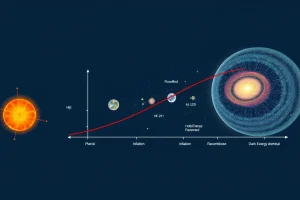
The history of the universe is often charted in terms of redshift, because redshift directly measures the scale factor and thus the age of the universe. The following table summarizes the major epochs, from the Planck epoch to the present day, with approximate redshifts and temperatures.
| Epoch | Time After Big Bang | Temperature | Approximate Redshift | Key Events |
|---|---|---|---|---|
| Planck epoch | <10-43 s | >1032 K | >1032 | Quantum gravity effects dominate; no current theory |
| Grand Unification epoch | 10-43 to 10-36 s | 1028–1032 K | 1028–1032 | Strong and electroweak forces unify; inflation may begin |
| Inflationary epoch | 10-36 to 10-32 s | ~1027 K | ~1027 | Exponential expansion; quantum fluctuations seeded structure |
| Electroweak epoch | 10-32 to 10-12 s | 1015–1027 K | 1015–1027 | Electromagnetic and weak forces separate; W/Z bosons acquire mass |
| Quark epoch | 10-12 to 10-6 s | 1012–1015 K | 1012–1015 | Quarks and gluons form quark-gluon plasma |
| Hadron epoch | 10-6 to 1 s | 1010–1012 K | 1010–1012 | Protons and neutrons form; baryon asymmetry established |
| Lepton epoch | 1 to 10 s | 109–1010 K | 109–1010 | Leptons dominate; neutrinos decouple |
| Photon epoch | 10 s to 380,000 yr | 104–109 K | 104–109 | Photons coupled to matter; Big Bang nucleosynthesis occurs (first ~20 min) |
| Recombination | 380,000 yr | ~3000 K | ~1100 | Electrons combine with nuclei; photons decouple; CMB released |
| Dark Ages | 380,000 yr to ~150 million yr | ~3000 K to ~50 K | 1100 to ~20 | No stars; neutral hydrogen fills space |
| Reionization | ~150 million to ~1 billion yr | ~50 K to ~20 K | 20 to ~6 | First stars and galaxies form; ultraviolet light reionizes hydrogen |
| Structure Formation | ~1 billion yr to present | ~20 K to 2.7 K | 6 to 0 | Galaxies, clusters, and large-scale structure assemble; dark energy accelerates expansion |
This timeline is the standard Lambda-CDM model, which is the consensus framework for cosmology. The CMB, observed by COBE, WMAP, and Planck, provides a snapshot of the universe at recombination. The James Webb Space Telescope (JWST) is now probing the epoch of reionization and the first galaxies.
Comparison: Cosmological vs. Doppler Redshift
Quick Comparison
Both effects shift light to longer wavelengths, but they arise from different spacetime geometries. Cosmological redshift is a geometric effect of expanding space; Doppler redshift is a kinematic effect of relative motion in flat spacetime.
Table
| Property | Cosmological Redshift | Doppler Redshift |
|---|---|---|
| Cause | Expansion of the universe (scale factor changes) | Relative motion of source and observer |
| Physical theory | General relativity | Special relativity (or classical Doppler for non-relativistic) |
| Formula | 1 + z = aobs / aemit | 1 + z = sqrt((1 + β)/(1 – β)) |
| Depends on | Cosmic time and distance | Velocity component along line of sight |
| Example | CMB redshift z ≈ 1100 | Star moving in a binary system |
| Observational signature | All distant objects show it; scales with distance | Can be blueshift or redshift depending on direction |
| Interpretation | Space itself stretches | Object moves through space |
Similarities
Both result in a shift of spectral lines toward longer wavelengths. For small redshifts (z < 0.1), the two formulas converge to the same non-relativistic approximation: z ≈ v/c. In practice, for nearby galaxies, the distinction is often not observationally significant because the local universe is nearly homogeneous and the expansion is slow.
Differences
The key difference is the underlying geometry. Doppler redshift is a special-relativistic effect: it depends on the velocity of the source relative to the observer in a flat, static spacetime. Cosmological redshift is a general-relativistic effect: it arises because the spacetime metric itself changes with time. In a universe that expands, a photon’s wavelength is stretched continuously as it travels. This means that even if the source is at rest relative to the comoving coordinates, the light will still be redshifted. In contrast, a Doppler redshift would not occur if the source and observer are at rest relative to each other.
Another difference is that cosmological redshift is always positive (for distant objects) because the universe is expanding; Doppler redshift can be either positive or negative (blueshift) depending on the direction of motion. Also, cosmological redshift is cumulative: it depends on the total expansion that occurred during the photon’s journey, not just the current velocity of the source.
Historical Context
In the 1920s, Vesto Slipher measured the redshifts of spiral nebulae and found that most were moving away from us. Edwin Hubble then discovered a linear relationship between distance and redshift (Hubble–Lemaître law). Initially, this was interpreted as a Doppler effect. However, with the development of general relativity and the Friedmann–Lemaître–Robertson–Walker metric, it became clear that the redshift of distant galaxies is primarily due to the expansion of space, not their motion through space. The distinction is often blurred in introductory texts, but it is fundamental to modern cosmology.
Which Model Is Accepted Today?
The standard model of cosmology, Lambda-CDM, treats the observed redshift of distant galaxies as cosmological in origin. The expansion of the universe is a well-established fact, supported by the CMB, the large-scale distribution of galaxies, and the accelerating expansion discovered in 1998. Doppler redshifts are still relevant for local motions, such as the peculiar velocities of galaxies within clusters, but for cosmological distances, the expansion dominates. No alternative model has been able to explain the full set of observations without invoking cosmic expansion.
Why It Matters
Understanding the difference between cosmological and Doppler redshift is crucial for interpreting astronomical observations. If we misinterpret a cosmological redshift as a Doppler shift, we would infer absurd velocities (many times the speed of light) for distant galaxies. More importantly, cosmological redshift provides a direct measure of the scale factor of the universe at the time the light was emitted, allowing us to reconstruct the history of cosmic expansion. It is the foundation of distance measurements in cosmology, from the Hubble constant to the redshift–distance relation used to probe dark energy. The cosmic microwave background, the relic radiation from recombination, is the ultimate proof of cosmological redshift and the Big Bang model.
Evidence / Sources
The distinction between the two types of redshift is discussed in standard cosmology textbooks and peer-reviewed articles. The sources used for this article include:
- COSMOS – Cosmological Redshift (Swinburne University)
- Space.com – Redshift and blueshift: What do they mean?
- Bedran, M.L. (2002) – A comparison between the Doppler and cosmological redshifts, American Journal of Physics
- Physics Stack Exchange – ‘Doppler redshift’ vs ‘Cosmological redshift’
Related Registry Entries
Explore related concepts in the cosmic reference:
- Cosmic Microwave Background
- Inflation
- Recombination
- Hubble–Lemaître Law
- Large-Scale Structure
FAQ
Can we observationally distinguish cosmological redshift from Doppler redshift?
For a single galaxy, you cannot tell the difference based on the redshift alone. However, the ensemble of redshifts observed across the sky—with more distant galaxies having larger redshifts following the Hubble–Lemaître law—strongly favors the cosmological interpretation. Additionally, the cosmic microwave background, which is redshifted by a factor of 1100, cannot be explained by Doppler motion alone.
Is the expansion of the universe causing galaxies to move faster than light?
No. The cosmological redshift is not due to motion through space. The apparent recession velocity can exceed the speed of light for very distant objects, but this is a geometric effect of space expanding, not a violation of special relativity. The galaxies themselves are not moving through space; space is stretching.
Why is the CMB redshifted to such a high value?
The CMB was emitted when the universe was about 380,000 years old, at a temperature of ~3000 K. Since then, the universe has expanded by a factor of about 1100, so the wavelength of the photons has been stretched by that factor, lowering the temperature to 2.725 K. This is a clear example of cosmological redshift.
Leave a Reply