
Short Answer
Main Explanation
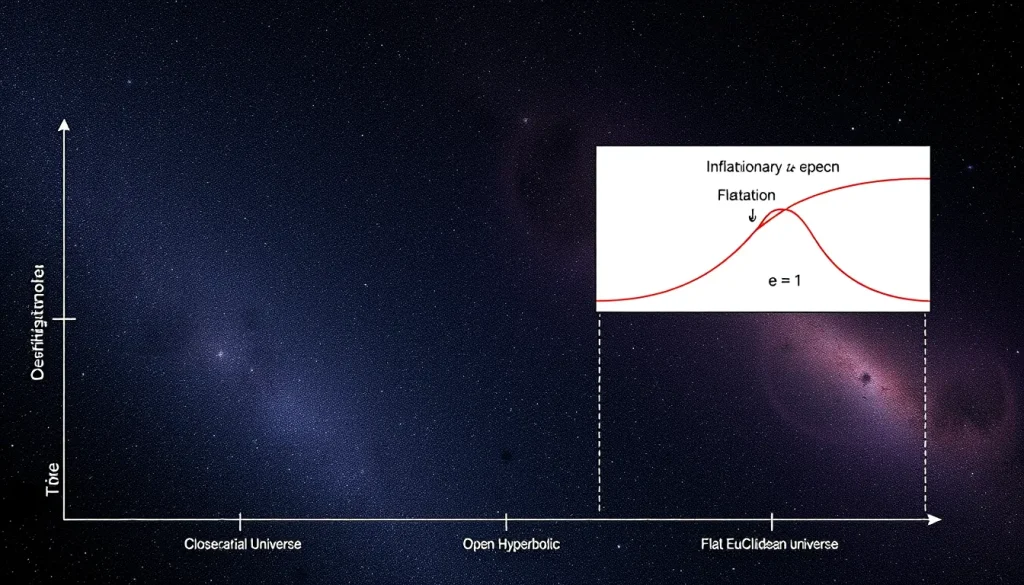
The flatness problem, also known as the oldness problem, is a fine-tuning puzzle in standard Big Bang cosmology. It asks: why does the universe appear to be so close to spatial flatness (i.e., having exactly the critical density) when the equations of general relativity make flatness an unstable condition? The problem arises because any tiny deviation from critical density in the early universe would have grown enormously over billions of years, yet observations today show the density parameter Ω is very close to 1.
To understand this, we must examine how the cosmic density parameter evolves. In a universe with spatial curvature k, the relationship is:
|1 – Ω| = |k|c² / (H²R²)
where H is the Hubble parameter and R is the scale factor. For a matter-dominated universe, |1 – Ω| grows as t^(2/3); for a radiation-dominated universe, it grows as t. This means that if Ω is close to 1 today, it must have been extraordinarily close to 1 in the past. For instance, at the Planck time (10⁻⁴³ seconds after the Big Bang), Ω must have been within 1 part in 10⁵⁷ of 1. That is an astonishingly precise initial condition with no known physical reason in standard cosmology.
The solution to this puzzle is cosmic inflation, a period of exponential expansion in the first fraction of a second. Inflation stretches any initial curvature to near flatness, just as inflating a balloon makes its surface appear locally flat. This mechanism naturally drives Ω to 1, explaining why we observe a nearly flat universe today.
Inflation also resolves other cosmological puzzles, such as the horizon problem and the origin of large-scale structure. The flatness problem is thus a key piece of evidence for inflationary theory, which is now part of the standard ΛCDM (Lambda-Cold Dark Matter) model of cosmology.
Concept
Definition
The flatness problem is the observation that the spatial geometry of the universe appears to be very close to flat (Ω ≈ 1), despite the fact that any deviation from critical density would have grown over cosmic time. This requires an extraordinary fine-tuning of initial conditions in the standard Big Bang model.
How It Works
In the Friedmann equations, the curvature term evolves with the scale factor. For any universe with k ≠ 0, |1 – Ω| increases as the universe expands. Therefore, if the universe is nearly flat today, it must have been even closer to flat in the distant past. The problem is that there is no reason for the initial density to be so precisely tuned.
Equation
The evolution of the density parameter is given by:
|1 – Ω(a)| = |1 – Ω₀| / (H(a)² a²)
where a is the scale factor and Ω₀ is the present-day density parameter. For a radiation-dominated universe, |1 – Ω| ∝ a²; for matter domination, ∝ a.
Example
If at the time of nucleosynthesis (about 1 second after the Big Bang), Ω had differed from 1 by more than 1 part in 10¹⁶, the universe would have either recollapsed or expanded too quickly to form galaxies. Yet observations show Ω is within 1% of 1 today.
Observable Consequences
A flat universe has critical density, which determines its ultimate fate. It also affects the angular size of fluctuations in the cosmic microwave background (CMB). Measurements of the CMB by missions like COBE, WMAP, and Planck have confirmed that the universe is spatially flat to within about 0.4% (Ω_k = -0.0005 ± 0.007).
Common Misconceptions
One misconception is that the flatness problem implies the universe is exactly flat. In reality, it could have a tiny curvature that is too small to detect. Another is that inflation is the only possible solution; while it is the leading explanation, alternative theories exist but are less supported.
Cosmic Epochs and the Flatness Problem
The flatness problem is intimately tied to the earliest moments of the universe. The following timeline outlines the major epochs and their role in shaping the cosmos.
| Epoch | Time After Big Bang | Temperature | Key Events |
|---|---|---|---|
| Planck Epoch | < 10⁻⁴³ s | > 10³² K | Quantum gravity effects dominate; no current theory fully describes this era. |
| Grand Unification Epoch | 10⁻⁴³ – 10⁻³⁶ s | 10²⁷ – 10³² K | Strong and electroweak forces unified; inflation likely begins at the end of this epoch. |
| Inflationary Epoch | 10⁻³⁶ – 10⁻³² s | ~10²⁷ K | Exponential expansion flattens spatial curvature and dilutes monopoles; quantum fluctuations seed structure. |
| Electroweak Epoch | 10⁻³² – 10⁻¹² s | 10¹⁵ – 10²⁷ K | Electromagnetic and weak forces separate; Higgs mechanism gives particles mass. |
| Quark Epoch | 10⁻¹² – 10⁻⁶ s | 10¹² – 10¹⁵ K | Quarks and gluons exist in a quark-gluon plasma; no hadrons yet. |
| Hadron Epoch | 10⁻⁶ – 1 s | 10¹⁰ – 10¹² K | Quarks combine into protons and neutrons; matter-antimatter asymmetry emerges. |
| Lepton Epoch | 1 – 10 s | 10⁹ – 10¹⁰ K | Leptons dominate; neutrinos decouple; electron-positron annihilation occurs. |
| Photon Epoch | 10 s – 380,000 yr | 10⁴ – 10⁹ K | Photons dominate; nucleosynthesis forms light elements (H, He, Li). |
| Recombination | ~380,000 yr | ~3000 K | Electrons combine with nuclei to form neutral atoms; photons decouple, releasing the CMB. |
| Dark Ages | 380,000 yr – ~150 million yr | ~10 – 3000 K | The universe is dark and neutral; no stars yet. |
| Reionization | ~150 million – 1 billion yr | ~10 – 100 K | First stars and galaxies emit UV light, reionizing hydrogen. |
| Structure Formation | ~1 billion yr – present | 2.7 K today | Galaxies, clusters, and large-scale structure form via gravitational collapse. |
Inflation, which occurs during the Inflationary Epoch, is the key mechanism that solves the flatness problem. It also explains the near-scale-invariant spectrum of density fluctuations observed in the CMB by Planck and other missions.
Why It Matters
The flatness problem is not just an abstract curiosity. It tells us that the standard Big Bang model was incomplete. The extreme fine-tuning required for Ω to be near 1 today points to new physics in the early universe. Inflation, the leading solution, has profound implications: it explains the origin of cosmic structure, the uniformity of the CMB, and the absence of magnetic monopoles. Moreover, the flatness of the universe directly affects its ultimate fate: a flat universe with Ω = 1 will expand forever, approaching zero velocity asymptotically. Understanding flatness is therefore essential for cosmology and for testing theories of the early universe.
Evidence / Sources
Observations from the cosmic microwave background (CMB) provide the strongest evidence for spatial flatness. The COBE mission (1989) first measured the CMB spectrum, WMAP (2001) mapped temperature anisotropies, and the Planck satellite (2009-2013) produced the most precise measurements to date, finding Ω_k = -0.0005 ± 0.007 (Planck 2018 results). These measurements are consistent with a flat universe. The angular size of the first acoustic peak in the CMB power spectrum is a direct probe of curvature; its location at ~1° indicates near-zero curvature. Additionally, the observed abundances of light elements from Big Bang nucleosynthesis and the large-scale distribution of galaxies support the ΛCDM model, which includes inflation and flatness.
Related Registry Entries
FAQ
What is the flatness problem in simple terms?
The flatness problem is the surprising fact that the universe appears to be almost perfectly flat (spatially), even though any slight deviation from flatness in the early universe would have grown enormously over time. This requires extreme fine-tuning of the initial density.
How does inflation solve the flatness problem?
Inflation is a brief period of exponential expansion that stretches space so much that any initial curvature is flattened, driving the density parameter Ω extremely close to 1, exactly as observed.
What evidence supports a flat universe?
Measurements of the cosmic microwave background by the Planck satellite show that the curvature parameter Ω_k is consistent with zero (Ω_k = -0.0005 ± 0.007). The angular scale of the first acoustic peak in the CMB also indicates near-flatness.
Is the universe exactly flat?
Observations are consistent with a flat universe, but they only constrain curvature to be very small. It could be slightly curved, but the deviation is too small to detect with current precision.


Leave a Reply