
Short Answer
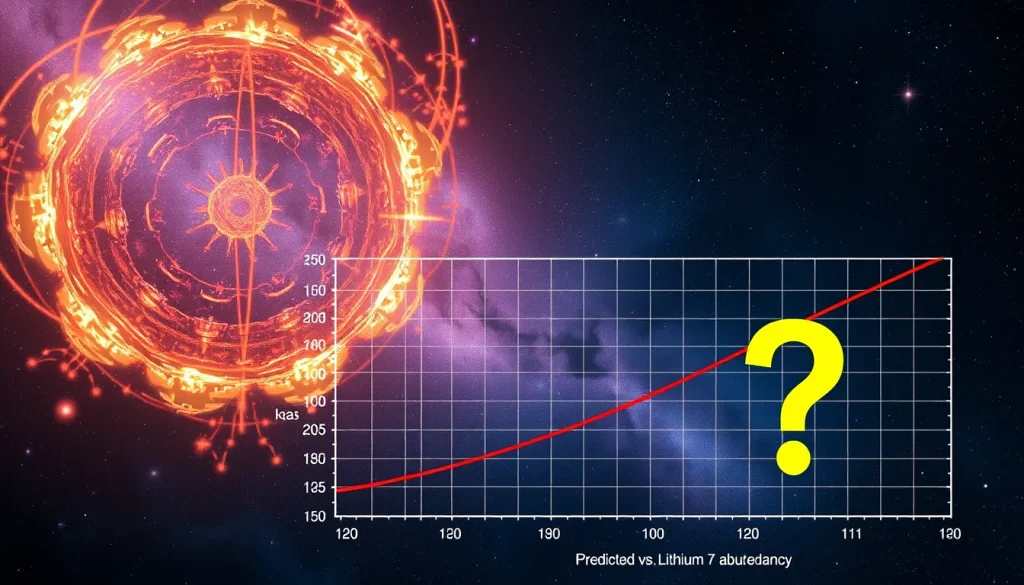
The lithium problem (also called the cosmological lithium discrepancy) is one of the most persistent puzzles in modern cosmology. It refers to the mismatch between the predicted abundance of lithium-7 produced in the first few minutes after the Big Bang and the amount actually observed in the oldest, most metal-poor stars in our galaxy. While predictions from Big Bang nucleosynthesis (BBN) combined with cosmic microwave background (CMB) measurements indicate that about three to four times more lithium-7 should exist than is seen, observations consistently show a lower value. This discrepancy is significant—roughly a 4–5 sigma effect—and has resisted easy explanation for decades.
| Key Facts: The Lithium Problem | |
|---|---|
| Discrepancy factor | ~3–4× (predicted vs. observed ⁷Li) |
| Significance | 4–5σ mismatch | Elements affected | Primarily ⁷Li; D and ⁴He agree with predictions |
| Observational probe | Metal-poor (Population II) halo stars |
| Predictions rely on | BBN theory + CMB baryon density (WMAP/Planck) |
| Possible resolutions | Astrophysical systematics, nuclear physics resonances, new physics |
Main Explanation
Big Bang nucleosynthesis is the process that forged the lightest elements—deuterium, helium-3, helium-4, and lithium-7—during the first three minutes after the Big Bang. At that time, the universe was a hot, dense plasma of protons, neutrons, electrons, and photons. As it expanded and cooled, nuclear reactions fused these particles into heavier nuclei, but only for a brief window before the temperature dropped too low for further fusion. The resulting abundances depend sensitively on the baryon density of the universe, which is now precisely measured by satellite missions such as WMAP and Planck through their observations of the cosmic microwave background.
When the baryon density from CMB data is fed into standard BBN calculations, the predicted primordial abundance of lithium-7 is about three to four times higher than what astronomers measure in the oldest, most pristine stars. These stars—Population II halo stars—are thought to preserve the chemical composition of the early universe because they formed before significant stellar nucleosynthesis had enriched the interstellar medium with heavier elements. Their lithium absorption lines provide a direct measurement of primordial lithium. The observed values consistently fall below the theoretical prediction, creating the lithium problem.
The discrepancy does not affect deuterium or helium-4, which agree well with BBN predictions. This selective mismatch suggests that the problem is specific to lithium-7 production or destruction, rather than a fundamental failure of BBN as a whole. The standard cosmological model (ΛCDM) has otherwise been remarkably successful, so the lithium problem stands out as a rare crack in an otherwise smooth edifice.
Cosmic Epochs and BBN
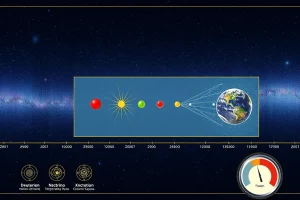
To understand the lithium problem, it helps to place BBN within the broader cosmic timeline. The universe has passed through several distinct epochs, each with its own physics:
| Epoch | Time after Big Bang | Key Events |
|---|---|---|
| Planck epoch | <10⁻⁴³ s | Quantum gravity era; no known physics |
| Grand Unification epoch | 10⁻⁴³–10⁻³⁶ s | Strong and electroweak forces unified |
| Inflationary epoch | 10⁻³⁶–10⁻³² s | Rapid exponential expansion; seeds for structure |
| Electroweak epoch | 10⁻³²–10⁻¹² s | Electromagnetic and weak forces separate |
| Quark epoch | 10⁻¹²–10⁻⁶ s | Quarks and gluons in quark-gluon plasma |
| Hadron epoch | 10⁻⁶–1 s | Protons and neutrons form |
| Lepton epoch | 1–10 s | Leptons dominate; neutrinos decouple |
| Photon epoch | 10 s–380,000 yr | Photons dominate; BBN occurs (first 3 min) |
| Recombination | ~380,000 yr | Electrons and nuclei form neutral atoms; CMB released |
| Dark Ages | 380,000 yr–~150 million yr | No stars yet; neutral hydrogen |
| Reionization | ~150 million–1 billion yr | First stars and galaxies ionize hydrogen |
| Structure Formation | 1 billion yr–present | Galaxies, clusters, large-scale structure |
BBN occurs during the photon epoch, when the temperature has fallen to about 10⁹ K (roughly 1 second to 3 minutes). The nuclear reactions that produce lithium-7 are extremely sensitive to the baryon density and to the rates of specific nuclear processes, such as the destruction of beryllium-7 (which later decays to lithium-7). Any small change in these rates—or the presence of exotic particles—could alter the final lithium abundance.
Evidence
Observation
The primordial lithium abundance is inferred from the absorption lines of lithium-7 in the atmospheres of metal-poor halo stars. These stars are among the oldest in the Milky Way and are believed to have formed from gas that had not yet been enriched by stellar nucleosynthesis. Their spectra show a consistent lithium abundance that is roughly a factor of 3–4 lower than the BBN+CMB prediction.
Prediction
Standard BBN theory, using the baryon density derived from CMB measurements (WMAP and Planck), predicts a primordial ⁷Li/H ratio of about 5×10⁻¹⁰. This prediction is robust and has been confirmed by independent calculations and experimental nuclear cross-section data.
Measurement
The observed ⁷Li/H ratio in metal-poor stars is typically around 1.5×10⁻¹⁰. The measurements have been refined over decades using high-resolution spectroscopy and careful modeling of stellar atmospheres, but the discrepancy persists.
Why It Supports the Model
The agreement between BBN predictions and observations for deuterium and helium-4 is a major success of the hot Big Bang model. The lithium problem does not overturn this success; rather, it highlights a specific, unresolved tension that may point to subtle astrophysical or nuclear effects, or to physics beyond the Standard Model.
Limitations
Observational uncertainties include possible systematic errors in stellar atmosphere models, diffusion and mixing in stars that could deplete lithium, and the possibility that the observed stars are not truly pristine. Nuclear physics uncertainties also exist, particularly for reactions involving beryllium-7, but current data are well constrained.
Alternative Explanations
Proposed solutions fall into three broad categories: (1) astrophysical systematics—e.g., lithium depletion in stellar interiors; (2) nuclear physics—e.g., an undiscovered resonance that enhances ⁷Be destruction; (3) new physics—e.g., decaying particles, varying fundamental constants, or axions that alter BBN yields. None has yet been conclusively confirmed.
Current Scientific Consensus
The lithium problem remains an open puzzle. Most cosmologists accept that BBN is fundamentally correct, but the discrepancy is significant enough to motivate continued research across astrophysics and particle physics.
Why It Matters
The lithium problem is not merely a technical annoyance; it is a window into the physics of the early universe. If the discrepancy is due to new particles or interactions, it would be a direct hint of physics beyond the Standard Model. If it is due to stellar astrophysics, it would improve our understanding of how stars process light elements. Either way, resolving the lithium problem will sharpen our picture of the first few minutes of cosmic history and test the limits of the standard cosmological model.
Evidence / Sources
The following sources provide authoritative information on the lithium problem:
- Wikipedia: Cosmological lithium problem
- Cyburt, Fields, Olive, Yeh (2016). “Big Bang Nucleosynthesis: Present Status.” Reviews of Modern Physics. DOI: 10.1103/revmodphys.88.015004
- Fields (2011). “The Primordial Lithium Problem.” arXiv:1203.3551
Related Registry Entries
- Big Bang Nucleosynthesis
- Cosmic Microwave Background
- WMAP Mission
- Primordial Abundance
Last Reviewed / Updated: September 5, 2026
FAQ
What exactly is the lithium problem?
It is the discrepancy between the predicted primordial abundance of lithium-7 from Big Bang nucleosynthesis (using the CMB-determined baryon density) and the observed lower abundance in old, metal-poor stars.
Why doesn't deuterium or helium show a similar problem?
Deuterium and helium-4 measurements agree well with BBN predictions, so the problem is specific to lithium-7, suggesting a unique issue in its production or destruction.
Could the lithium problem be solved by new physics?
Yes, some proposed solutions involve beyond-Standard-Model particles or interactions that could alter BBN yields, but none has been confirmed. Astrophysical and nuclear explanations are also being explored.
Leave a Reply