
Short Answer
Short Answer / Definition
Lepton asymmetry is the excess of leptons (such as electrons, muons, taus, and their associated neutrinos) over antileptons in the universe. In the standard model of cosmology, a tiny lepton asymmetry is expected, but its exact value remains uncertain. This asymmetry influences the physics of the early universe, particularly the process of Big Bang nucleosynthesis (BBN) and the damping of cosmic microwave background (CMB) anisotropies.
Main Explanation
The universe began in a state of extreme heat and density. As it expanded and cooled, fundamental particles formed, interacted, and eventually gave rise to the structures we see today. One of the most intriguing puzzles of modern cosmology is the matter–antimatter asymmetry: why is the universe filled with matter and not antimatter? The baryon asymmetry (protons and neutrons over their antiparticles) is well measured, but the lepton asymmetry—the analogous excess of leptons—remains far less constrained.
Lepton asymmetry refers to the difference between the number density of leptons and antileptons, normalized to the photon density. It is often expressed as a dimensionless parameter, ξν = μν/T, where μν is the neutrino chemical potential and T is the temperature. In the standard Big Bang model, the universe is assumed to have a nearly zero lepton asymmetry, but even a small non-zero value can have measurable consequences.

To understand lepton asymmetry, we must place it in the context of the universe’s evolution. The standard ΛCDM model describes a sequence of epochs, each governed by different physical processes. Here is a brief timeline of the major cosmic epochs:
| Epoch | Time after Big Bang | Temperature | Key Events |
|---|---|---|---|
| Planck Epoch | < 10⁻⁴³ s | > 10³² K | Quantum gravity effects dominate; current physics breaks down. |
| Grand Unification Epoch | 10⁻⁴³ – 10⁻³⁶ s | 10²⁹ – 10³² K | Strong and electroweak forces unify; possible baryogenesis. |
| Inflationary Epoch | 10⁻³⁶ – 10⁻³² s | ~10²⁸ K | Exponential expansion; seeds for structure formation. |
| Electroweak Epoch | 10⁻³² – 10⁻¹² s | 10¹⁵ – 10²⁸ K | Electromagnetic and weak forces separate; Higgs mechanism. |
| Quark Epoch | 10⁻¹² – 10⁻⁶ s | 10¹² – 10¹⁵ K | Quarks and gluons exist as a quark–gluon plasma. |
| Hadron Epoch | 10⁻⁶ – 1 s | 10¹⁰ – 10¹² K | Quarks combine into protons and neutrons; hadrons form. |
| Lepton Epoch | 1 – 10 s | 10⁹ – 10¹⁰ K | Leptons and antileptons dominate; electron-positron annihilation. |
| Photon Epoch | 10 s – 380,000 yr | 10⁴ – 10⁹ K | Photons dominate; BBN occurs; nuclei form. |
| Recombination | ~380,000 yr | ~3,000 K | Electrons combine with nuclei; CMB released. |
| Dark Ages | 380,000 – 150 million yr | ~60 – 3,000 K | No stars; universe is dark and neutral. |
| Reionization | 150 million – 1 billion yr | ~20 – 60 K | First stars and galaxies ionize neutral hydrogen. |
| Structure Formation | 1 billion yr – present | 2.7 K (today) | Galaxies, clusters, and large-scale structure grow. |
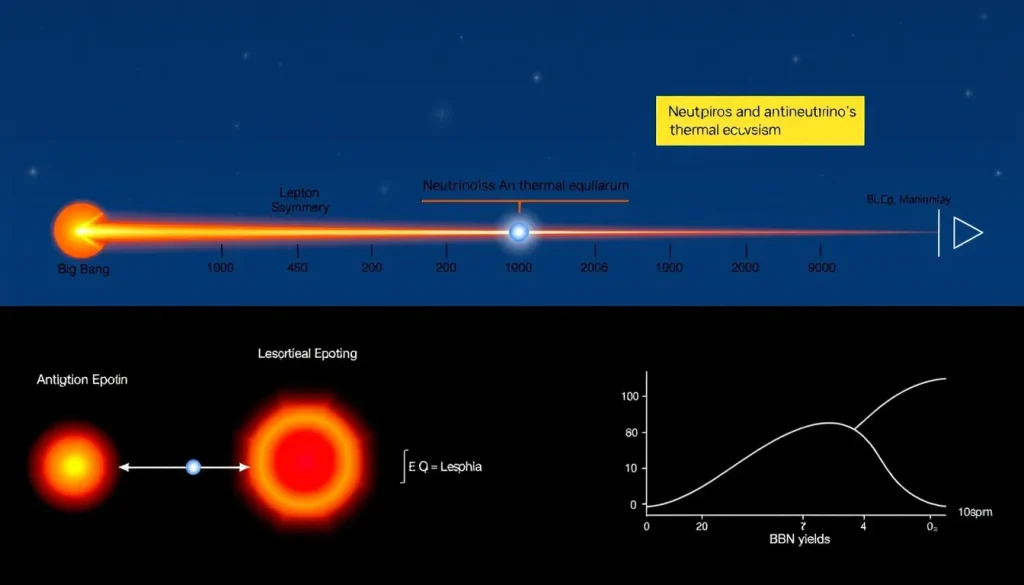
Lepton asymmetry is most relevant during the Lepton Epoch (about 1 to 10 seconds after the Big Bang) and the subsequent Photon Epoch when BBN occurs. During these times, neutrinos and antineutrinos are in thermal equilibrium with the plasma. A non-zero lepton asymmetry changes the neutrino number density and energy distribution, which in turn alters the expansion rate and the neutron-to-proton ratio. This directly affects the production of light elements, especially helium-4, during BBN.
The cosmic microwave background (CMB) also carries imprints of lepton asymmetry. A non-zero asymmetry modifies the neutrino-to-photon ratio, which affects the damping tail of the CMB power spectrum and the effective number of relativistic degrees of freedom (Neff). Precision measurements from WMAP and Planck have placed tight bounds on ξν, but the constraints depend on flavor and on assumptions about neutrino mixing.
Concept: Lepton Asymmetry
Definition
Lepton asymmetry is the difference between the number density of leptons (electrons, muons, taus, and their neutrinos) and antileptons, normalized to the photon density. It is often quantified by the degeneracy parameter ξν = μν/T, where μν is the chemical potential of the neutrino and T is the plasma temperature. A positive ξ indicates an excess of neutrinos over antineutrinos.
How It Works
In the early universe, lepton number is conserved in standard model interactions (except for sphaleron processes that can convert baryon number to lepton number). If the universe began with a net lepton number, it persists through the epochs. During the lepton epoch, neutrinos are in thermal equilibrium. A non-zero chemical potential shifts the Fermi-Dirac distributions of neutrinos relative to antineutrinos, affecting the energy density and pressure. This changes the expansion rate via the Friedmann equation, and also alters the weak interaction rates that set the neutron-to-proton ratio.
Equation
The lepton asymmetry can be expressed as:
ηL = (nL − nL̄) / nγ
where nL is the lepton number density, nL̄ is the antilepton number density, and nγ is the photon number density. In terms of the degeneracy parameter, for a single neutrino species, the contribution to the energy density is:
ρν = (7/8)(π²/30) T⁴ [1 + (30/7)(ξ/π)² + (15/7)(ξ/π)⁴]
This expression shows how ξ modifies the neutrino energy density, which in turn affects the expansion rate and Neff.
Example
Suppose the electron neutrino has a degeneracy parameter ξνe = 0.05. This would increase the neutrino energy density by about 1% and shift the neutron-to-proton ratio at the time of BBN, leading to a higher primordial helium abundance. Current constraints from BBN and CMB suggest that |ξ| is less than about 0.05 for all flavors (95% confidence), but future measurements from CMB-S4 or a CMB Stage-4 experiment could reach sensitivities of ~0.01.
Observable Consequences
- Big Bang Nucleosynthesis: A non-zero lepton asymmetry changes the neutron-to-proton ratio, altering the yields of helium-4, deuterium, and lithium. The EMPRESS survey’s recent measurement of primordial helium-4 has renewed interest in this constraint.
- CMB Damping Tail: The extra radiation energy density from a lepton asymmetry increases the damping of CMB anisotropies on small scales, which is degenerate with Neff.
- Large-Scale Structure: The growth of structure is sensitive to the expansion history, so a lepton asymmetry can leave a subtle imprint on galaxy clustering.
Common Misconceptions
- Lepton asymmetry is the same as baryon asymmetry. They are distinct: baryon asymmetry concerns protons and neutrons, while lepton asymmetry concerns electrons, muons, taus, and neutrinos. Both contribute to the matter–antimatter imbalance, but they are separately conserved in many models.
- Lepton asymmetry must be zero because the universe is matter-dominated. In fact, a small lepton asymmetry is allowed and even expected if baryogenesis produces lepton number. The observed baryon asymmetry could be accompanied by a comparable lepton asymmetry.
- Lepton asymmetry only matters for neutrinos. While neutrinos are the most affected due to their weak interactions, a lepton asymmetry also influences electron/positron annihilation and the CMB spectrum.
Why It Matters
Lepton asymmetry is a fundamental property of the universe that connects particle physics to cosmology. It is a key parameter in models of baryogenesis (including leptogenesis), and it affects our interpretation of BBN and CMB data. Understanding lepton asymmetry helps us answer the profound question: why does the universe contain more matter than antimatter? Moreover, precise measurements of lepton asymmetry can constrain physics beyond the standard model, such as the existence of sterile neutrinos or new interactions.
The current precision cosmology era—with missions like Planck, and future facilities like CMB-S4 and the Simons Observatory—offers the opportunity to measure lepton asymmetry with unprecedented accuracy. Even a null result is valuable, as it would tighten the standard cosmological model.
Evidence / Sources
Observational evidence for lepton asymmetry is indirect. The most stringent constraints come from combining BBN predictions with measurements of primordial light-element abundances (especially helium-4) and CMB observations. The EMPRESS survey’s recent determination of primordial helium-4 has been used to derive new limits. Additionally, the Planck satellite’s measurement of Neff provides complementary bounds.
Key sources include:
- Escudero, Ibarra, & Maura (2023), Primordial lepton asymmetries in the precision cosmology era, Phys. Rev. D 107, 035024. doi:10.1103/physrevd.107.035024
- Lattanzi & Moretti (2024), Lepton Asymmetries in Cosmology, Symmetry 16(12), 1657. doi:10.3390/sym16121657
- JHEP (2025), Primordial lepton asymmetries: neutrino transport, spectral distortions and cosmological constraints, JHEP 06, 213. doi:10.1007/JHEP06(2025)213
Related Registry Entries
Last Reviewed / Updated: September 5, 2026
FAQ
What is lepton asymmetry in simple terms?
Lepton asymmetry is the imbalance between leptons (like electrons and neutrinos) and antileptons in the universe. A tiny asymmetry means slightly more matter than antimatter in the lepton family, which influences the early universe's expansion and element formation.
How is lepton asymmetry measured?
It is not directly measured but inferred from its effects on Big Bang nucleosynthesis (especially helium-4 abundance) and the cosmic microwave background's damping tail. Combining these observations yields constraints on the degeneracy parameter ξ.
Why is lepton asymmetry important for the universe's evolution?
A non-zero lepton asymmetry changes the neutrino energy density, which alters the expansion rate during BBN and the CMB epoch. This affects the production of light elements and the growth of cosmic structure, making it a crucial parameter in precision cosmology.
Does lepton asymmetry violate the standard model?
In the standard model, lepton number is conserved in most interactions, but sphaleron processes can violate it. A non-zero asymmetry could arise from physics beyond the standard model, such as leptogenesis, making it a probe of new physics.



Leave a Reply