
Short Answer
Main Explanation
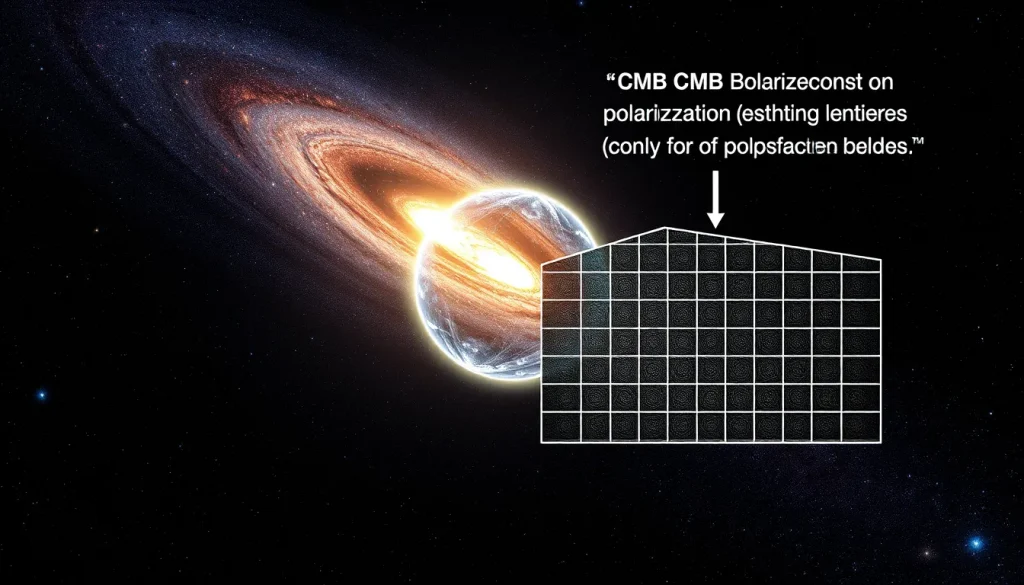
The cosmic microwave background (CMB) is the oldest light in the universe, a relic of the hot, dense state that existed about 380,000 years after the Big Bang. Its temperature and polarization patterns encode a wealth of information about the universe’s composition, geometry, and evolution. One of the most subtle but crucial effects on the CMB is gravitational lensing: the bending of light by massive structures along the line of sight. This lensing distorts the CMB’s temperature and polarization maps, and it has a particularly important impact on the polarization’s B-mode component—the very signal that could reveal primordial gravitational waves from inflation.
Short Answer
Gravitational lensing remaps the CMB polarization field, converting some of the curl-free E-mode polarization into curl-like B-modes. This lensing-induced B-mode signal acts as a contaminant for the primordial B-mode signal generated by inflationary gravitational waves. However, the lensing signal itself is also a valuable probe of large-scale structure, and modern experiments use it both to measure the distribution of matter and to ‘delens’ the CMB to uncover the primordial signal.
What We Know
The universe began in an incredibly hot, dense state and has been expanding and cooling ever since. The standard cosmological model—Lambda-CDM—describes this evolution through distinct epochs:
| Epoch | Time After Big Bang | Temperature | Redshift | Key Events |
|---|---|---|---|---|
| Planck epoch | <10⁻⁴³ s | >10³² K | infinite | Quantum gravity effects dominate; no known physics. |
| Grand Unification epoch | 10⁻⁴³–10⁻³⁶ s | 10²⁷–10³² K | >10²⁸ | Strong and electroweak forces unify; inflation may begin. |
| Inflationary epoch | 10⁻³⁶–10⁻³² s | ~10²⁷ K | >10²⁸ | Exponential expansion; quantum fluctuations seeded. |
| Electroweak epoch | 10⁻³²–10⁻¹² s | 10¹⁵–10²⁷ K | ~10²⁶ | Electromagnetic and weak forces separate; Higgs mechanism. |
| Quark epoch | 10⁻¹²–10⁻⁶ s | 10¹²–10¹⁵ K | ~10¹⁵ | Quarks and gluons form quark-gluon plasma. |
| Hadron epoch | 10⁻⁶–1 s | 10¹⁰–10¹² K | ~10¹³ | Quarks combine into protons and neutrons; baryon asymmetry. |
| Lepton epoch | 1–10 s | 10⁹–10¹⁰ K | ~10¹⁰ | Leptons dominate; neutrinos decouple. |
| Photon epoch | 10 s–380,000 yr | 3,000–10⁹ K | ~10⁹–1,100 | Photons coupled to matter; Big Bang nucleosynthesis (first elements). |
| Recombination | ~380,000 yr | ~3,000 K | ~1,100 | Electrons combine with protons to form neutral hydrogen; CMB released. |
| Dark Ages | 380,000 yr–~150 million yr | ~3,000–60 K | 1,100–20 | No stars; universe dark and neutral. |
| Reionization | ~150 million–1 billion yr | ~60–20 K | 20–6 | First stars and galaxies form; ionize intergalactic medium. |
| Structure Formation | 1 billion yr–present | <20 K | <6 | Galaxies cluster; dark energy dominates expansion. |
The CMB we observe today is a snapshot of the universe at recombination. Its temperature anisotropies (variations of about 1 part in 100,000) and its polarization pattern are the seeds of all cosmic structure. The CMB polarization has two components: E-modes (gradient-like) and B-modes (curl-like). Primordial scalar density fluctuations produce only E-modes, while inflationary gravitational waves (tensor perturbations) produce both E- and B-modes. The B-mode signal from inflation is extremely faint, far below the E-mode amplitude.
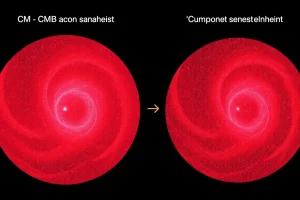
Gravitational lensing—the deflection of CMB photons by intervening matter—remaps the CMB temperature and polarization fields. The deflection field is caused by the gravitational potential of large-scale structure. For polarization, lensing mixes the E and B components: a pure E-mode pattern, when lensed, acquires a B-mode component. This lensing-induced B-mode signal is much larger than the primordial B-mode signal at angular scales below a few degrees (multipole ℓ > ~100). As a result, lensing acts as a contaminant for the detection of primordial gravitational waves, as emphasized in the seminal work by Seljak and Hirata (2004) [3].
However, the lensing signal is not just noise. It is a powerful probe of the distribution of matter between us and the CMB, and it can be reconstructed statistically from the CMB maps using quadratic estimators (Hanson, Challinor, and Lewis 2009) [2]. Once the lensing deflection field is known, it can be used to ‘delens’ the CMB, removing the lensing-induced B-modes to uncover the primordial signal (Lewis and Challinor 2006) [1].
What We Don’t Know
While the lensing effect is well understood theoretically, there are open questions. The exact amplitude of the primordial B-mode signal from inflation is unknown—it depends on the energy scale of inflation, which could be anywhere from about 10¹⁶ GeV (grand unification scale) to much lower. If the tensor-to-scalar ratio r is below about 0.001, the primordial B-mode signal will be buried under lensing noise even for next-generation experiments. Also, the reconstruction of the lensing field has its own noise and biases, which must be carefully modeled.
Evidence
The lensing of the CMB has been detected at high significance by multiple experiments, including the Atacama Cosmology Telescope (ACT), the South Pole Telescope (SPT), and the Planck satellite. The Planck 2018 results, for example, measured the lensing deflection power spectrum to better than 2.5% precision. These measurements are consistent with the predictions of the Lambda-CDM model and provide independent constraints on cosmological parameters like the amplitude of matter fluctuations (σ₈) and the Hubble constant. The lensing-induced B-mode signal has also been directly observed (e.g., by SPTpol and POLARBEAR), confirming the contamination that must be removed for inflationary B-mode searches.
Competing Explanations
While gravitational lensing is the standard explanation for the observed B-mode power at small angular scales, alternative theories—such as cosmic birefringence (rotation of polarization by new physics)—could also produce B-modes. The 2014 paper by Liang Dai [4] discusses how weak lensing itself can rotate the polarization direction, a subtle effect distinct from the generation of B-modes. However, the lensing interpretation is robust and well-supported by the cross-correlation of CMB maps with large-scale structure tracers.
Current Research
Current and future experiments—such as the Simons Observatory, CMB-S4, and the BICEP Array—are designed to measure the lensing B-mode signal with high precision and to perform delensing to push sensitivity to r below 0.001. These efforts will not only test inflation but also map the distribution of dark matter over a large fraction of the sky. The James Webb Space Telescope (JWST) is complementing these efforts by studying the epoch of reionization and the first galaxies, which are the sources of the gravitational potentials that lens the CMB.
Why It Matters
Gravitational lensing of the CMB is both a nuisance and a treasure. It contaminates the primordial B-mode signal that would directly probe the physics of inflation at energy scales far beyond any particle accelerator. But it also provides a unique way to map dark matter, measure the growth of cosmic structure, and test general relativity on large scales. Understanding and removing lensing is essential for the next generation of CMB experiments, which aim to answer some of the deepest questions in cosmology: What happened during the first fraction of a second of the universe? What is dark matter? And why is the universe expanding at an accelerating rate?
Evidence / Sources
The scientific basis for this article rests on key peer-reviewed publications and mission results. The review by Lewis and Challinor (2006) [1] provides a comprehensive treatment of CMB lensing. Hanson, Challinor, and Lewis (2009) [2] detail reconstruction methods. Seljak and Hirata (2004) [3] established lensing as a contaminant for gravity-wave B-modes. Dai (2014) [4] discusses rotation effects. Planck’s 2018 lensing results and the measurements from ACT and SPT are also referenced in the scientific literature.
Related Registry Entries
- Cosmic Microwave Background
- Inflation
- Polarization
- Recombination
- Dark Matter
Last Reviewed: September 5, 2026
FAQ
Why does gravitational lensing convert E-modes to B-modes?
Gravitational lensing remaps the CMB polarization field by displacing the observed direction of incoming light. This remapping mixes the gradient-like E-mode pattern and introduces a curl-like component, which is the B-mode. Even if the intrinsic polarization is pure E-mode, the lensing deflection creates B-modes.
How do cosmologists separate the lensing B-mode from the primordial B-mode?
They use the fact that the lensing B-mode is correlated with the lensing deflection field, which can be reconstructed from the CMB temperature and E-mode maps. By measuring the deflection field, they can predict and subtract the lensing B-mode, a process called delensing. Alternatively, they observe the B-mode power spectrum at large angular scales (low ℓ) where primordial B-modes dominate over lensing.
What is the current status of the search for primordial B-modes?
As of 2026, no definitive detection of primordial B-modes has been made. The best upper limit on the tensor-to-scalar ratio is r < 0.036 (BICEP/Keck 2021). Future experiments like CMB-S4 aim to reach r ~ 0.001, which requires precise delensing.
Leave a Reply