

Short Answer
Main Explanation
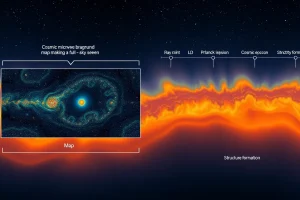
The cosmic microwave background (CMB) is the oldest electromagnetic radiation in the universe — a relic glow that has been traveling toward us since the universe became transparent roughly 380,000 years after the Big Bang. When the DASI experiment first detected polarization in this radiation in 2002, it confirmed a fundamental prediction of the gravitational instability paradigm, the framework explaining how tiny primordial fluctuations grew into the galaxies and large-scale structures we observe today [1][3].
CMB polarization refers to the orientation of the electric field oscillations in the CMB photons. Unlike temperature anisotropies, which map density variations, polarization encodes directional information about the radiation field at the moment of last scattering — specifically, its quadrupole moment [3][4].
Definition
Polarization in cosmology refers to the orientation of the oscillations of electromagnetic waves as they travel through space [2]. In the CMB context, it is the linear polarization pattern imprinted on the radiation by Thomson scattering of photons off free electrons at the last scattering surface. This polarization provides critical information about the early universe’s structure, dynamics, and evolution [2][3].
How It Works
Thomson scattering — the elastic scattering of photons by free electrons — generates linear polarization when the incident radiation field seen by an electron has a quadrupole anisotropy. If an electron is bathed in perfectly isotropic radiation, the scattered light remains unpolarized because the scattered electric field components from all directions cancel. However, when a temperature difference exists between perpendicular directions (a quadrupole pattern), the scattered radiation acquires a net linear polarization [3][4].
This quadrupole anisotropy arises naturally from three types of cosmological perturbations present at the last scattering surface: scalar (compressional) density perturbations, vector (vortical) motions, and tensor (gravitational wave) modes [4].
Equation
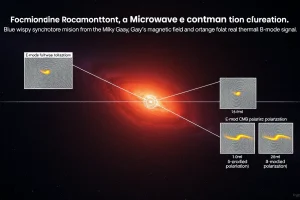
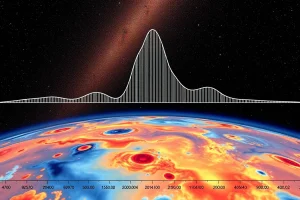
The polarization field on the sky is conventionally described using Stokes parameters Q and U, which characterize linear polarization. From these, one constructs spin-2 spherical harmonics that separate the signal into two parity-defined components: E-modes (curl-free, even parity — unchanged under mirror reflection) and B-modes (divergence-free, odd parity — sign-flipped under mirror reflection) [2][4]. The power spectra CEEℓ and CBBℓ are the primary observables. E-modes are sourced mainly by scalar density perturbations, while B-modes require tensor perturbations (primordial gravitational waves from inflation) or gravitational lensing of E-modes [1][4].
Example
The DASI (Degree Angular Scale Interferometer) experiment at the South Pole made the first detection of CMB polarization in 2002, measuring E-mode polarization at the level of a few microkelvin [1]. Since then, NASA’s WMAP mission (2001–2010) and the European Space Agency’s Planck mission (2009–2013) have mapped CMB polarization across the entire sky with unprecedented precision. Planck delivered the most detailed all-sky maps of both temperature and polarization to date, measuring E-modes with remarkable accuracy and placing stringent upper limits on primordial B-modes [1].
Observable Consequences
- E-mode polarization provides independent confirmation of the standard cosmological model, including the acoustic oscillations in the early plasma and the geometry of the universe [1][3].
- B-modes from primordial gravitational waves would provide direct evidence for cosmic inflation, as tensor perturbations generated during the inflationary epoch produce a unique B-mode signature [1][4].
- CMB lensing — the deflection of CMB photons by the gravitational potential of intervening large-scale structure — converts E-modes into B-modes, allowing cosmologists to map the distribution of matter through cosmic time [1].
Common Misconceptions
- Misconception: CMB polarization measures temperature. Polarization is a distinct observable from temperature, though both derive from the same radiation field. Polarization specifically encodes directional (quadrupole) information about the radiation field at last scattering [3].
- Misconception: All B-modes come from inflation. Gravitational lensing of E-modes generates B-modes at a level that must be carefully modeled and subtracted to isolate any primordial inflationary signal [1].
- Misconception: The CMB is strongly polarized. The polarization signal is extraordinarily faint — only about 5% of the temperature anisotropy, which itself is only one part in 100,000 of the CMB’s 2.7 K temperature [3].
Cosmic Timeline: From Planck Epoch to Present
To fully appreciate the CMB and its polarization, one must place it within the broader narrative of cosmic evolution. The standard Lambda-CDM (ΛCDM) model describes a sequence of epochs, each governed by distinct physical processes.
| Epoch | Time After Big Bang | Temperature | Key Events |
|---|---|---|---|
| Planck epoch | < 10⁻⁴³ s | > 10³² K | Quantum gravity effects dominate; all four fundamental forces unified |
| Grand Unification epoch | 10⁻⁴³ – 10⁻³⁶ s | 10²⁷ – 10³² K | Strong force separates from electroweak force |
| Inflationary epoch | 10⁻³⁶ – 10⁻³² s | ~10²⁷ K | Exponential expansion; quantum fluctuations seeded all cosmic structure |
| Electroweak epoch | 10⁻³² – 10⁻¹² s | 10¹⁵ – 10²⁷ K | Electromagnetic and weak forces separate |
| Quark epoch | 10⁻¹² – 10⁻⁶ s | 10¹² – 10¹⁵ K | Quarks, leptons, and gauge bosons form a quark-gluon plasma |
| Hadron epoch | 10⁻⁶ – 1 s | 10¹⁰ – 10¹² K | Protons and neutrons form; matter–antimatter asymmetry established |
| Lepton epoch | 1 – 10 s | 10⁹ – 10¹⁰ K | Leptons and antileptons dominate; neutrinos decouple |
| Photon epoch (BBN) | 10 s – 380,000 yr | 3,000 – 10⁹ K | Big Bang nucleosynthesis; photons dominate the energy density |
| Recombination | ~380,000 yr | ~3,000 K | Electrons and protons combine to form neutral hydrogen; CMB released |
| Dark Ages | 380,000 – ~150 million yr | ~30 – 3,000 K | No luminous sources; the universe is dark and neutral |
| Reionization | ~150 million – 1 billion yr | ~10 – 30 K | First stars and galaxies ionize the intergalactic medium |
| Structure Formation | ~1 billion yr – present | 2.7 K | Galaxies, clusters, and large-scale structure form under gravity |
Each epoch left its imprint on the CMB. The temperature anisotropies we observe today were seeded during inflation as quantum fluctuations, amplified to cosmic scales, and then frozen into the radiation field at recombination. The polarization pattern, in turn, carries information about the velocity fields and gravitational wave background present at that moment [3][4].
Why It Matters
CMB polarization is not merely a technical measurement — it is one of the most powerful observational windows into the physics of the early universe. The polarization pattern provides a direct test of the gravitational instability paradigm: if the temperature anisotropies we observe are the result of primordial fluctuations, those same fluctuations must have polarized the CMB at the level observed. The verification of CMB polarization by DASI in 2002 thus represents a fundamental confirmation of our basic assumptions about how structure formed in the universe [3].
Beyond confirmation, polarization promises to unlock new physics. The search for primordial B-modes is one of the most active frontiers in cosmology, as their detection would provide direct evidence for inflation and for gravitational waves generated during the first fractions of a second after the Big Bang [1][4]. Even the absence of a primordial B-mode signal constrains inflationary models, narrowing the parameter space of possible theories.
Polarization also enables precision cosmology. E-mode polarization measurements improve constraints on cosmological parameters — the Hubble constant, the baryon density, the spectral index of primordial fluctuations — by breaking degeneracies that limit temperature-only analyses. The COBE mission first detected temperature anisotropies in 1992, WMAP refined them, and Planck pushed both temperature and polarization measurements to their current precision. Together with ground-based experiments like ACT and the South Pole Telescope, these missions have established the ΛCDM model as the consensus framework for cosmic evolution [1].
Evidence / Sources
Key evidence for CMB polarization comes from multiple experiments spanning more than two decades:
- DASI (2002): First detection of CMB polarization, confirming theoretical predictions and opening the field of CMB polarimetry [1].
- WMAP (2001–2010): NASA mission that mapped CMB temperature and polarization anisotropies across the full sky, providing precise constraints on cosmological parameters.
- Planck (2009–2013): ESA mission that delivered the most detailed all-sky maps of CMB temperature and polarization, measuring E-modes with unprecedented precision and placing upper limits on primordial B-modes [1].
- Ground-based experiments: BICEP/Keck Array, the Atacama Cosmology Telescope (ACT), and the South Pole Telescope (SPT) have continued to push the sensitivity of polarization measurements, particularly in the search for B-modes [1].
Related Registry Entries
Explore related topics in the cosmology knowledge base:
- E-modes and B-modes — The geometric decomposition of CMB polarization patterns into even-parity (curl-free) and odd-parity (divergence-free) components.
- Cosmic Inflation — The exponential expansion in the first instants of the universe that seeded the fluctuations observed in the CMB.
- Recombination — The epoch when electrons and protons combined to form neutral hydrogen, releasing the CMB.
- ΛCDM Model — The standard cosmological model that CMB polarization measurements help constrain.
FAQ
What is CMB polarization?
CMB polarization is the faint linear polarization pattern in the cosmic microwave background radiation, produced by Thomson scattering of CMB photons off free electrons at the last scattering surface. It encodes directional (quadrupole) information about the radiation field about 380,000 years after the Big Bang.
Why is CMB polarization important?
CMB polarization provides a direct test of the gravitational instability paradigm, confirms the standard cosmological model, and offers a unique probe of cosmic inflation. The search for primordial B-mode polarization is one of the most active frontiers in cosmology, as detecting it would provide direct evidence for gravitational waves generated during inflation.
What are E-modes and B-modes?
E-modes and B-modes are two geometric components of CMB polarization. E-modes are curl-free, even-parity patterns generated primarily by scalar density perturbations. B-modes are divergence-free, odd-parity patterns that can be generated by tensor perturbations (primordial gravitational waves from inflation) or by gravitational lensing of E-modes.
Has primordial B-mode polarization been detected?
As of the most recent published results, primordial B-mode polarization has not been definitively detected. Experiments like BICEP/Keck and Planck have placed increasingly stringent upper limits on the tensor-to-scalar ratio, constraining but not yet confirming inflationary models that predict detectable B-modes.
Leave a Reply