
Short Answer
Main Explanation
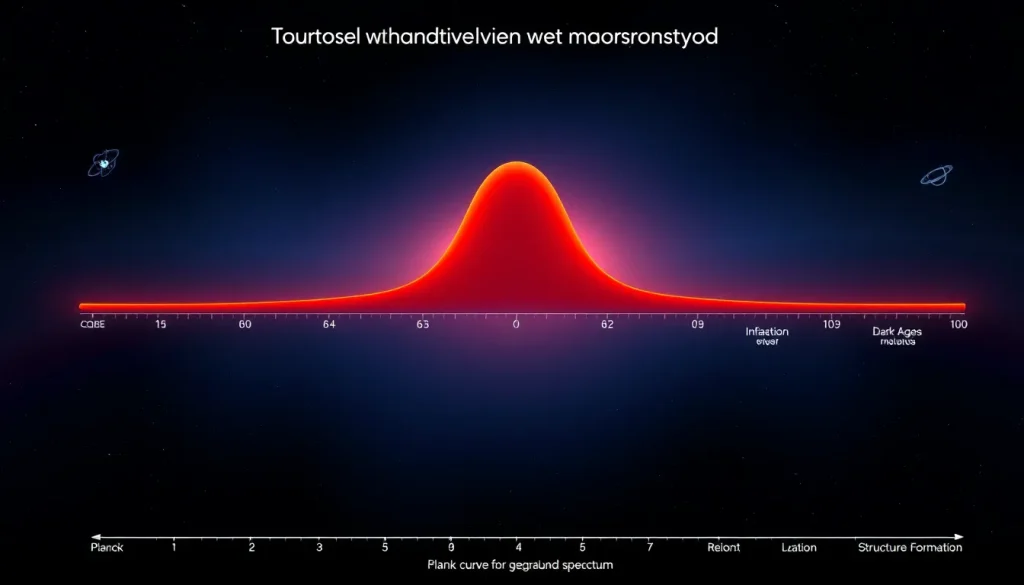
The cosmic microwave background (CMB) is the oldest light in the universe, a faint glow that fills all of space. Its spectrum — the distribution of intensity across wavelengths — is the most precise blackbody ever observed, matching a theoretical Planck curve at a temperature of 2.725 ± 0.001 K to better than one part in 10,000 (as measured by the FIRAS instrument on NASA’s COBE satellite). This extraordinary precision is not a cosmic accident; it is a direct consequence of the physics of the hot, dense early universe and the expansion of space itself.
In the first moments after the Big Bang, the universe was a plasma of photons, electrons, protons, and other particles in thermal equilibrium. Frequent scattering between photons and charged particles — especially Thomson scattering off free electrons — kept the radiation in a blackbody state. Any deviation from a perfect thermal distribution would have been rapidly erased by these interactions, which exchange energy and change photon number. The high photon-to-baryon ratio (about 1.6 × 10⁹ photons per baryon) also helped: with so many photons, each scattering event brings the distribution closer to equilibrium.
As the universe expanded, it cooled. When the temperature dropped to about 3,000 K — roughly 380,000 years after the Big Bang — protons and electrons combined to form neutral hydrogen, a process called recombination. With free electrons disappearing, photons decoupled from matter and have streamed freely ever since. The crucial point is that the expansion of space stretches the wavelength of all photons uniformly. A blackbody spectrum retains its shape under this adiabatic expansion: the temperature decreases as T ∝ 1/a (where a is the scale factor), but the spectrum remains Planckian. This is why the CMB we observe today, with a temperature of 2.725 K, is still a perfect blackbody — it is the same thermal distribution from the decoupling epoch, cooled by a factor of about 1,100.
The CMB’s blackbody perfection is a cornerstone of modern cosmology. It confirms that the early universe was in thermal equilibrium, supports the hot Big Bang model, and rules out many alternative theories. It also provides a pristine snapshot of the universe at recombination, encoding information about density fluctuations that seeded galaxies and clusters. Later missions, including NASA’s WMAP and the European Space Agency’s Planck, mapped the tiny temperature anisotropies (at the level of 1 part in 100,000) that reveal the composition, geometry, and evolution of the cosmos.
Cosmic Epochs: From Planck to Present
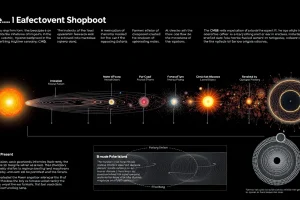
The CMB is a relic of a specific epoch, but to understand its perfection we must place it in the broader timeline of cosmic history. Below is a table of the major epochs, from the very beginning to the era of structure formation.
| Epoch | Time after Big Bang | Temperature | Key Events |
|---|---|---|---|
| Planck epoch | < 10−43 s | > 1032 K | Quantum gravity effects; unification of forces |
| Grand Unification epoch | 10−43 – 10−36 s | 1028 – 1032 K | Strong force separates; possible inflation begins |
| Inflationary epoch | 10−36 – 10−32 s | ~1027 K (during) | Exponential expansion; seeds of structure generated |
| Electroweak epoch | 10−32 – 10−12 s | 1015 – 1028 K | Electromagnetic and weak forces separate |
| Quark epoch | 10−12 – 10−6 s | 1012 – 1015 K | Quarks and gluons form quark-gluon plasma |
| Hadron epoch | 10−6 – 1 s | 1010 – 1012 K | Protons and neutrons form; matter-antimatter annihilation |
| Lepton epoch | 1 – 10 s | 109 – 1010 K | Leptons dominate; neutrinos decouple |
| Photon epoch | 10 s – 380,000 yr | 109 K down to 3,000 K | Photons dominate; Big Bang nucleosynthesis (first 3 min) |
| Recombination | ~380,000 yr | ~3,000 K | Electrons and protons form hydrogen; photons decouple (CMB released) |
| Dark Ages | 380,000 yr – ~150 million yr | 3,000 K down to ~60 K | No stars; universe is dark and neutral |
| Reionization | ~150 million – 1 billion yr | ~60 K down to ~20 K | First stars and galaxies form; reionize intergalactic medium |
| Structure Formation | 1 billion yr – present | 20 K down to 2.725 K | Galaxies, clusters, and large-scale structure assemble |
Each epoch is defined by the dominant particles and interactions. The CMB’s blackbody spectrum was established during the photon epoch, when thermal equilibrium reigned. After recombination, the radiation cooled but retained its shape, making it a direct probe of conditions at that early time.
Concept
Definition
A blackbody is an idealized object that absorbs all incident radiation and emits radiation with a spectrum that depends only on its temperature. The CMB is not a physical object but a radiation field that follows the Planck law to extraordinary precision, making it the best natural approximation to a blackbody ever observed.
How It Works
In the early universe, photons interacted frequently with free electrons and protons via Thomson scattering and other processes. These interactions forced the photon distribution into thermal equilibrium, characterized by a single temperature. As the universe expanded, the photon wavelengths stretched, but the distribution remained Planckian. The temperature dropped, but the spectral shape was preserved.
Equation
The Planck law gives the specific intensity of blackbody radiation:
Bν(T) = (2hν3/c2) × 1/[exp(hν/kBT) − 1]
where h is Planck’s constant, ν is frequency, c is the speed of light, kB is Boltzmann’s constant, and T is temperature. The CMB follows this exactly.
Example
The FIRAS instrument on COBE measured the CMB spectrum from 60 to 600 GHz and found it to be a blackbody at 2.725 K with no deviations larger than 50 parts per million of the peak intensity. This is like measuring a perfectly smooth curve to a precision finer than the width of a human hair across a football field.
Observable Consequences
The blackbody nature of the CMB implies that the early universe was in thermal equilibrium. It also sets a strict upper limit on any energy release after recombination (e.g., from decaying particles or cosmic strings). The CMB’s temperature is isotropic to about 1 part in 100,000, and those tiny anisotropies carry the seeds of cosmic structure.
Common Misconceptions
One misconception is that the CMB is a blackbody because it is emitted by a hot gas. In reality, the CMB is not emitted by any current source; it is a relic of the hot Big Bang. Another is that the CMB has a temperature because it is in thermal equilibrium today; in fact, the photons have not interacted since decoupling, but the expansion preserves the blackbody shape. Finally, some think the CMB is perfect; in reality, it has tiny spectral distortions (at levels below 10−5), which are a rich target for future experiments.
Why It Matters
The perfection of the CMB blackbody is not just a curiosity — it is one of the pillars of the Big Bang model. It rules out the steady-state theory and other alternatives, confirms that the universe went through a hot, dense phase, and provides a precise calibration for all other cosmological measurements. The CMB’s anisotropies, measured by COBE, WMAP, and Planck, have allowed cosmologists to determine the universe’s age, composition (5% ordinary matter, 27% dark matter, 68% dark energy), geometry (flat), and the seeds of structure. The blackbody spectrum also enables us to measure the CMB temperature as a function of redshift, confirming the adiabatic expansion of space. Future missions, such as the Simons Observatory and CMB-S4, aim to detect primordial gravitational waves via B-mode polarization and to hunt for spectral distortions that could reveal new physics in the early universe.
Evidence / Sources
The primary evidence for the CMB’s blackbody perfection comes from the FIRAS instrument on NASA’s COBE satellite, which measured the spectrum to extraordinary precision. The results were published by Fixsen and Mather (2002) and are summarized in the NASA Technical Reports Server document. Additional theoretical context is provided by Wayne Hu’s lecture notes on CMB theory and by Chluba (2025) on spectral distortions. The standard cosmological model (ΛCDM) is consistent with all these observations.
Related Registry Entries
FAQ
Why is the CMB a perfect blackbody?
The CMB is a perfect blackbody because it originated from a state of thermal equilibrium in the hot early universe. Frequent photon-electron scattering maintained a Planck distribution, and the expansion of space preserved that distribution while cooling the temperature.
What did COBE/FIRAS measure?
COBE's FIRAS instrument measured the CMB spectrum from 60 to 600 GHz and found it to match a 2.725 K blackbody curve with deviations smaller than 50 parts per million, confirming its perfect blackbody nature.
Does the CMB have any spectral distortions?
Yes, tiny distortions are predicted at levels below 10⁻⁵, arising from processes like the damping of small-scale fluctuations and the reionization of the universe. These are a major target for future experiments.
How does the CMB's blackbody shape survive the expansion of the universe?
The expansion of space stretches all photon wavelengths uniformly, which shifts the temperature but preserves the Planckian shape. This is a consequence of the adiabatic expansion of a blackbody radiation field.
Leave a Reply