
Short Answer
Main Explanation
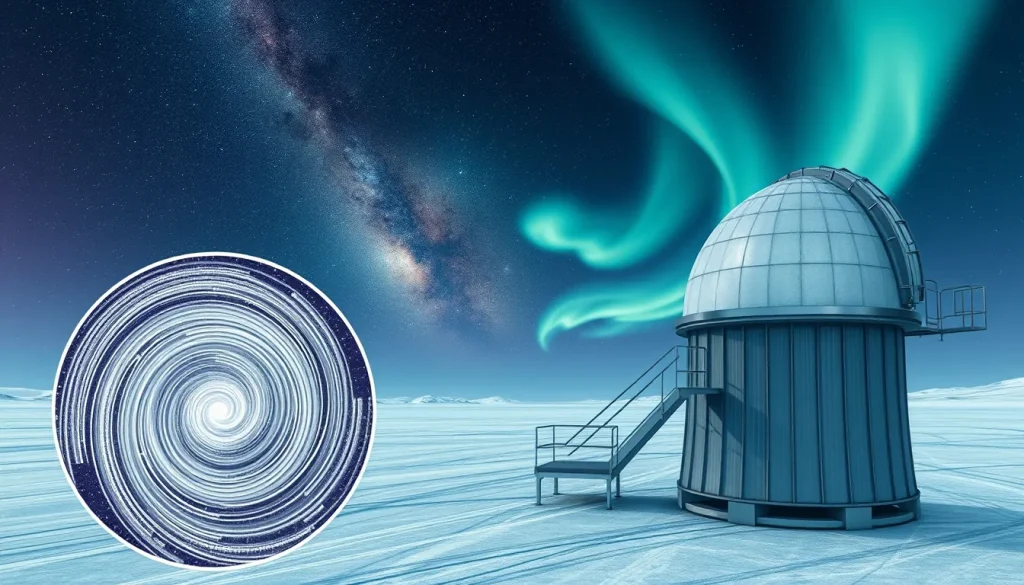
The BICEP (Background Imaging of Cosmic Extragalactic Polarization) and Keck Array experiments are a series of cryogenic telescopes located at the Amundsen-Scott South Pole Station in Antarctica. Their mission is to measure the polarization of the cosmic microwave background (CMB) — the faint afterglow of the Big Bang — in search of a signal from primordial gravitational waves.
These gravitational waves, predicted by “slow roll” models of cosmic inflation, would have been generated during a brief period of exponential expansion in the first fraction of a second after the Big Bang. They would leave a distinctive imprint on the CMB: a pattern of polarization known as B-modes.
The experiments have gone through five generations: BICEP1, BICEP2, the Keck Array, BICEP3, and the BICEP Array. Each generation has increased the number of detectors and improved sensitivity. The telescopes operate at frequencies of 95, 150, and 220 GHz, chosen to distinguish the faint CMB signal from foreground emission by galactic dust. As of 2025, the BICEP/Keck collaboration has not detected primordial gravitational waves; however, their observations have set the tightest constraints to date on the amplitude of these waves, ruling out many inflation models.
Mission: BICEP/Keck Array
Mission Facts
- Location: Amundsen-Scott South Pole Station, Antarctica
- Coordinates: 89°59′59″S 0°00′00″E
- Frequencies: 95, 150, 220 GHz
- Generations: BICEP1, BICEP2, Keck Array, BICEP3, BICEP Array
- First results: March 2014
- Latest data release: BK18 (October 2021)
Telescope and Instrument
The BICEP telescopes are cryogenic refracting telescopes equipped with arrays of superconducting detectors. BICEP3, the current instrument, has a 0.25-meter-diameter aperture and is shielded by a metal skirt that blocks reflected light from the surrounding ice.
Wavelength
The instruments observe at three frequency bands: 3.2 mm (95 GHz), 2.0 mm (150 GHz), and 1.4 mm (220 GHz). Multi-frequency observations are essential for separating the faint CMB signal from foreground emission by galactic dust.
Objective
To measure the polarization of the CMB and detect the B-mode polarization pattern produced by primordial gravitational waves generated during cosmic inflation.
Major Results
In March 2014, the BICEP2 team announced the detection of B-mode polarization. However, a subsequent joint analysis with Planck data (the BKP analysis) revealed that the signal could be entirely attributed to galactic dust. The BK18 analysis, which combined BICEP/Keck observations through the 2018 observing season with Planck and WMAP data, set an upper limit on the tensor-to-scalar ratio of r < 0.036 at 95% confidence — the tightest constraint to date. More recent papers (BK-XX and BK-XXI, 2026) have further refined component-separated maps and explored early-universe parity violation.
Dataset
The collaboration has released multiple data products, including BK14, BK15, BK18, and the BKP joint analysis with Planck. The BK18 data products were released in October 2021.
Legacy
BICEP/Keck has demonstrated that ground-based CMB polarization measurements can achieve the sensitivity required to probe inflation. The techniques developed by the collaboration are being carried forward in the BICEP Array and future CMB experiments.
Cosmic Epochs: A Timeline of the Universe
The universe evolved through a series of distinct epochs, each governed by different physical processes. The table below summarizes the major phases from the Planck epoch to the present day.
| Epoch | Time After Big Bang | Temperature | Key Events |
|---|---|---|---|
| Planck Epoch | 0 to 10⁻⁴³ s | >10³² K | All four fundamental forces unified; quantum gravity dominates |
| Grand Unification Epoch | 10⁻⁴³ to 10⁻³⁶ s | 10²⁸–10³² K | Strong force separates from electroweak force |
| Inflationary Epoch | ~10⁻³⁶ to 10⁻³² s | ~10²⁸ K | Exponential expansion; quantum fluctuations stretched to cosmic scales |
| Electroweak Epoch | 10⁻³² to 10⁻¹² s | 10¹⁵–10²⁸ K | Higgs mechanism gives particles mass; electromagnetic and weak forces separate |
| Quark Epoch | 10⁻¹² to 10⁻⁶ s | 10¹²–10¹⁵ K | Quarks and gluons form a quark-gluon plasma |
| Hadron Epoch | 10⁻⁶ to 1 s | 10¹⁰–10¹² K | Protons and neutrons form |
| Lepton Epoch | 1 to 10 s | 10⁹–10¹⁰ K | Leptons dominate; neutrinos decouple |
| Photon Epoch | 10 s to 380,000 yr | 3,000–10⁹ K | Photons dominate; Big Bang nucleosynthesis produces light elements |
| Recombination | ~380,000 yr | ~3,000 K | Electrons combine with protons to form neutral hydrogen; CMB released |
| Dark Ages | 380,000 to ~150 million yr | ~3,000 to ~50 K | Universe dark; gravity begins to assemble structure |
| Reionization | ~150 million to ~1 billion yr | ~50 to ~20 K | First stars and galaxies form; ultraviolet light reionizes hydrogen |
| Structure Formation | ~1 billion yr to present | <20 K | Galaxies, clusters, and large-scale structure assemble |
The cosmic microwave background is the relic radiation released at recombination, approximately 380,000 years after the Big Bang. As the universe expanded, this radiation was stretched (redshifted) to microwave wavelengths, and its temperature cooled to the 2.7 K we observe today. Missions such as COBE, WMAP, and Planck have mapped the CMB with extraordinary precision, revealing tiny temperature fluctuations that seeded the formation of galaxies and clusters. The James Webb Space Telescope (JWST) is now probing the era of reionization and the first galaxies.
Measurement: The Tensor-to-Scalar Ratio
The key parameter that BICEP/Keck measures is the tensor-to-scalar ratio, r, which quantifies the amplitude of primordial gravitational waves relative to the density perturbations that seeded galaxy formation.
- Value: r < 0.036 (95% confidence), from BK18 + Planck + WMAP
- Units: Dimensionless
- Instrument: BICEP3 and the Keck Array
- Method: Measurement of B-mode polarization in the CMB at multiple frequencies, with component separation to remove galactic dust foregrounds
- Uncertainty: The upper limit is the tightest available. Future instruments aim to push sensitivity to r ~ 0.001
- Dataset: BK18 (BICEP/Keck through the 2018 observing season, combined with Planck and WMAP)
Why It Matters
The detection of primordial gravitational waves would be a direct probe of cosmic inflation — the leading theory of the universe’s first fraction of a second. It would reveal physics at energy scales far beyond what particle accelerators can reach, and would confirm that quantum fluctuations were stretched to cosmic scales during inflation. The BICEP/Keck program, by setting ever-tighter upper limits on r, is progressively narrowing the range of viable inflation models and guiding the design of next-generation experiments. Understanding the full sequence of cosmic epochs — from the Planck epoch through recombination to structure formation — is essential for interpreting what BICEP/Keck is looking for: the earliest possible imprint of quantum gravity and the seeds of everything we see today.
Evidence / Sources
- BICEP/Keck official website: bicepkeck.org
- Ade et al. (BICEP/Keck Collaboration), “Improved Constraints on Primordial Gravitational Waves using Planck, WMAP, and BICEP/Keck Observations through the 2018 Observing Season,” Phys. Rev. Lett. 127, 151301 (2021)
- Wikipedia: BICEP and Keck Array
- Center for Astrophysics | Harvard & Smithsonian: BICEP
Related Registry Entries
- Cosmic Microwave Background: The relic radiation from the Big Bang, released at recombination.
- Cosmic Inflation: The brief period of exponential expansion in the first fraction of a second.
- B-Mode Polarization: The curl-like polarization pattern in the CMB that would reveal primordial gravitational waves.
- Tensor-to-Scalar Ratio (r): The parameter quantifying the amplitude of primordial gravitational waves relative to density perturbations.
Last reviewed: September 5, 2026
FAQ
What did BICEP2 announce in March 2014?
The BICEP2 team announced the detection of B-mode polarization in the CMB, which they interpreted as evidence of primordial gravitational waves. However, a subsequent joint analysis with Planck data (BKP) showed that the signal could be entirely explained by galactic dust foreground emission.
What are B-modes in the CMB?
B-modes are a specific curl-like pattern in the polarization of the cosmic microwave background. They can be produced by primordial gravitational waves from inflation (the signal BICEP/Keck searches for) or by gravitational lensing of E-mode polarization by intervening matter.
Has BICEP/Keck detected primordial gravitational waves?
No. As of 2025, the BICEP/Keck collaboration has not detected primordial gravitational waves. The BK18 analysis set an upper limit of r < 0.036 at 95% confidence, ruling out many but not all inflation models.
Why is the South Pole an ideal location for BICEP/Keck?
The South Pole offers an extremely dry, high-altitude atmosphere with minimal water vapor, which is crucial for observing the faint microwave signals from the CMB. The stable atmospheric conditions and the ability to observe a fixed patch of sky year-round also help.
What is the tensor-to-scalar ratio r?
The tensor-to-scalar ratio r is a dimensionless parameter that measures the amplitude of primordial gravitational waves (tensor perturbations) relative to the density fluctuations (scalar perturbations) that seeded galaxy formation. A detection of r > 0 would confirm inflation and reveal the energy scale at which it occurred.

Leave a Reply