Short Answer
Short Answer: The James Webb Space Telescope (JWST) studies the early universe by observing infrared light from distant galaxies and quasars, whose light has been stretched by cosmic expansion. Because light takes time to travel, looking farther away means looking further back in time. JWST’s infrared sensitivity allows it to see the first stars and galaxies that formed within the first billion years after the Big Bang, as well as the epoch of reionization and the cosmic dawn.
| Mission | James Webb Space Telescope (JWST) |
|---|---|
| Launch | December 25, 2021 |
| Wavelength | Infrared (0.6–28.5 μm) |
| Primary Goal | Study the first galaxies, reionization, and the assembly of structure |
| Key Instruments | NIRCam, NIRSpec, MIRI, FGS/NIRISS |
| Orbit | Sun–Earth L2 Lagrange point |
Main Explanation
The universe began about 13.8 billion years ago in a hot, dense state known as the Big Bang. Over time, it expanded and cooled, passing through a series of distinct epochs. JWST, with its large mirror and infrared instruments, is uniquely suited to observe the light from the earliest cosmic eras, which has been redshifted into the infrared by the expansion of space.
When astronomers use a telescope to look farther away, they are also looking back in time. JWST’s view of the interacting galaxies Arp 107, for example, includes both near- and mid-infrared light, revealing star-formation history and collision details. Near-infrared light shows older stars, while mid-infrared highlights young stars and star-forming regions. This capability is essential for probing the early universe.
The Cosmic Epochs
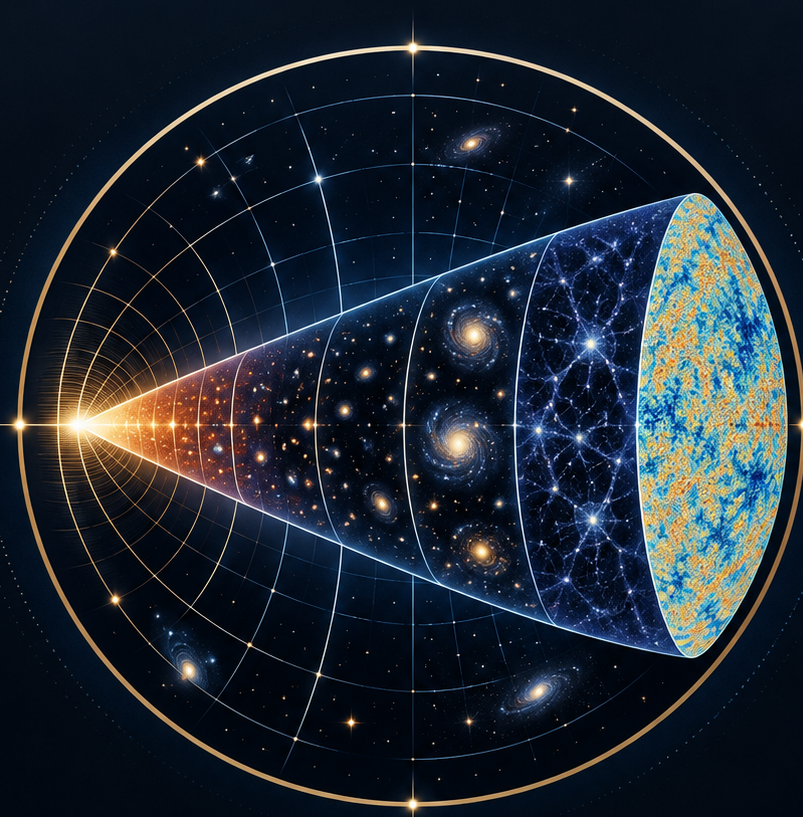
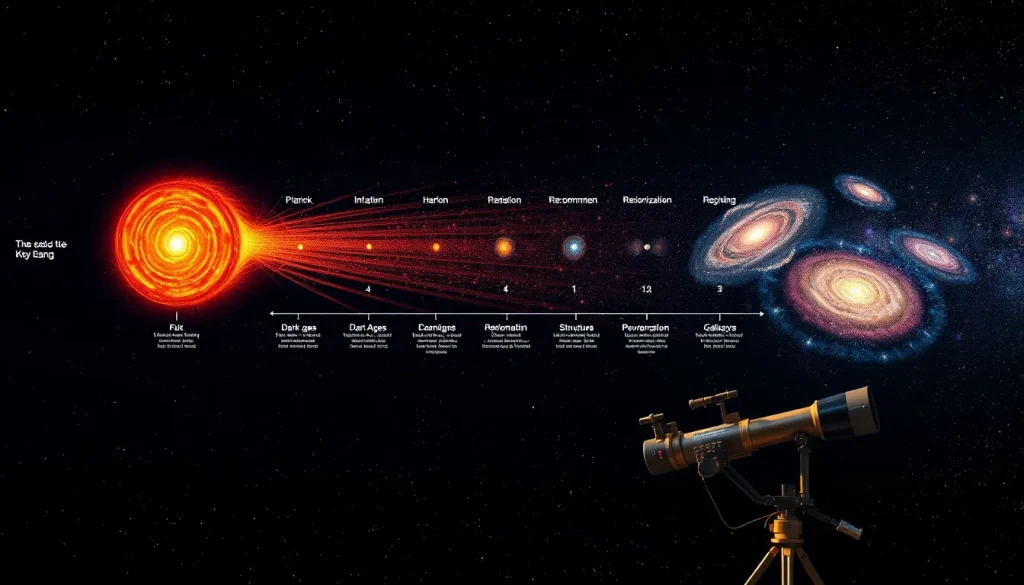
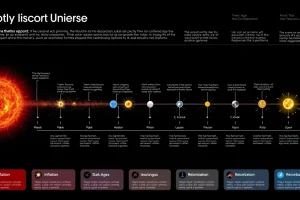
The standard model of cosmology (ΛCDM) describes a sequence of epochs from the Planck era to the present. Below is a timeline of the major phases, with approximate times, temperatures, and redshifts.
| Epoch | Time After Big Bang | Temperature | Redshift (z) | Key Events |
|---|---|---|---|---|
| Planck Epoch | < 10⁻⁴³ s | > 10³² K | — | Quantum gravity effects dominate; no current theory fully describes this era. |
| Grand Unification Epoch | 10⁻⁴³ – 10⁻³⁶ s | 10²⁷ – 10³² K | — | Strong and electroweak forces unified; inflation begins at the end. |
| Inflationary Epoch | 10⁻³⁶ – 10⁻³² s | ~10²⁷ K | — | Exponential expansion; quantum fluctuations seeded large-scale structure. |
| Electroweak Epoch | 10⁻³² – 10⁻¹² s | 10¹⁵ – 10²⁷ K | — | Electromagnetic and weak forces separate; particles acquire mass. |
| Quark Epoch | 10⁻¹² – 10⁻⁶ s | 10¹² – 10¹⁵ K | — | Quarks and gluons form a quark–gluon plasma. |
| Hadron Epoch | 10⁻⁶ – 1 s | 10¹⁰ – 10¹² K | — | Protons and neutrons form; matter–antimatter asymmetry established. |
| Lepton Epoch | 1 – 10 s | 10⁹ – 10¹⁰ K | — | Leptons dominate; neutrinos decouple. |
| Photon Epoch | 10 s – 380,000 yr | 3,000 – 10⁹ K | ~1,100 | Photons dominate; Big Bang nucleosynthesis creates light elements. |
| Recombination | ~380,000 yr | ~3,000 K | ~1,100 | Electrons combine with protons to form neutral hydrogen; universe becomes transparent; CMB released. |
| Dark Ages | 380,000 – ~150 million yr | ~3,000 – 50 K | 1,100 – 20 | No luminous sources; neutral hydrogen fills the universe. |
| Reionization | ~150 million – 1 billion yr | ~50 – 10 K | 20 – 6 | First stars and galaxies form; their ultraviolet light reionizes hydrogen. |
| Structure Formation | 1 billion yr – present | < 10 K | < 6 | Galaxies cluster; dark matter halos grow; large-scale structure emerges. |
When It Happened
The earliest epochs occurred within the first second after the Big Bang, while recombination happened at 380,000 years. The Dark Ages lasted until about 150 million years, and reionization spanned from roughly 150 million to 1 billion years.
Temperature
Temperatures ranged from the unimaginable heat of the Planck epoch (over 10³² K) to the cool 3,000 K at recombination, and down to a few tens of kelvin during the Dark Ages.
Approximate Redshift
Redshift z measures how much the universe has expanded since light was emitted. Recombination corresponds to z ≈ 1,100; the first galaxies are seen at z ≈ 10–15; reionization ends around z ≈ 6.
Dominant Particles/Physics
Early epochs were governed by quantum gravity, grand unified theories, and particle physics. After recombination, neutral hydrogen and dark matter dominated. During reionization, radiation from massive stars and accreting black holes reionized the intergalactic medium.
What Happened
Inflation stretched quantum fluctuations to cosmic scales, seeding density variations. Nucleosynthesis produced helium and trace lithium. Recombination released the cosmic microwave background (CMB). The first stars (Population III) formed in dark matter halos, ending the Dark Ages and initiating reionization.
What Came Before
Each epoch followed from the previous one as the universe cooled and expanded. The Planck epoch is the earliest we can describe; before it, our physics breaks down.
What Came Next
After reionization, the universe became transparent to ultraviolet light, and galaxies continued to grow and merge, eventually forming the large-scale structure we see today.
Evidence
Key evidence includes the CMB (discovered by Penzias and Wilson, mapped by COBE, WMAP, and Planck), the primordial abundances of light elements, and JWST’s deep-field images and spectra of high-redshift galaxies. JWST has confirmed galaxies at z > 10, showing that structure formed earlier than previously thought.
Why It Matters
Understanding the early universe is fundamental to cosmology. JWST’s observations are rewriting textbooks: it has found galaxies that are more luminous and more massive than expected at early times, and it is probing the sources of reionization. These results test the ΛCDM model and may reveal new physics, such as the nature of dark matter or the details of inflation.
Evidence / Sources
- NASA Science: How Can Webb Study the Early Universe?
- Nature Astronomy: The first billion years according to JWST (2025)
- arXiv: Observations of the First Galaxies in the Era of JWST (2025)
- Annual Review: Galaxy Formation and Reionization (2022)
Related Registry Entries
- Cosmic Microwave Background
- Reionization
- First Stars & Galaxies
- Inflation
- Dark Ages
Last Reviewed: September 4, 2026
FAQ
How does JWST see the early universe?
JWST observes infrared light from distant galaxies. Because light takes time to travel, looking farther away means looking back in time. The expansion of the universe stretches ultraviolet and visible light from early galaxies into the infrared, which JWST is designed to detect.
What is the cosmic microwave background?
The CMB is the leftover radiation from the Big Bang, emitted about 380,000 years later when the universe cooled enough for electrons and protons to form neutral hydrogen. It provides a snapshot of the universe at that early time and is a key evidence for the Big Bang model.
What did JWST discover about the first galaxies?
JWST has found galaxies at redshifts greater than 10, meaning they existed less than 500 million years after the Big Bang. Some are more massive and luminous than expected, challenging previous models of galaxy formation and suggesting that star formation began earlier and more efficiently than thought.
Leave a Reply