Short Answer
Main Explanation
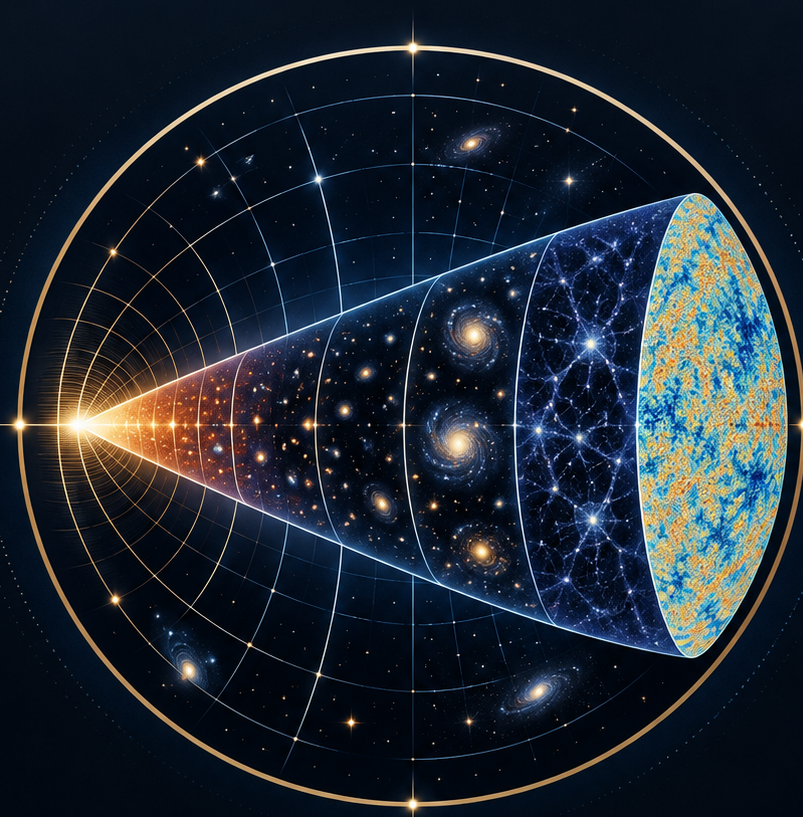
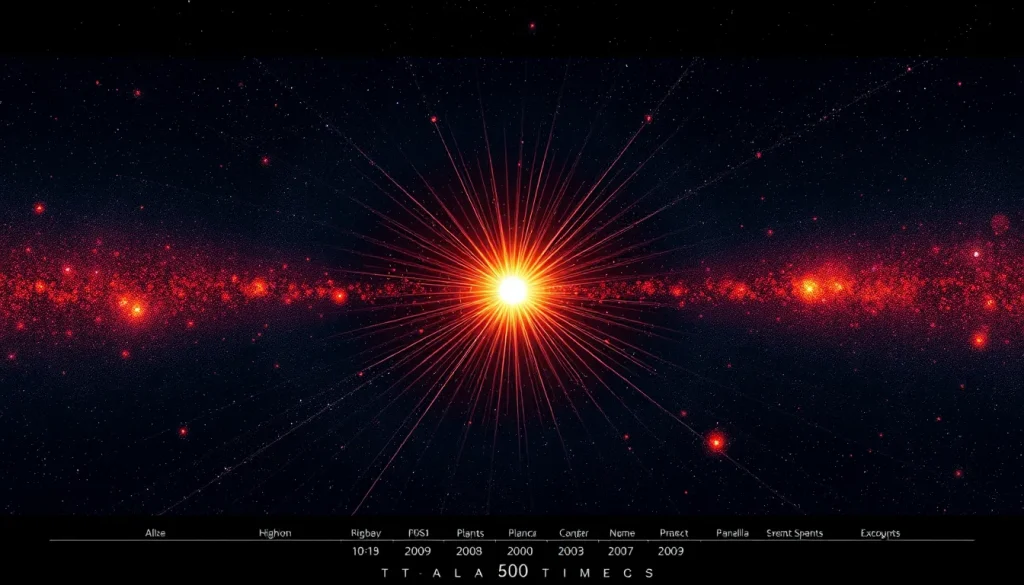
The question “Where did the Big Bang happen?” is one of the most common and most misunderstood in cosmology. The intuitive picture of an explosion—a fireball expanding outward from a point—is deeply misleading. In reality, the Big Bang was not an explosion in space; it was an explosion of space itself. According to the standard ΛCDM model, the universe began as a hot, dense state about 13.8 billion years ago, and has been expanding and cooling ever since. Crucially, this expansion happens uniformly everywhere, so there is no unique “location” where the Big Bang occurred.
To understand this, consider the surface of a balloon being inflated. An ant living on the balloon’s surface sees every other point moving away from it, with no point that is the “center” of the expansion. In the same way, we observe that distant galaxies recede from us in all directions, and observers in any other galaxy would see the same pattern. This is a direct consequence of the cosmological principle—the assumption that the universe is homogeneous and isotropic on large scales, which is strongly supported by observations of the cosmic microwave background (CMB).
The Big Bang did not happen at a point because the universe itself was once a point—but that point was not located in some pre-existing space. Instead, space and time came into existence at that instant. Thus, the Big Bang happened everywhere in the sense that every region of today’s universe originated from that initial state.
The Cosmic Epochs
The history of the universe is divided into distinct epochs, each characterized by different physical conditions and dominant particles. Here is a timeline of the major phases:
| Epoch | Time After Big Bang | Temperature | Key Events |
|---|---|---|---|
| Planck Epoch | 0 to ~10⁻⁴³ s | ~10³² K | Quantum gravity dominates; all four fundamental forces unified. |
| Grand Unification Epoch | 10⁻⁴³ to 10⁻³⁶ s | 10²⁷–10³² K | GUT force separates from gravity; inflation may begin. |
| Inflationary Epoch | 10⁻³⁶ to 10⁻³² s | Dropping rapidly | Exponential expansion; quantum fluctuations become seeds for structure. |
| Electroweak Epoch | 10⁻³² to 10⁻¹² s | 10¹⁵–10²⁷ K | Electromagnetic and weak forces separate; quarks and leptons form. |
| Quark Epoch | 10⁻¹² to 10⁻⁶ s | 10¹²–10¹⁵ K | Quarks and gluons exist in a quark-gluon plasma. |
| Hadron Epoch | 10⁻⁶ to 1 s | 10¹⁰–10¹² K | Quarks combine into protons and neutrons; matter-antimatter asymmetry emerges. |
| Lepton Epoch | 1 s to ~10 s | 10⁹–10¹⁰ K | Leptons dominate; neutrinos decouple. |
| Photon Epoch | 10 s to ~380,000 yr | 10⁴–10⁹ K | Photons dominate; nuclei form (Big Bang nucleosynthesis). |
| Recombination | ~380,000 yr | ~3000 K | Electrons combine with nuclei to form neutral atoms; universe becomes transparent. |
| Dark Ages | 380,000 yr to ~150 million yr | ~10–3000 K | No stars yet; the universe is dark and filled with neutral hydrogen. |
| Reionization | ~150 million yr to ~1 billion yr | ~10–100 K | First stars and galaxies ionize hydrogen again. |
| Structure Formation | 1 billion yr to present | ~2.7 K | Galaxies, clusters, and large-scale structure form under gravity; dark energy accelerates expansion. |
Each epoch left imprints on the observable universe. The most famous relic is the cosmic microwave background—light emitted at recombination, now redshifted to microwave wavelengths. It provides a snapshot of the universe when it was just 380,000 years old, and its tiny temperature fluctuations (at the level of one part in 100,000) are the seeds from which galaxies and clusters grew.
Inflation and the “Everywhere” Nature
Cosmic inflation, proposed in the 1980s, explains why the universe appears so uniform and flat. It posits a brief period of exponential expansion in the first fraction of a second, which stretched quantum fluctuations to cosmic scales. Inflation also solves the “horizon problem”: regions of the sky that are now far apart were once in causal contact before inflation. Because inflation happened everywhere, the uniformity we observe is a natural consequence.
The fact that the Big Bang happened everywhere is not just a philosophical statement—it has observable consequences. If the Big Bang had occurred at a single point, we would expect to see a preferred direction in the sky, a “center” toward which the universe collapses. Instead, the CMB is remarkably isotropic, and galaxy surveys show no preferred direction. This is consistent with the idea that every point in space is equivalent.
Question Article
What We Know
We know that the universe is expanding uniformly, as described by the Hubble–Lemaître law. We know that the CMB has a nearly perfect blackbody spectrum at 2.725 K, with anisotropies that match the predictions of inflationary ΛCDM. We know that the abundances of light elements (hydrogen, helium, lithium) match Big Bang nucleosynthesis calculations. These observations all support the conclusion that the Big Bang was a space-filling event, not a localized explosion.
What We Don’t Know
We do not know what happened before the Planck epoch, or whether the universe underwent a “bounce” or had a pre-Big Bang phase. We also do not know the exact nature of dark matter and dark energy, which together make up about 95% of the universe’s energy density. The ultimate fate of the universe—whether it will expand forever, recollapse, or undergo a “Big Rip”—remains uncertain.
Evidence
- Cosmic Microwave Background: The uniformity of the CMB (to one part in 100,000) shows that the early universe was extremely homogeneous, as expected if the Big Bang happened everywhere.
- Galaxy Redshift Surveys: Maps of galaxy positions show no large-scale structure that would indicate a center or edge.
- Expansion Rate: The linear relationship between distance and recession velocity (Hubble’s law) holds in every direction.
Competing Explanations
Alternatives to the standard model, such as steady-state theory or plasma cosmology, have been ruled out by the discovery of the CMB and the observed evolution of galaxies. Some modified-gravity theories attempt to explain cosmic acceleration without dark energy, but none have reproduced the full suite of cosmological observations as successfully as ΛCDM.
Current Research
Ongoing and future missions—such as the James Webb Space Telescope (JWST), the Simons Observatory, and SPHEREx—are probing the epoch of reionization, the nature of inflation (via B-mode polarization in the CMB), and the properties of dark energy. These will refine our understanding of the earliest moments and the large-scale structure of the universe.
Why It Matters
Understanding that the Big Bang happened everywhere reshapes our cosmic perspective. It tells us that we are not at the center of the universe, nor are we special in location. This humility is at the heart of modern science. It also has practical implications: by studying the CMB and the distribution of galaxies, we can test fundamental physics at energies far beyond any particle accelerator, and we can trace the universe’s evolution from its first moments to the present. The question “Where did the Big Bang happen?” is not just a curiosity—it is a gateway to understanding the origin of space, time, and everything within them.
Evidence / Sources
The content of this article is grounded in the following sources, which provide authoritative explanations of the Big Bang and the expansion of the universe:
- Forbes – “Ask Ethan: Where Did The Big Bang Happen?” (2016)
- New Scientist – “In which direction in the sky did the big bang take place?” (2023)
- Physics Stack Exchange – “Did the Big Bang happen at a point?” (accepted answer by John Rennie)
- Universe Today – “Where Was the Big Bang?”
Related Registry Entries
Explore more cosmic topics:
- Cosmic Microwave Background
- Inflation
- Recombination
- Large-Scale Structure
FAQ
If the Big Bang happened everywhere, why do we see galaxies moving away from us?
Because the space between galaxies is expanding. This expansion stretches the wavelengths of light, causing a redshift. From our vantage point, every distant galaxy appears to recede, but an observer in any other galaxy would see the same effect.
Is there a center of the universe?
No. The universe has no center because the Big Bang happened everywhere. Every point in space is equivalent, and the expansion is uniform.
What is the universe expanding into?
Nothing. The universe is not expanding into a pre-existing space; rather, space itself is being created as the universe expands. There is no 'outside' to the universe.
What was the temperature of the universe at the Big Bang?
The temperature was unimaginably high—around 10³² K during the Planck epoch. As the universe expanded, it cooled to the current 2.725 K of the cosmic microwave background.
Leave a Reply