Short Answer
Main Explanation
The cosmic microwave background (CMB) is the oldest light in the universe, a relic of the hot, dense state that existed just 380,000 years after the Big Bang. While its temperature anisotropies have been mapped with extraordinary precision, the CMB also carries a subtler signal: polarization. This polarization, first detected by the DASI experiment in 2002 [1], encodes information about the physical conditions of the early universe that temperature alone cannot provide. By studying the patterns of polarized light, cosmologists can probe the epoch of inflation, the nature of primordial perturbations, and the history of reionization.
The CMB polarization arises from Thomson scattering of photons by free electrons at the last scattering surface. When the universe was hot and ionized, photons and electrons were tightly coupled. As the universe expanded and cooled, electrons and protons combined to form neutral hydrogen, and photons decoupled, streaming freely. The polarization pattern is generated by the quadrupole anisotropy of the temperature field at the last scattering surface [2]. This quadrupole can be produced by scalar (density) perturbations, vector (vortical) perturbations, and tensor (gravitational wave) perturbations. Each leaves a distinct imprint on the polarization pattern, allowing us to separate them.
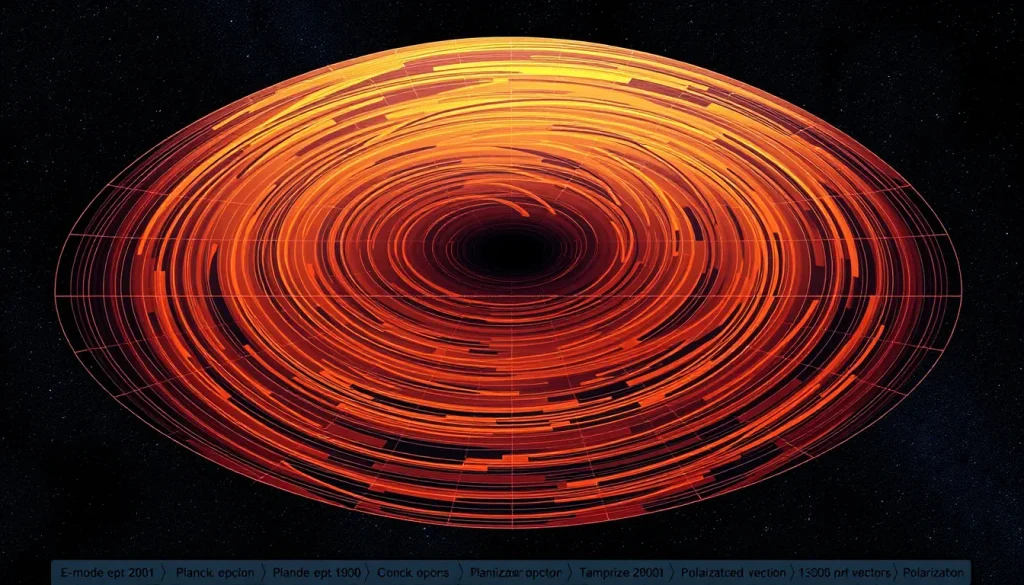
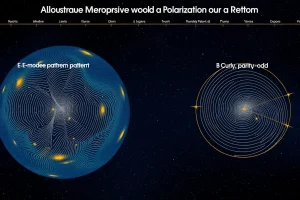
The polarization of the CMB is conventionally decomposed into two geometric modes: E-modes (curl-free) and B-modes (divergence-free). E-modes are generated by scalar perturbations and have been measured by many experiments. B-modes, on the other hand, are a unique signature of tensor perturbations, i.e., primordial gravitational waves predicted by inflation. The detection of B-modes would provide direct evidence for inflation and reveal the energy scale of the early universe [3].
The CMB polarization also probes the epoch of reionization. When the first stars and galaxies formed, they reionized the intergalactic medium, leaving an imprint on the polarization at large angular scales. Measurements of this signal constrain the timing and duration of reionization [4].
The Cosmic Epochs: A Timeline
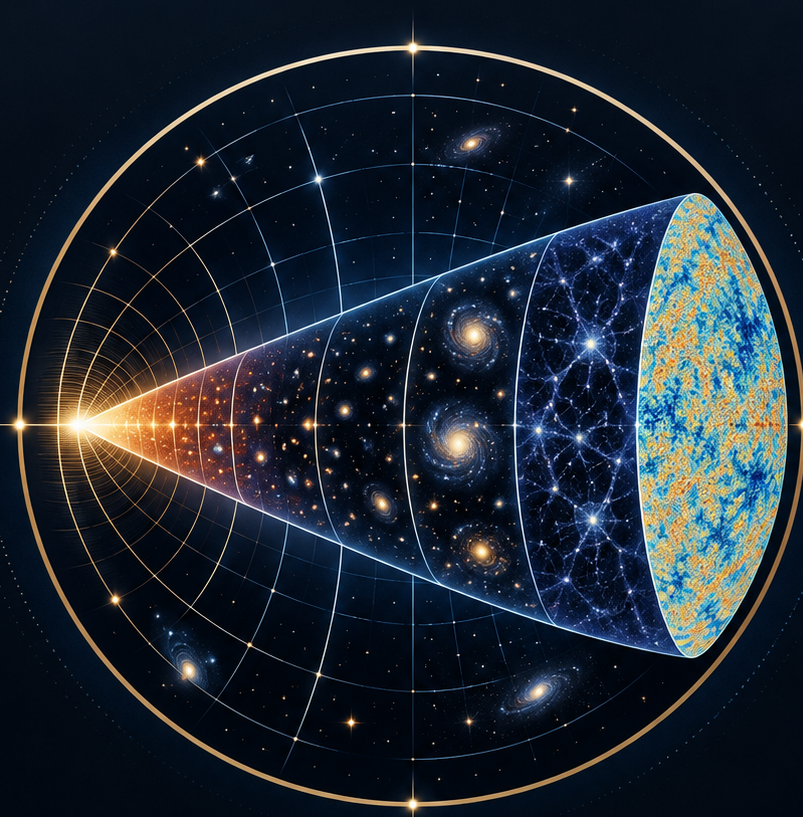
To understand how CMB polarization reveals the universe’s first moments, we must place it in the context of cosmic history. The standard model of cosmology, Lambda-CDM, describes a universe that began with a singularity, underwent a period of exponential expansion (inflation), then passed through a series of epochs as it cooled. The table below summarizes the major epochs.
| Epoch | Time After Big Bang | Temperature | Redshift | Key Events |
|---|---|---|---|---|
| Planck epoch | < 10-43 s | > 1032 K | > 1032 | Quantum gravity effects dominate; all forces unified. |
| Grand Unification epoch | 10-43 – 10-36 s | 1032 – 1028 K | 1032 – 1028 | Strong and electroweak forces separate. |
| Inflationary epoch | 10-36 – 10-32 s | ~1027 K | ~1027 | Exponential expansion; quantum fluctuations stretched to cosmic scales. |
| Electroweak epoch | 10-32 – 10-12 s | 1027 – 1015 K | 1027 – 1015 | Electromagnetic and weak forces separate; particles acquire mass. |
| Quark epoch | 10-12 – 10-6 s | 1015 – 1012 K | 1015 – 1012 | Quarks and gluons form a quark-gluon plasma. |
| Hadron epoch | 10-6 – 1 s | 1012 – 1010 K | 1012 – 1010 | Protons and neutrons form; matter-antimatter asymmetry established. |
| Lepton epoch | 1 – 10 s | 1010 – 109 K | 1010 – 109 | Leptons dominate; neutrinos decouple. |
| Photon epoch | 10 s – 380,000 yr | 109 – 3000 K | 109 – 1100 | Photons dominate; nucleosynthesis occurs; plasma of electrons and nuclei. |
| Recombination | ~380,000 yr | ~3000 K | ~1100 | Electrons and protons combine to form neutral hydrogen; photons decouple, releasing the CMB. |
| Dark Ages | 380,000 – 150 million yr | 3000 – 60 K | 1100 – 20 | No luminous sources; universe is dark and neutral. |
| Reionization | 150 million – 1 billion yr | 60 – 20 K | 20 – 6 | First stars and galaxies form; reionize the intergalactic medium. |
| Structure Formation | 1 billion yr – present | < 20 K | < 6 | Galaxies, clusters, and large-scale structure grow under gravity. |
The CMB polarization is generated at the epoch of recombination, but it carries imprints from earlier epochs, especially inflation. The B-mode signal, if detected, would be a direct relic of gravitational waves produced during inflation, providing a unique probe of physics at energies far beyond the reach of particle accelerators.
Concept
Definition
CMB polarization is the linear polarization of the cosmic microwave background radiation, produced by Thomson scattering of photons off free electrons at the last scattering surface. It is characterized by the Stokes parameters and decomposed into E-modes and B-modes.
How It Works
Thomson scattering polarizes light when the incident radiation has a quadrupole anisotropy. In the early universe, density perturbations and gravitational waves created such quadrupoles. The scattered photons then carry a polarization pattern that reflects the underlying perturbation modes. Scalar perturbations produce E-mode polarization, while tensor perturbations (gravitational waves) produce both E- and B-modes. The B-mode signal is particularly important because it is not generated by scalar perturbations at linear order, making it a clean probe of inflation.
Equation
The polarization field can be expressed in terms of the Stokes parameters Q and U, which transform under rotations. The E and B modes are defined via the spin-2 spherical harmonics: Elm and Blm are the coefficients of the decomposition. The power spectra ClEE, ClBB, and ClTE are the primary observables.
Example
Consider a single plane-wave density perturbation. The quadrupole it induces at the last scattering surface leads to a characteristic E-mode pattern: a radial or tangential alignment of polarization vectors. A gravitational wave, on the other hand, produces a curl-like B-mode pattern. By measuring the angular power spectra, cosmologists can separate these contributions.
Observable Consequences
E-mode polarization has been measured by WMAP, Planck, and ground-based experiments, confirming the standard model of structure formation. B-mode polarization remains a target; its detection would confirm inflation and constrain the energy scale of the early universe. Additionally, the large-scale polarization from reionization provides a measurement of the optical depth to reionization, constraining the epoch of first star formation.
Common Misconceptions
One misconception is that CMB polarization is the same as temperature anisotropy. In fact, polarization is a separate signal that arises from scattering. Another is that B-modes are exclusively from inflation; they can also be produced by gravitational lensing of E-modes, which must be subtracted. Finally, polarization does not directly show the universe’s first moments; it is a probe of conditions at recombination and earlier via the imprints of inflation.
Why It Matters
CMB polarization is a cornerstone of modern cosmology. It provides independent confirmation of the Lambda-CDM model, offers a direct test of inflation, and helps map the epoch of reionization. The quest to detect B-modes is one of the most exciting frontiers in astrophysics, with experiments like the Simons Observatory and CMB-S4 pushing toward higher sensitivity. Understanding polarization is essential for interpreting the CMB as a whole and for unlocking the physics of the universe’s first moments.
Evidence / Sources
The first detection of CMB polarization was made by the DASI experiment in 2002 [1]. Subsequent measurements by WMAP and Planck have mapped the E-mode polarization with high precision, confirming the predictions of the standard model. The Planck satellite also provided constraints on the tensor-to-scalar ratio, ruling out many inflationary models. The James Webb Space Telescope (JWST) is now probing the reionization epoch, complementing CMB polarization measurements. Key sources include the review by Rahimi and Reichardt (2024) [1], the pedagogical primer by Hu and White (1997) [2], the early universe review by Souradeep (2011) [3], and the practical guide by de Oliveira-Costa (2004) [4].
Related Registry Entries
FAQ
What is CMB polarization?
CMB polarization is the linear polarization of the cosmic microwave background radiation, produced by Thomson scattering of photons off free electrons at the last scattering surface. It encodes information about the early universe's density perturbations and gravitational waves.
Why are B-modes important?
B-modes are a unique signature of primordial gravitational waves predicted by inflation. Their detection would provide direct evidence for inflation and reveal the energy scale of the early universe, though they can also be generated by gravitational lensing of E-modes.
How does CMB polarization reveal the universe's first moments?
CMB polarization carries imprints from the epoch of recombination and earlier. The B-mode signal, if detected, would be a relic of gravitational waves from inflation, probing physics at energies far beyond particle accelerators. It also constrains reionization and the standard model of cosmology.
Leave a Reply