Short Answer
Main Explanation
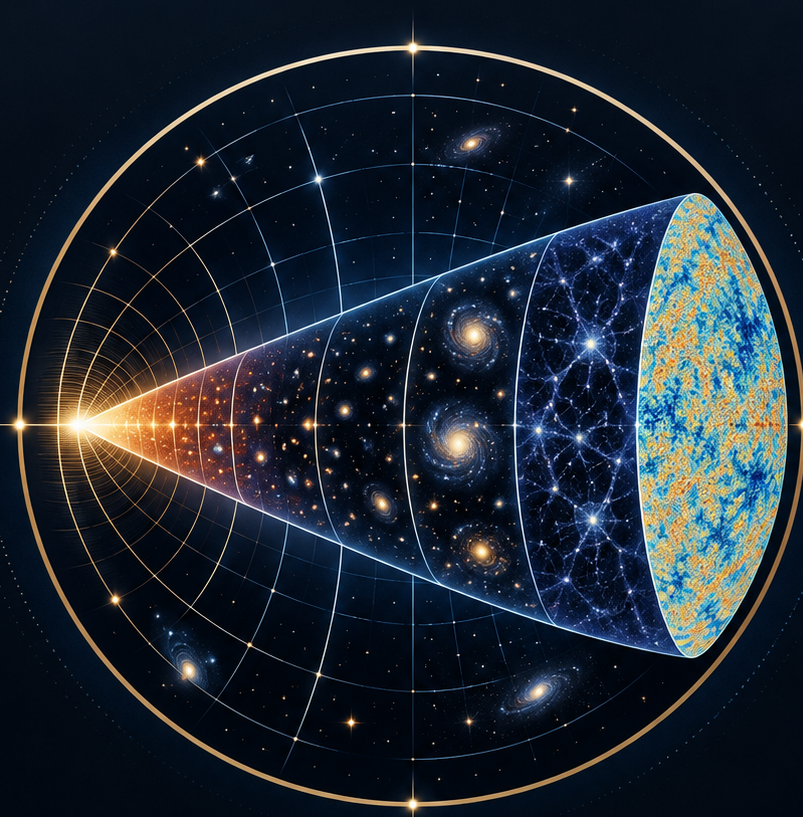
To understand what happened 380,000 years after the Big Bang, we must trace the universe’s evolution from its earliest moments. The standard model of cosmology, the Lambda-CDM model, describes a sequence of epochs that transformed a hot, dense singularity into the structured cosmos we see today.
The Planck Epoch (0 to 10⁻⁴³ seconds)
At the very beginning, the universe existed in a state of extreme energy and temperature, where quantum effects of gravity dominated. Our current physics cannot fully describe this era, but it set the initial conditions for everything that followed.
Grand Unification and Inflation (10⁻⁴³ to 10⁻³² seconds)
As the universe expanded and cooled, the fundamental forces began to separate. Around 10⁻³⁶ seconds, a period of rapid exponential expansion called cosmic inflation occurred, stretching quantum fluctuations to cosmic scales and seeding the large-scale structure we observe today.
Electroweak and Quark Epochs (10⁻³² to 10⁻⁴ seconds)
After inflation, the universe was a quark-gluon plasma. The electroweak force split into electromagnetic and weak forces. Quarks and antiquarks annihilated, leaving a slight excess of matter that would form the building blocks of atoms.
Hadron and Lepton Epochs (10⁻⁴ to 10 seconds)
Quarks combined into protons and neutrons. The hadron epoch ended with the annihilation of most hadrons, followed by the lepton epoch where electrons and positrons dominated. Neutrinos decoupled during this period.
Photon Epoch (10 seconds to ~380,000 years)
The universe was a hot, dense plasma of nuclei, electrons, and photons. Photons constantly scattered off free electrons, making the universe opaque. This period also saw the formation of the first light elements (primordial nucleosynthesis) — hydrogen, helium, and traces of lithium.
Recombination (≈380,000 years)
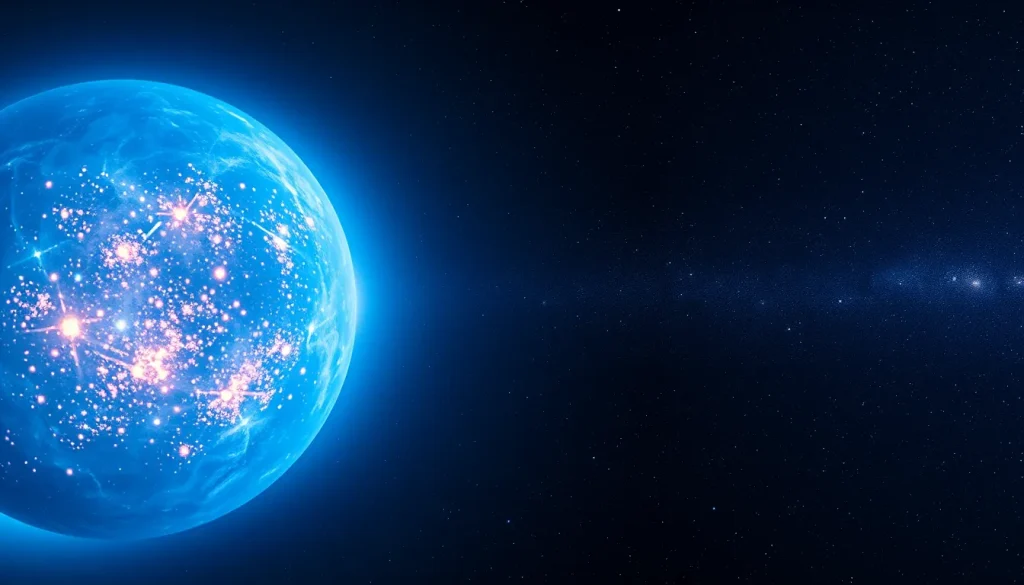
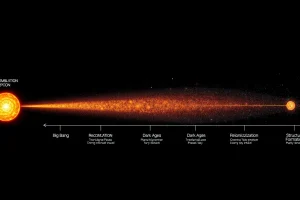
As the universe cooled to about 3,000 K, electrons and protons combined to form neutral hydrogen. This process, called recombination, dramatically reduced the number of free electrons, allowing photons to travel unimpeded. The universe became transparent, and the photons released at this moment form the cosmic microwave background (CMB) we observe today.
The Dark Ages and Reionization (380,000 years to ~1 billion years)
After recombination, the universe was filled with neutral hydrogen and no stars. This period is called the Dark Ages. Eventually, gravity pulled matter into clumps, forming the first stars and galaxies. Their intense ultraviolet radiation reionized the neutral hydrogen, a process called reionization. The first stars, likely massive and short-lived, transformed the universe into the ionized state we see today.
Structure Formation (1 billion years to present)
Over billions of years, galaxies clustered into filaments and superclusters, with dark matter providing the gravitational scaffolding. The universe continues to expand and cool, with dark energy driving accelerated expansion.
Cosmic Epoch: Recombination
When It Happened
Recombination occurred approximately 380,000 years after the Big Bang, based on measurements of the CMB by missions like Planck.
Temperature
The temperature at recombination was about 3,000 K, corresponding to the energy needed for hydrogen to become neutral.
Approximate Redshift
The redshift of the CMB is z ≈ 1,100, meaning the universe has expanded by a factor of about 1,100 since that light was emitted.
Dominant Particles/Physics
Before recombination, the universe was a plasma of free protons, electrons, and photons. After recombination, neutral hydrogen atoms dominated, and photons decoupled from matter.
What Happened
As the universe cooled below 3,000 K, electrons and protons combined to form neutral hydrogen. The scattering of photons by free electrons ceased, and the photons streamed freely. This released a flood of light that we now detect as the CMB.
What Came Before
Before recombination, the universe was an opaque plasma, with photons constantly scattering off free electrons. This was the photon epoch, when the universe was filled with a hot, dense fog.
What Came Next
After recombination, the universe entered the Dark Ages, where no stars or galaxies existed. The neutral hydrogen would later be reionized by the first stars and galaxies.
Evidence
The CMB is the most direct evidence. It is an almost perfect blackbody spectrum at 2.725 K, with tiny anisotropies that match predictions from inflation and structure formation. Missions like COBE, WMAP, and Planck have mapped these fluctuations with increasing precision.
Why It Matters
The recombination epoch is a turning point in cosmic history. It marks the moment the universe became transparent, allowing light to travel freely. The CMB is a treasure trove of information about the universe’s composition, age, and geometry. It provides the earliest direct snapshot of the universe and supports the Big Bang model. Understanding recombination also helps us trace the formation of the first stars and galaxies, as the neutral hydrogen left behind was the raw material for cosmic dawn.
Evidence / Sources
Key observations that confirm our understanding of recombination and the CMB include:
- COBE (1989-1993) measured the CMB’s blackbody spectrum and discovered its anisotropies.
- WMAP (2001-2010) provided detailed maps of temperature fluctuations, refining cosmological parameters.
- Planck (2009-2013) delivered the most precise measurements of the CMB to date, constraining the universe’s age to 13.8 billion years.
- JWST is now probing the epoch of reionization, studying the first galaxies and stars.
These missions, along with ground-based experiments, have solidified the Lambda-CDM model and our understanding of the early universe.
Related Registry Entries
Explore related topics in our cosmology registry:
- Cosmic Microwave Background
- Recombination
- Dark Ages
- Reionization
- Big Bang Nucleosynthesis
Last Reviewed / Updated: September 4, 2026
FAQ
Why is 380,000 years after the Big Bang significant?
At that time, the universe cooled enough for protons and electrons to combine into neutral hydrogen, releasing the cosmic microwave background and making the universe transparent to light.
What is the cosmic microwave background?
The CMB is the afterglow of the Big Bang, the oldest light in the universe. It was emitted at recombination and has been redshifted to microwave wavelengths over billions of years.
How do we know the universe is 13.8 billion years old?
Precise measurements of the CMB by the Planck mission, combined with cosmological models, yield an age of 13.8 billion years with high accuracy.
Leave a Reply