Short Answer
Main Explanation
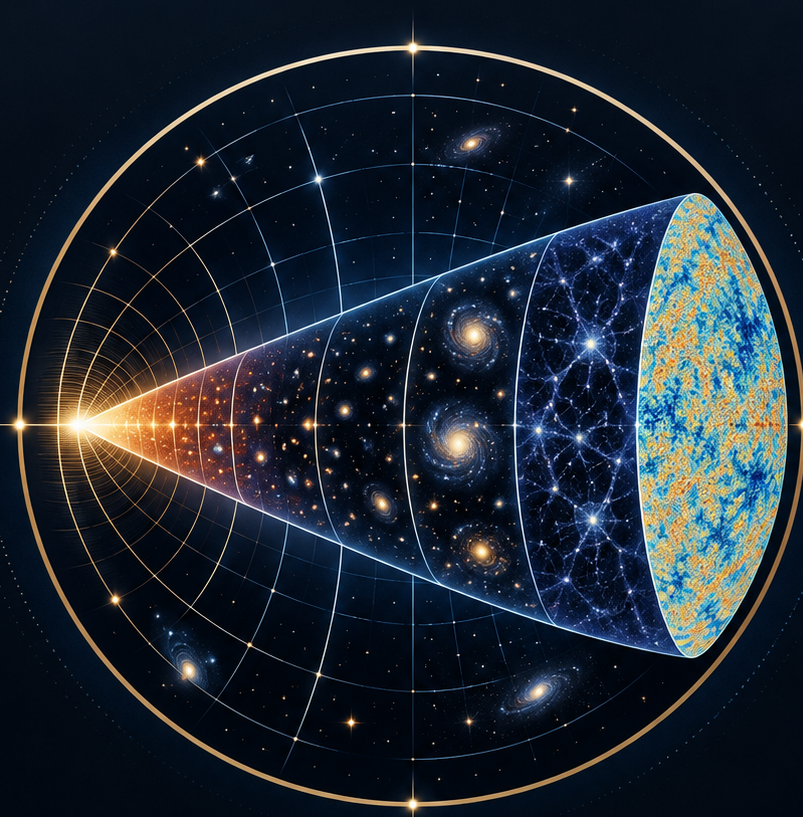
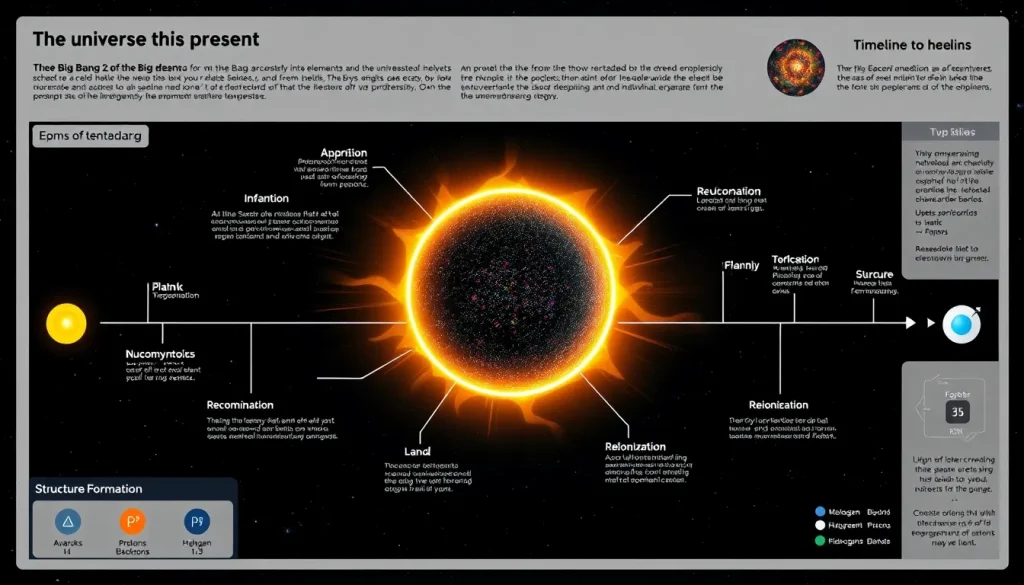
The story of the universe is a story of expansion and cooling. From an unimaginably hot and dense initial state, the cosmos has evolved through distinct epochs, each governed by different physical processes. Understanding what happened three minutes after the Big Bang requires a journey through the first few minutes of cosmic history.
From Planck Epoch to Inflation
The earliest moment we can describe is the Planck epoch (t < 10−43 s), where our current physical theories break down. At this time, all four fundamental forces—gravity, electromagnetism, and the strong and weak nuclear forces—were unified, and quantum effects dominated. The universe was at a temperature exceeding 1032 K. Our understanding here is speculative, as no observations can probe this era (symmetry magazine, source).
Following this, the Grand Unification epoch saw the separation of gravity from the other forces. Then, at around 10−36 seconds, a period of inflation occurred. In an infinitesimal fraction of a second, the universe expanded exponentially, growing from a subatomic size to about a coin-sized region (ESA, source). This rapid expansion smoothed out any irregularities and set the stage for the large-scale structure we see today.
The First Seconds and the Quark–Hadron Transition
After inflation, the universe continued to expand and cool. At temperatures around 1015 K (the electroweak epoch), the electromagnetic and weak forces separated. As the temperature dropped further, quarks and gluons—the building blocks of protons and neutrons—existed in a free state (the quark epoch). By about 10−6 seconds, the universe had cooled enough (~1013 K) for quarks to combine into hadrons (protons and neutrons) during the hadron epoch. This was followed by the lepton epoch, where electrons and other leptons dominated interactions.
Three Minutes: Big Bang Nucleosynthesis
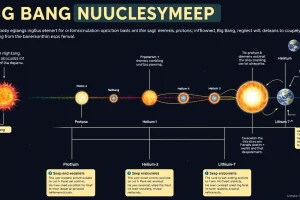
About three minutes after the Big Bang, the temperature had fallen to approximately one billion degrees (Planck satellite, source). This is cool enough for protons and neutrons to fuse into light atomic nuclei. The process, called Big Bang nucleosynthesis (BBN), produced helium-4, deuterium, helium-3, and a small amount of lithium-7. The ratio of hydrogen to helium was set: about 75% hydrogen and 25% helium by mass. This composition still matches observations of the primordial universe (Planck satellite, source).
BBN is a cornerstone of the Big Bang model. Its predictions for the abundances of light elements agree remarkably well with observations of ancient, metal-poor gas clouds. The process ended after about 20 minutes, when the temperature dropped too low for further fusion.
The Photon Epoch and Recombination
For the next few hundred thousand years, the universe remained a hot, opaque plasma of photons, electrons, and nuclei. Photons constantly scattered off free electrons, making the universe opaque (Planck satellite, source). Around 380,000 years after the Big Bang, the temperature fell to about 3,000 K—cool enough for electrons to bind with nuclei to form neutral atoms. This event, recombination, released the photons that we now observe as the cosmic microwave background (CMB). The CMB is the oldest light in the universe, a relic of this era.
Dark Ages, Reionization, and Structure Formation
After recombination, the universe entered the Dark Ages—a period with no luminous sources. Gravity gradually amplified the tiny density fluctuations seeded during inflation, allowing gas to collapse into the first stars and galaxies. These first stars, likely massive and short-lived, emitted ultraviolet light that reionized the neutral hydrogen during the epoch of reionization (around 400 million years after the Big Bang). Over the next billions of years, galaxies merged and clustered, forming the large-scale structure we observe today—filaments, clusters, and voids.
Key Missions and Discoveries
Our understanding of the early universe has been shaped by missions that mapped the CMB. The COBE satellite (1989) confirmed the CMB’s blackbody spectrum and detected slight temperature fluctuations. WMAP (2001) produced high-resolution maps, pinpointing the age of the universe and the composition of matter and energy. The Planck satellite (2009) refined these measurements to unprecedented precision, constraining the Hubble constant and the properties of inflation. The James Webb Space Telescope (JWST) is now probing the epoch of reionization, revealing the first galaxies.
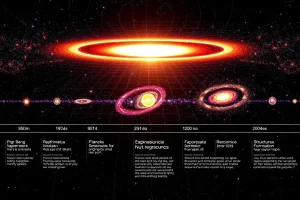
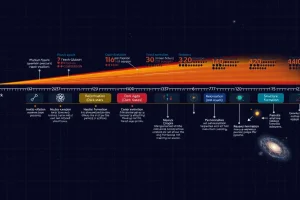
Timeline of Cosmic Epochs
| Epoch | Time | Temperature | Key Events |
|---|---|---|---|
| Planck | <10−43 s | >1032 K | Quantum gravity era |
| Grand Unification | 10−43–10−36 s | 1027–1032 K | Forces separate |
| Inflation | ~10−36–10−32 s | ~1027 K | Exponential expansion |
| Electroweak | 10−32–10−12 s | 1015–1027 K | Electromagnetic & weak forces split |
| Quark | 10−12–10−6 s | 1012–1015 K | Quarks free |
| Hadron | 10−6–1 s | 1012–1013 K | Protons and neutrons form |
| Lepton | 1–10 s | 1010–1012 K | Leptons dominate |
| Photon (BBN) | 10 s–20 min | 109–1010 K | Nucleosynthesis |
| Recombination | ~380,000 yr | ~3,000 K | CMB released |
| Dark Ages | 380,000 yr–400 Myr | <3,000 K | No stars yet |
| Reionization | ~400 Myr–1 Gyr | ~10–100 K | First stars reionize hydrogen |
| Structure Formation | >1 Gyr | ~2.7 K today | Galaxies, clusters form |
Why It Matters
The first three minutes set the stage for everything that followed. Nucleosynthesis determined the primordial chemical composition, providing the raw material for stars and planets. The CMB carries an image of the universe at 380,000 years, encoding the seeds of all cosmic structure. By studying these relics, we test our models of fundamental physics and cosmology. The standard Lambda-CDM model, which incorporates inflation, dark matter, and dark energy, successfully explains the observed CMB fluctuations, light-element abundances, and large-scale structure. Understanding the early universe is not just about the past—it constrains the ultimate fate of the cosmos.
Evidence / Sources
- Planck Satellite: The First Three Minutes
- ESA: So, how did everything start?
- Symmetry Magazine: A universe is born
- Space.com: The 1st few seconds of the Big Bang
Related Registry Entries
- Cosmic Microwave Background
- Big Bang Nucleosynthesis
- Inflation
- Recombination
- Lambda-CDM Model
FAQ
What exactly happened at the three-minute mark?
At three minutes, the universe had cooled to about a billion degrees, allowing protons and neutrons to fuse into deuterium and helium nuclei. This process, Big Bang nucleosynthesis, lasted about 20 minutes and produced the primordial ratios of hydrogen and helium.
How do we know the composition of the early universe?
Astronomers measure the abundance of light elements in extremely old, metal-poor gas clouds and compare them to predictions from Big Bang nucleosynthesis. The close agreement is strong evidence for the Big Bang model.
What is the cosmic microwave background?
The CMB is the relic radiation from the photon epoch, released at recombination (380,000 years after the Big Bang). It shows a nearly uniform glow with tiny temperature fluctuations that correspond to density variations that later grew into galaxies.
Why is the universe mostly hydrogen and helium?
During Big Bang nucleosynthesis, the available time and temperature allowed only the lightest nuclei to form. Heavier elements were created later inside stars and supernovae, but they make up only a small fraction of the universe's baryonic matter.

Leave a Reply