Short Answer
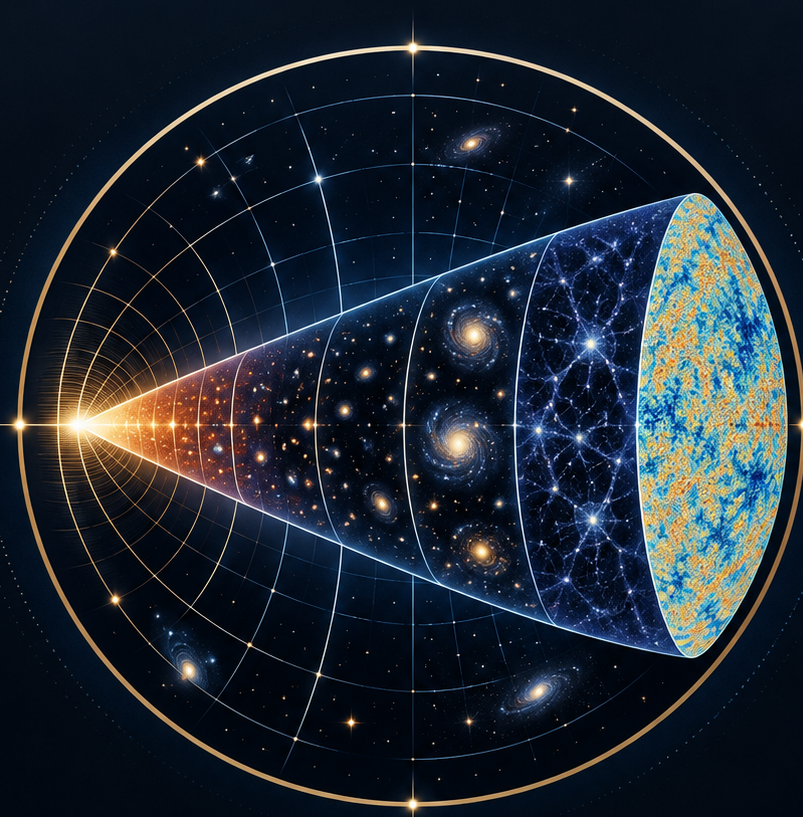
Short Answer: The Planck epoch was the universe’s earliest moment, lasting from t=0 to about 10⁻⁴³ seconds, when quantum gravity dominated and the fundamental forces were unified. After it, the universe expanded and cooled through a series of distinct epochs—Grand Unification, Inflation, Electroweak, Quark, Hadron, Lepton, Photon, Recombination, Dark Ages, Reionization, and Structure Formation—each characterized by specific particle content, temperatures, and physical processes. The cosmic microwave background (CMB) is a relic from recombination, and the subsequent evolution led to the large-scale structure we observe today.
| Property | Value |
|---|---|
| Planck time | ~5.39 × 10⁻⁴⁴ s |
| Planck temperature | ~1.42 × 10³² K |
| End of Planck epoch | ~10⁻⁴³ s |
| CMB temperature today | 2.725 K |
| Redshift of recombination | z ≈ 1100 |
| Current epoch | Dark energy dominated (ΛCDM) |
Main Explanation
The universe began with the Big Bang, but the first 10⁻⁴³ seconds—the Planck epoch—remain the most mysterious. At this scale, both general relativity and quantum mechanics break down, and our current physical theories cannot describe the conditions [3][4]. After this initial instant, the cosmos underwent a remarkable sequence of transformations that set the stage for everything we see today.
The standard model of cosmology, the ΛCDM (Lambda Cold Dark Matter) model, describes the universe’s evolution from the Planck epoch to the present. It is supported by a wealth of observations, including the cosmic microwave background (CMB), the abundance of light elements, and the large-scale distribution of galaxies.
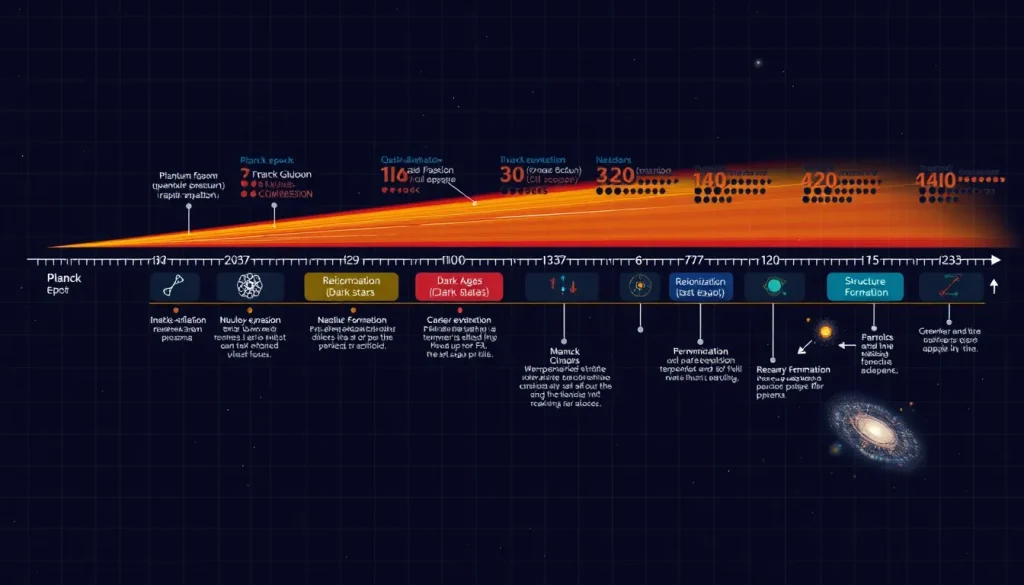
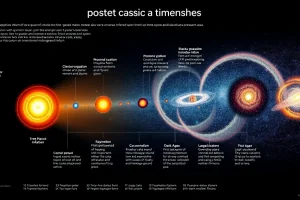
Below is a timeline of the major cosmic epochs, followed by detailed descriptions of each.
| Epoch | Time (after Big Bang) | Temperature | Key Events |
|---|---|---|---|
| Planck epoch | 0 – 10⁻⁴³ s | >10³² K | Quantum gravity dominates; all forces unified |
| Grand Unification epoch | 10⁻⁴³ – 10⁻³⁶ s | 10³² – 10²⁷ K | Strong force separates from electroweak |
| Inflationary epoch | 10⁻³⁶ – 10⁻³² s | ~10²⁷ K | Exponential expansion; seeds for structure |
| Electroweak epoch | 10⁻³² – 10⁻¹² s | 10²⁷ – 10¹⁵ K | Electromagnetic and weak forces separate |
| Quark epoch | 10⁻¹² – 10⁻⁶ s | 10¹⁵ – 10¹² K | Quarks and gluons form quark-gluon plasma |
| Hadron epoch | 10⁻⁶ – 1 s | 10¹² – 10¹⁰ K | Protons and neutrons form; baryogenesis |
| Lepton epoch | 1 – 10 s | 10¹⁰ – 10⁹ K | Leptons dominate; neutrinos decouple |
| Photon epoch | 10 s – 380,000 yr | 10⁹ – 3000 K | Photons dominate; Big Bang nucleosynthesis |
| Recombination | ~380,000 yr | ~3000 K | Atoms form; CMB released |
| Dark Ages | 380,000 yr – ~150 million yr | 3000 – ~50 K | No stars; universe dark |
| Reionization | ~150 million – 1 billion yr | ~50 – 20 K | First stars and galaxies ionize neutral hydrogen |
| Structure Formation | 1 billion yr – present | <20 K (cooling) | Galaxies, clusters, and large-scale structure evolve |
The Cosmic Epochs in Detail
Planck Epoch
When It Happened: 0 – 10⁻⁴³ s
Temperature: >10³² K
Approximate Redshift: >10³² (infinite at start)
Dominant Particles/Physics: Quantum gravity; all four fundamental forces unified
What Happened: The universe was a quantum foam where space and time were not well-defined. General relativity and quantum mechanics both break down at Planck scales [3][4].
What Came Before: Nothing—this is the earliest known epoch.
What Came Next: Grand Unification epoch.
Evidence: No direct evidence exists; the epoch is inferred from theoretical consistency.
Grand Unification Epoch
When It Happened: 10⁻⁴³ – 10⁻³⁶ s
Temperature: 10³² – 10²⁷ K
Approximate Redshift: 10³² – 10²⁷
Dominant Particles/Physics: Grand unified theories (GUT) predict unification of strong, weak, and electromagnetic forces.
What Happened: The strong force separated from the electroweak force, possibly triggering cosmic inflation.
What Came Before: Planck epoch.
What Came Next: Inflationary epoch.
Evidence: No direct evidence; GUTs are speculative but motivated by particle physics.
Inflationary Epoch
When It Happened: 10⁻³⁶ – 10⁻³² s
Temperature: ~10²⁷ K
Approximate Redshift: ~10²⁷
Dominant Particles/Physics: Inflaton field; vacuum energy drives exponential expansion.
What Happened: The universe expanded by at least 10²⁶ times in size, smoothing out initial conditions and producing quantum fluctuations that later seeded large-scale structure.
What Came Before: Grand Unification epoch.
What Came Next: Electroweak epoch.
Evidence: The flatness and horizon problems are solved; quantum fluctuations predicted match CMB anisotropy patterns [1].
Electroweak Epoch
When It Happened: 10⁻³² – 10⁻¹² s
Temperature: 10²⁷ – 10¹⁵ K
Approximate Redshift: 10²⁷ – 10¹⁵
Dominant Particles/Physics: Electroweak theory; Higgs mechanism.
What Happened: The electromagnetic and weak forces separated; particles acquired mass via the Higgs field.
What Came Before: Inflation.
What Came Next: Quark epoch.
Evidence: Physics at these energies is probed at particle accelerators like the LHC.
Quark Epoch
When It Happened: 10⁻¹² – 10⁻⁶ s
Temperature: 10¹⁵ – 10¹² K
Approximate Redshift: 10¹⁵ – 10¹²
Dominant Particles/Physics: Quarks, gluons, leptons; quark-gluon plasma.
What Happened: The universe was filled with a hot, dense plasma of free quarks and gluons.
What Came Before: Electroweak epoch.
What Came Next: Hadron epoch.
Evidence: Relativistic heavy-ion collisions recreate similar conditions.
Hadron Epoch
When It Happened: 10⁻⁶ – 1 s
Temperature: 10¹² – 10¹⁰ K
Approximate Redshift: 10¹² – 10¹⁰
Dominant Particles/Physics: Hadrons (protons, neutrons); strong force.
What Happened: Quarks combined to form hadrons; matter-antimatter asymmetry (baryogenesis) led to a slight excess of matter.
What Came Before: Quark epoch.
What Came Next: Lepton epoch.
Evidence: The observed matter-antimatter asymmetry requires this epoch; nucleosynthesis predictions depend on the proton/neutron ratio.
Lepton Epoch
When It Happened: 1 – 10 s
Temperature: 10¹⁰ – 10⁹ K
Approximate Redshift: 10¹⁰ – 10⁹
Dominant Particles/Physics: Leptons (electrons, neutrinos) and their antiparticles.
What Happened: Lepton-antilepton pairs annihilated; neutrinos decoupled, forming the cosmic neutrino background.
What Came Before: Hadron epoch.
What Came Next: Photon epoch.
Evidence: The cosmic neutrino background is predicted but not yet directly detected.
Photon Epoch
When It Happened: 10 s – 380,000 yr
Temperature: 10⁹ – 3000 K
Approximate Redshift: 10⁹ – 1100
Dominant Particles/Physics: Photons, electrons, atomic nuclei; Big Bang nucleosynthesis (BBN).
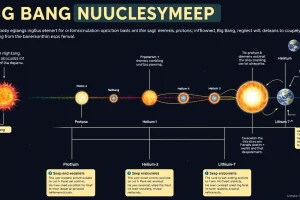
What Happened: During the first few minutes, protons and neutrons fused into helium and trace amounts of lithium. The universe remained a hot plasma of photons and charged particles.
What Came Before: Lepton epoch.
What Came Next: Recombination.
Evidence: Observed abundances of light elements match BBN predictions; CMB is a direct relic of the end of this epoch.
Recombination
When It Happened: ~380,000 yr
Temperature: ~3000 K
Approximate Redshift: z ≈ 1100
Dominant Particles/Physics: Atomic physics; electrons combine with protons to form neutral hydrogen.
What Happened: The universe became transparent to radiation; photons decoupled, forming the CMB. These photons have been traveling ever since and now appear as a faint glow at 2.725 K [1].
What Came Before: Photon epoch.
What Came Next: Dark Ages.
Evidence: The CMB was discovered in 1965 and mapped precisely by COBE, WMAP, and Planck missions [1].
Dark Ages
When It Happened: 380,000 yr – ~150 million yr
Temperature: 3000 – ~50 K
Approximate Redshift: 1100 – ~20
Dominant Particles/Physics: Neutral hydrogen and helium; gravity begins to amplify density fluctuations.
What Happened: The universe was dark—no stars or galaxies yet. Matter gradually clumped under gravity, setting the stage for star formation.
What Came Before: Recombination.
What Came Next: Reionization.
Evidence: Observations of the CMB and high-redshift quasars indicate a period of neutral hydrogen before the first stars.
Reionization
When It Happened: ~150 million – 1 billion yr
Temperature: ~50 – 20 K
Approximate Redshift: 20 – 6
Dominant Particles/Physics: First stars (Population III) and galaxies; ultraviolet radiation ionizes neutral hydrogen.
What Happened: The first stars ignited, producing heavy elements and reionizing the intergalactic medium. This epoch marks the end of the cosmic dark ages.
What Came Before: Dark Ages.
What Came Next: Structure Formation.
Evidence: Observations of high-redshift galaxies with JWST and quasar spectra show the transition from neutral to ionized hydrogen.
Structure Formation
When It Happened: 1 billion yr – present
Temperature: <20 K (cooling)
Approximate Redshift: 6 – 0
Dominant Particles/Physics: Dark matter, baryonic matter, dark energy; gravity and cosmic expansion.
What Happened: Galaxies, clusters, and superclusters formed under the influence of dark matter. Dark energy began to dominate around 5 billion years ago, accelerating the expansion.
What Came Before: Reionization.
What Came Next: The present and future of the universe.
Evidence: Galaxy surveys, cosmic microwave background measurements, and supernova observations all support the ΛCDM model.
Why It Matters
Understanding the sequence of cosmic epochs is fundamental to cosmology. It explains the origin of the CMB, the formation of the first atoms, and the emergence of galaxies and large-scale structure. The Planck epoch, where our current physics fails, points to the need for a quantum theory of gravity [2]. Each subsequent epoch offers observable predictions—from nucleosynthesis abundances to the polarization of the CMB—that test our models. Missions like COBE, WMAP, and Planck have measured the CMB with extraordinary precision [1], while JWST is now probing the era of reionization, directly observing the first galaxies. These observations not only confirm the ΛCDM model but also push us toward deeper questions about the ultimate laws of nature.
Evidence / Sources
Key evidence for the cosmic epochs comes from multiple independent measurements:
- The CMB temperature and anisotropy maps from COBE, WMAP, and Planck [1]
- Primordial element abundances (Big Bang nucleosynthesis)
- Large-scale structure surveys and galaxy redshift measurements
- High-redshift observations by JWST and other telescopes
These observations are consistent with the ΛCDM model, which is the current consensus framework. The sources used in this article are listed in the References section.
Related Registry Entries
- Cosmic Microwave Background
- Inflation (Cosmology)
- Recombination
- Dark Ages
- Reionization
- ΛCDM Model
FAQ
What happened immediately after the Planck epoch?
After the Planck epoch, the Grand Unification epoch began, during which the strong force separated from the electroweak force. This was followed by cosmic inflation, a period of exponential expansion that lasted until about 10⁻³² seconds.
What is the cosmic microwave background and why is it important?
The CMB is the remnant radiation from the recombination epoch, when the universe cooled enough for electrons and protons to form neutral hydrogen. It provides a snapshot of the universe at 380,000 years old and carries information about its composition, curvature, and early fluctuations.
How did the first atoms form?
During recombination, at a temperature of about 3000 K, free electrons combined with protons to form hydrogen atoms. This process released photons that became the CMB. Heavier elements were not formed until much later inside stars.
What are the dark ages?
The dark ages refer to the period after recombination but before the first stars formed, roughly 380,000 to 150 million years after the Big Bang. The universe was filled with neutral hydrogen and no luminous sources.
Leave a Reply