Short Answer
Main Explanation
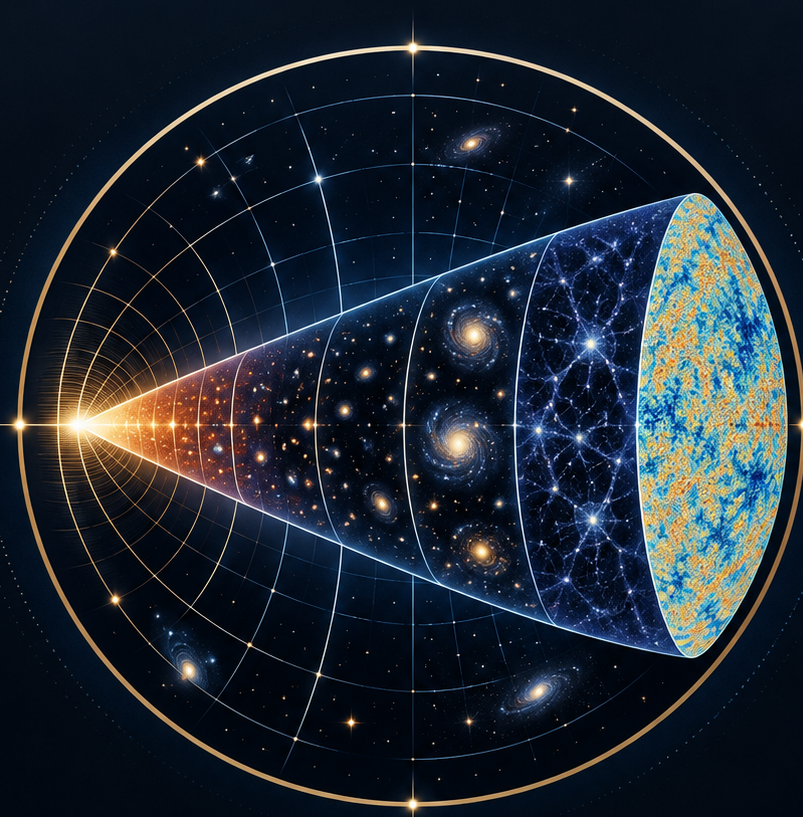
The cosmic microwave background (CMB) is the faint, uniform glow of radiation left over from the Big Bang. It was created about 380,000 years after the universe began, when the cosmos cooled enough for protons and electrons to combine into neutral hydrogen, allowing photons to travel freely. Today this radiation fills all of space with a near-perfect blackbody spectrum at a temperature of 2.7255 K [4]. Measuring this ancient light from Earth is one of the most precise ways to probe the universe’s origin, composition, and evolution.
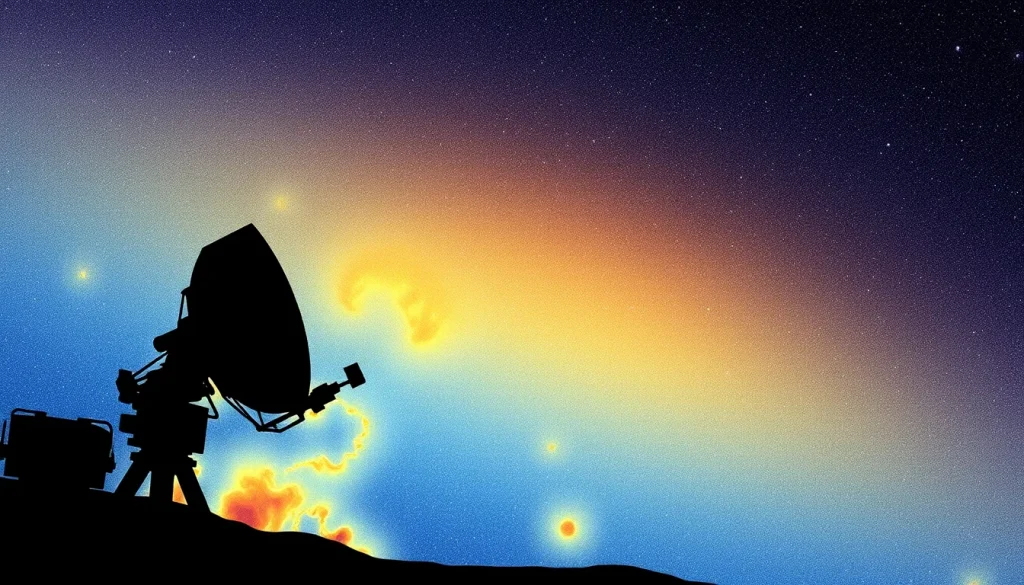
Ground-based observatories, high-altitude balloons, and space telescopes have all contributed to CMB measurements. The atmosphere absorbs and emits at microwave wavelengths, so ground-based experiments must be placed in dry, high-altitude sites, while balloon and satellite instruments avoid atmospheric interference entirely. Key missions include NASA’s COBE (1989), which first detected the CMB’s anisotropy in 1992; WMAP (2001), which mapped temperature fluctuations with high precision; and the European Space Agency’s Planck (2009), which measured both temperature and polarization to unprecedented accuracy [2][4].
From these measurements, cosmologists have derived the parameters of the standard model of cosmology, the Lambda-CDM model, which includes dark energy (Λ) and cold dark matter (CDM). The CMB’s angular power spectrum—the statistical distribution of temperature fluctuations across the sky—yields the density of baryonic matter, dark matter, and dark energy, as well as the curvature and age of the universe.
Cosmic Epoch
From the Planck Epoch to Reionization
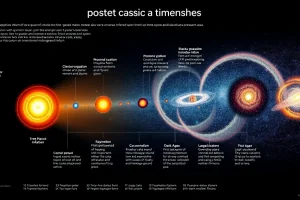
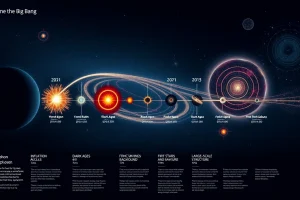
The universe has passed through distinct epochs, each governed by different physical processes. The table below summarizes the major eras, their approximate times, temperatures, redshifts, and dominant physics. The CMB as we observe it today was set during recombination, but its properties were shaped by all earlier epochs.
| Epoch | When | Temperature | Redshift (z) | Dominant Physics | What Happened |
|---|---|---|---|---|---|
| Planck epoch | 0 to ~10⁻⁴³ s | >10³² K | infinite | Quantum gravity | All four fundamental forces unified; quantum effects dominated. |
| Grand Unification epoch | ~10⁻⁴³ to 10⁻³⁶ s | 10²⁸–10³² K | ~10²⁹ | GUT forces | Strong force separates from electroweak; inflation begins. |
| Inflationary epoch | ~10⁻³⁶ to 10⁻³² s | ~10²⁷ K | ~10²⁸ | Scalar field (inflaton) | Exponential expansion smooths and flattens the universe; quantum fluctuations seed structure. |
| Electroweak epoch | ~10⁻³² to 10⁻¹² s | 10¹⁵–10²⁸ K | ~10¹⁵ | Electroweak force | Electromagnetic and weak forces separate; W and Z bosons acquire mass. |
| Quark epoch | ~10⁻¹² to 10⁻⁶ s | 10¹²–10¹⁵ K | ~10¹² | Quark-gluon plasma | Quarks and gluons exist freely; no bound hadrons yet. |
| Hadron epoch | ~10⁻⁶ to 1 s | 10¹⁰–10¹² K | ~10¹⁰ | Strong force, hadrons | Quarks combine into protons and neutrons; matter-antimatter annihilation leaves slight excess of matter. |
| Lepton epoch | ~1 to 10 s | 10⁹–10¹⁰ K | ~10⁹ | Leptons, neutrinos | Leptons and antileptons annihilate; neutrinos decouple. |
| Photon epoch | ~10 s to 380,000 yr | 3,000–10⁹ K | 10³–10⁹ | Photons, nuclei, electrons | Primordial nucleosynthesis forms light elements; photons remain tightly coupled to matter. |
| Recombination | ~380,000 yr | ~3,000 K | ~1,100 | Atomic physics | Electrons and protons form neutral hydrogen; photons decouple, creating the CMB. |
| Dark Ages | 380,000 yr to ~150 million yr | ~50–3,000 K | 20–1,100 | Gravity, neutral gas | The universe is dark and neutral; no stars or galaxies yet. |
| Reionization | ~150 million to 1 billion yr | ~10–50 K | 6–20 | First stars, quasars | Ultraviolet light from first stars reionizes hydrogen; the universe becomes transparent to UV again. |
| Structure Formation | 1 billion yr to present | <10 K | 0–6 | Dark matter, gravity, dark energy | Galaxies, clusters, and large-scale structure form; dark energy accelerates expansion. |
How We Measure the CMB
CMB measurements involve detecting tiny temperature variations (anisotropies) of about one part in 100,000 across the sky. Instruments use cryogenic bolometers or radiometers to measure microwave power in multiple frequency bands. The primary challenge is separating the CMB from foreground emission—synchrotron radiation from our galaxy, dust, and extragalactic sources. By comparing maps at different frequencies, cosmologists can subtract these contaminants [3].
The CMB’s angular power spectrum is constructed by decomposing the temperature map into spherical harmonics. The positions and heights of the acoustic peaks in this spectrum encode the baryon density, dark matter density, and the curvature of space. Measurements from WMAP and Planck have pinned down these parameters to sub-percent precision [4].
Why It Matters
The CMB is a direct snapshot of the universe when it was only 380,000 years old. It provides the strongest evidence for the Big Bang model, confirms the predictions of cosmic inflation, and gives precise values for the age, composition, and geometry of the cosmos. Without CMB measurements, we would not know that dark matter and dark energy dominate the universe, nor could we test theories of the early universe with such rigor.
Evidence / Sources
The following sources were used for this article:
- Wright, E. L. (2003). CMB Observational Techniques and Recent Results. arXiv:astro-ph/0401001.
- Durrer, R. (2015). The Cosmic Microwave Background: The history of its experimental investigation and its significance for cosmology. arXiv:1506.01907.
- Hanany, S., Niemack, M. D., & Page, L. (2013). CMB Telescopes and Optical Systems. In Handbook of Superconducting and THz Devices.
- Scott, D., & Smoot, G. F. (2025). Cosmic Microwave Background. Particle Data Group Review, revised August 2025.
Related Registry Entries
Explore related topics in this encyclopedia:
- Cosmic Microwave Background (CMB)
- Inflation
- Recombination
- Lambda-CDM Model
- WMAP Mission
- Planck Mission
Last Reviewed: September 4, 2026
FAQ
Why is the CMB so important for cosmology?
The CMB is a snapshot of the universe when it was only 380,000 years old. It contains information about the initial conditions, composition, and geometry of the cosmos, and it directly supports the Big Bang model and inflation.
How do ground-based telescopes measure the CMB despite atmospheric interference?
Ground-based experiments are placed at high, dry sites (e.g., Atacama Desert) and use multiple frequency bands to subtract atmospheric emission. Balloon and satellite missions avoid the atmosphere entirely.
What did COBE, WMAP, and Planck each discover?
COBE found the CMB's blackbody spectrum and first detected anisotropies. WMAP mapped temperature fluctuations with high precision, measuring key cosmological parameters. Planck provided even finer maps of temperature and polarization, refining the Lambda-CDM model.

Leave a Reply