Short Answer
Main Explanation
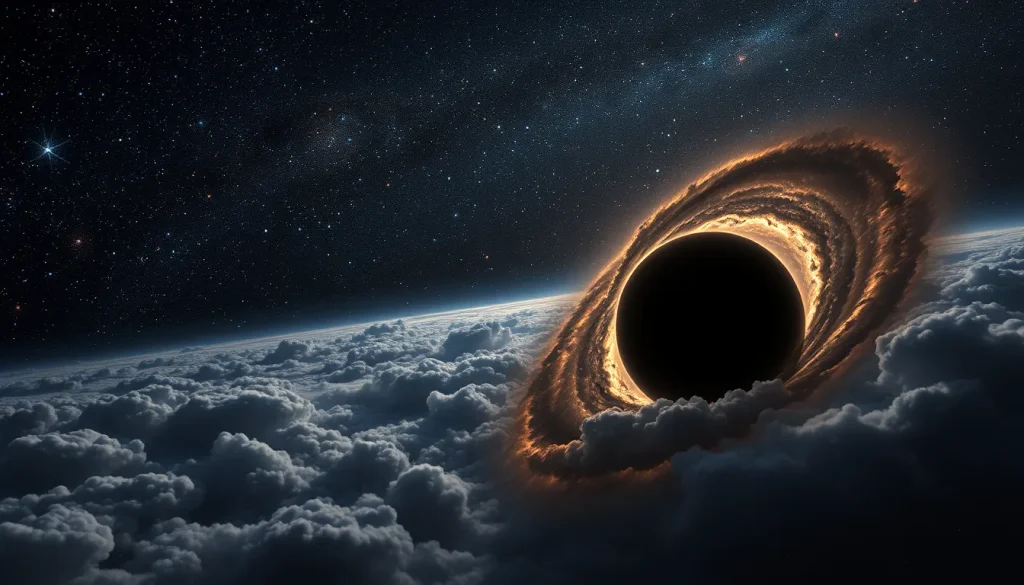
The universe began in a state of unimaginable heat and density, and within its first seconds, the seeds of everything we see today were laid. Black holes—objects so dense that not even light escapes them—are among the most extreme consequences of cosmic evolution. But how did the very first black holes come into existence? The answer lies in a delicate interplay between gravity, nuclear physics, and the expansion of space, and it remains one of the most active frontiers in astrophysics.
Short Answer
The first black holes likely formed from two possible pathways: the collapse of massive population III stars (light seeds of 10–100 solar masses) or the direct collapse of primordial gas clouds into heavy seeds of 10⁴–10⁵ solar masses. Recent observations, including an X-ray quasar at redshift ~10, support the heavy-seed scenario for at least some early supermassive black holes.
What We Know
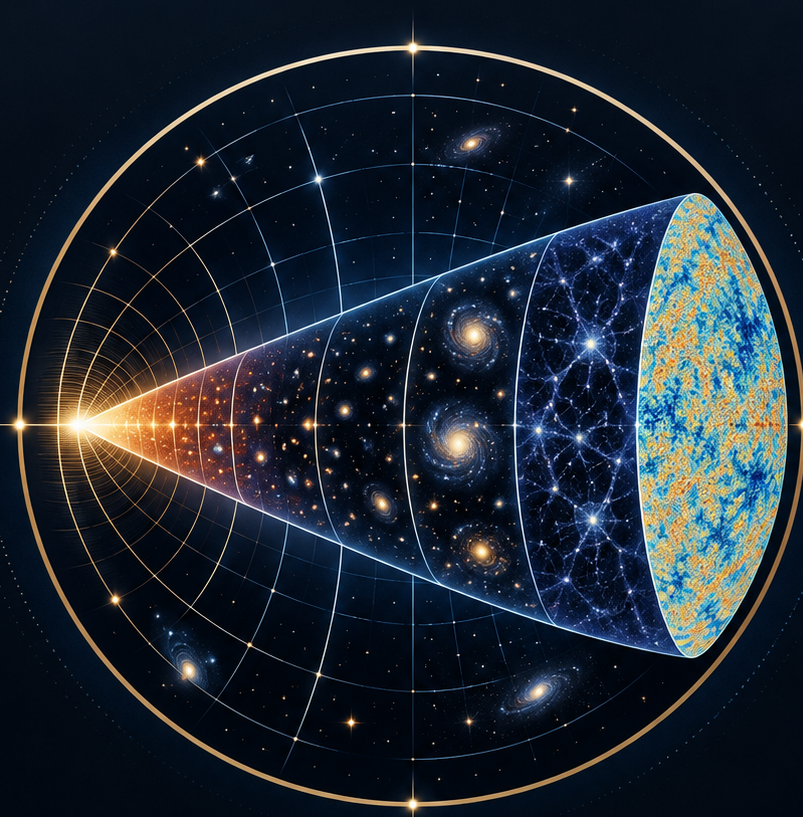
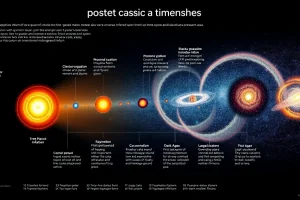
To understand the first black holes, we must first trace the universe’s history. The standard Lambda-CDM model describes a sequence of epochs, each governed by distinct physical processes.
| Epoch | Time After Big Bang | Temperature | Key Events |
|---|---|---|---|
| Planck Epoch | 0 to 10⁻⁴³ s | ~10³² K | Quantum gravity dominates; no current theory fully describes this era. |
| Grand Unification Epoch | 10⁻⁴³ to 10⁻³⁶ s | ~10²⁷ K | Strong and electroweak forces unify; inflation begins. |
| Inflationary Epoch | 10⁻³⁶ to 10⁻³² s | ~10²⁷ K | Exponential expansion of space; quantum fluctuations become seeds of structure. |
| Electroweak Epoch | 10⁻³² to 10⁻¹² s | ~10¹⁵ K | Electromagnetic and weak forces separate; particles acquire mass. |
| Quark Epoch | 10⁻¹² to 10⁻⁶ s | ~10¹² K | Quarks and gluons form a quark-gluon plasma. |
| Hadron Epoch | 10⁻⁶ to 1 s | ~10¹⁰ K | Protons and neutrons form; matter-antimatter asymmetry emerges. |
| Lepton Epoch | 1 to 10 s | ~10⁹ K | Leptons dominate; neutrinos decouple. |
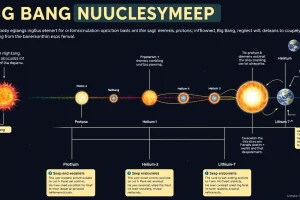
| Photon Epoch | 10 s to 380,000 yr | 10⁹ to 3000 K | Photons dominate; big bang nucleosynthesis creates light elements. |
| Recombination | ~380,000 yr | ~3000 K | Electrons bind to nuclei; photons decouple, releasing the cosmic microwave background (CMB). |
| Dark Ages | 380,000 yr to ~150 million yr | 3000 to ~60 K | The universe is dark and neutral; no stars or galaxies yet. |
| Reionization & Cosmic Dawn | ~150 million to 1 billion yr | ~60 to ~20 K | First stars and galaxies form, reionizing hydrogen; first black holes emerge. |
| Structure Formation | 1 billion yr to present | ~2.7 K (now) | Galaxies cluster; supermassive black holes grow at galaxy centers. |
The cosmic microwave background, discovered by COBE and mapped with exquisite precision by WMAP and the Planck mission, is a relic of recombination. It shows tiny temperature fluctuations that grew into the large-scale structure we observe today. Around 100–200 million years after the Big Bang, the first stars—population III stars—formed from pristine hydrogen and helium. These stars were likely extremely massive (tens to hundreds of solar masses) and short-lived, ending their lives in supernovae or collapsing directly into black holes.
What We Don’t Know
The exact masses and formation rates of the first stars remain uncertain. More critically, we do not know whether the first black holes were predominantly light (10–100 solar masses) or heavy (10⁴–10⁵ solar masses). The rapid appearance of supermassive black holes (billions of solar masses) less than 700 million years after the Big Bang challenges the light-seed pathway, because accreting at the Eddington limit would require sustained growth that may be unrealistic.
Evidence
Recent observations from the Chandra X-ray Observatory and the James Webb Space Telescope have provided compelling evidence for heavy seeds. In 2023, astronomers detected an X-ray quasar at redshift ~10 (about 500 million years after the Big Bang) in the galaxy UHZ1. The black hole’s mass is estimated at 10⁷–10⁸ solar masses, and its properties are consistent with a heavy seed formed by the direct collapse of a gas cloud (Bogdán et al., 2024). This supports the theoretical work of Priyamvada Natarajan and colleagues, who predicted that massive black holes could form without stars (Scientific American, 2024).
Competing Explanations
The two main scenarios are:
- Light seeds (stellar remnants): Population III stars collapse to black holes of ~10–100 solar masses. These seeds then grow by accretion and mergers. This is the traditional pathway and is well-motivated by stellar evolution, but it struggles to produce billion-solar-mass black holes by redshift 7 in the available time.
- Heavy seeds (direct collapse): In regions with intense ultraviolet radiation from nearby stars, hydrogen gas can be prevented from forming stars, allowing a massive cloud to collapse directly into a black hole of 10⁴–10⁵ solar masses. This provides a head start and can explain the early supermassive black holes more easily.
Current Research
Ongoing and future missions—including JWST, the upcoming Nancy Grace Roman Space Telescope, and the Laser Interferometer Space Antenna (LISA) for gravitational waves—will test these scenarios. JWST is already discovering galaxies and quasars at redshifts beyond 10, providing direct probes of the first black hole seeds. Theoretical simulations are also refining the conditions for direct collapse, including the role of dark matter halos and baryonic cooling.
Why It Matters
Understanding the first black holes is not just an exercise in cosmic archaeology. Black holes influence the evolution of galaxies through feedback—winds and radiation that heat and expel gas. The seeds of the first black holes likely shaped the reionization of the universe and the growth of structure. Moreover, the existence of supermassive black holes in the early universe challenges our models of accretion and growth, forcing us to reconsider physics under extreme conditions. Solving this mystery will illuminate the connection between the smallest quantum fluctuations and the largest structures in the cosmos.
Evidence / Sources
The evidence for the cosmic timeline and black hole formation comes from multiple independent observations: the CMB (COBE, WMAP, Planck), the abundance of light elements (big bang nucleosynthesis), the large-scale distribution of galaxies (SDSS, DES), and direct imaging of high-redshift quasars (Chandra, JWST). The heavy-seed scenario is supported by the detection of an X-ray quasar at z≈10 (Bogdán et al., 2024, Nature Astronomy). Reviews by Inayoshi, Visbal, and Haiman (2020) and Smith, Bromm, and Loeb (2017) summarize the theoretical landscape.
Related Registry Entries
- Cosmic Microwave Background
- Reionization
- Dark Ages
- Inflation
- First Stars & Galaxies
- Supermassive Black Hole Seeds
FAQ
What is the difference between light and heavy seeds for black holes?
Light seeds (10–100 solar masses) are the remnants of the first massive stars (Population III). Heavy seeds (10⁴–10⁵ solar masses) form from the direct collapse of gas clouds, bypassing star formation. Heavy seeds provide a head start for growing supermassive black holes by redshift 7.
How do we observe the first black holes?
We detect them as quasars—bright accreting black holes—at high redshifts using X-ray and infrared telescopes like Chandra and JWST. The most distant known quasar, UHZ1, is at redshift ~10, seen as it was ~500 million years after the Big Bang.
Why is the cosmic microwave background important for understanding the first black holes?
The CMB provides the initial conditions for structure formation. Its tiny temperature fluctuations, measured by COBE, WMAP, and Planck, reveal the density variations that later grew into the first stars and black holes.
Leave a Reply