Short Answer
The first galaxies emerged from the darkness of the early universe a few hundred million years after the Big Bang, marking the end of the cosmic dark ages and the beginning of structure formation. These ancient systems were far smaller and more chaotic than modern galaxies, but they set the stage for everything that followed — including the Milky Way. This reference guide traces the universe from its earliest instants to the birth of galaxies, explaining the key epochs, the physics, and the observations that illuminate our cosmic origins.
| Property | Value |
|---|---|
| Age of universe at first galaxy formation | ~100–200 million years |
| Redshift | z ≈ 10–30 |
| Temperature | ~10–100 K (gas), CMB ~30 K |
| Key missions | COBE, WMAP, Planck, JWST |
| Consensus model | Lambda-CDM (ΛCDM) |
Main Explanation
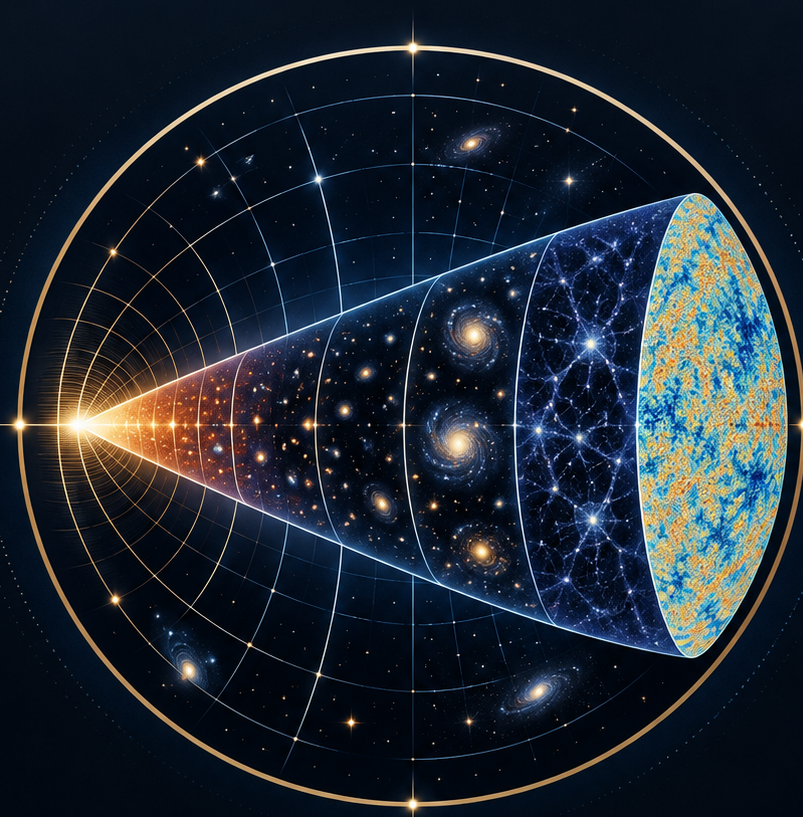
The standard cosmological model, Lambda-CDM, describes a universe that began in a hot, dense state about 13.8 billion years ago and has been expanding and cooling ever since. The first fractions of a second set the fundamental physics; the next few hundred thousand years produced the light elements and the cosmic microwave background (CMB); and then came the long, dark period when gravity slowly assembled the first structures. The first galaxies are the culmination of that process — the first objects large enough to sustain ongoing star formation and to influence the surrounding intergalactic medium.
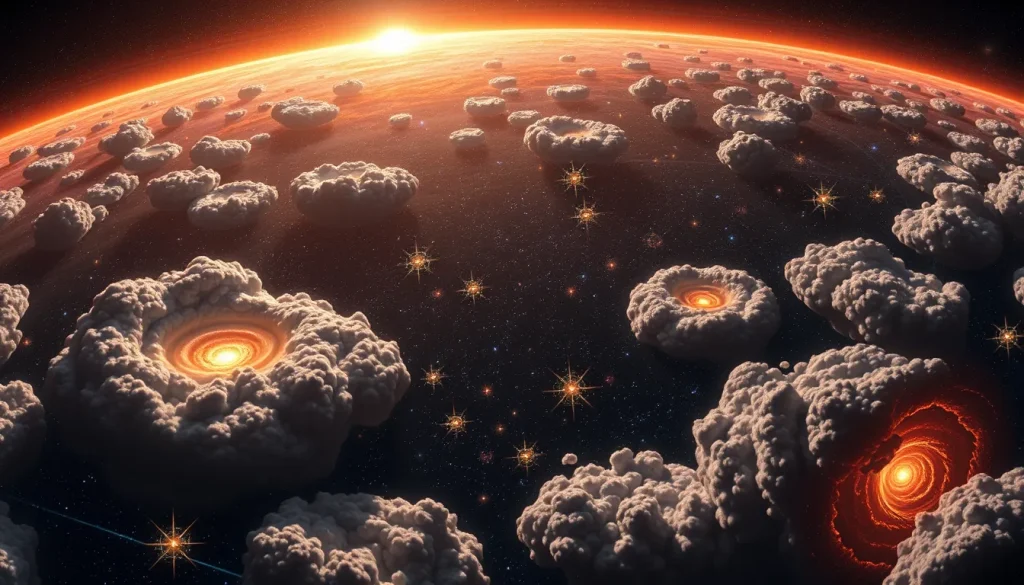
According to Bromm & Yoshida (2011), the first galaxies formed “at the end of the cosmic dark ages, a few 100 million years after the Big Bang.” They were built from dark matter halos that collapsed from tiny density fluctuations seeded by inflation. These halos attracted primordial gas — mostly hydrogen and helium — which cooled and fragmented, giving birth to the first stars, known as Population III stars. These stars were likely massive, hot, and short-lived, and their ultraviolet radiation began to reionize the neutral hydrogen that filled the universe.
Modern observations, especially with the James Webb Space Telescope (JWST), have transformed our view of this era. As Stark et al. (2025) note, “This field has undergone a transformation in the last two years” thanks to JWST’s deep imaging and spectroscopy, revealing galaxies throughout the first billion years. The Nature Astronomy perspective from 2025 highlights that JWST has provided “a snapshot of the great progress made towards understanding the initial chapters of our cosmic history.”
Cosmic Epochs
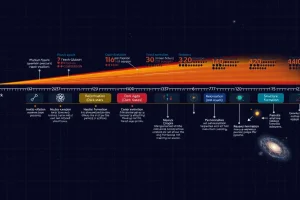
The history of the universe is often divided into epochs, each dominated by different physical processes. The following table summarizes the major epochs from the Planck epoch to structure formation.
| Epoch | Time after Big Bang | Redshift | Temperature | Key Events |
|---|---|---|---|---|
| Planck Epoch | <10⁻⁴³ s | >10³² | >10³² K | Quantum gravity effects; all forces unified |
| Grand Unification Epoch | 10⁻⁴³–10⁻³⁶ s | ~10²⁸ | 10²⁸–10³² K | Strong force separates from electroweak |
| Inflationary Epoch | 10⁻³⁶–10⁻³² s | ~10²⁵ | ~10²⁷ K | Exponential expansion; seeds for structure |
| Electroweak Epoch | 10⁻³²–10⁻¹² s | ~10²⁰ | 10¹⁵–10²⁷ K | Electromagnetic and weak forces separate |
| Quark Epoch | 10⁻¹²–10⁻⁶ s | ~10¹⁵ | 10¹²–10¹⁵ K | Quarks and gluons form quark-gluon plasma |
| Hadron Epoch | 10⁻⁶–1 s | ~10¹² | 10¹⁰–10¹² K | Protons and neutrons form; matter-antimatter asymmetry |
| Lepton Epoch | 1–10 s | ~10¹⁰ | 10⁹–10¹⁰ K | Leptons dominate; neutrinos decouple |
| Photon Epoch | 10 s–380,000 yr | 10⁴–10¹⁰ | 3000–10⁹ K | Nucleosynthesis; photons dominate; CMB released |
| Recombination | ~380,000 yr | ~1100 | ~3000 K | Electrons combine with nuclei; CMB emitted |
| Dark Ages | 380,000 yr–200 Myr | 20–1100 | ~10–3000 K | No stars; neutral hydrogen fills space |
| Reionization | ~200 Myr–1 Gyr | 6–20 | ~10–100 K | First stars and galaxies reionize hydrogen |
| Structure Formation | >1 Gyr | <6 | <10 K | Galaxies cluster; large-scale structure evolves |
When It Happened
The first galaxies appeared during the Reionization epoch, roughly 100–200 million years after the Big Bang (Bromm & Yoshida, 2011). This is when the first stars ignited and began to ionize the surrounding neutral hydrogen.
Temperature and Redshift
At the time of first galaxy formation, the cosmic microwave background had cooled to about 30 K, and the gas temperature was similar. The redshift was approximately z ≈ 10–30, meaning the universe was much smaller and denser than today.
Dominant Physics
Gravity from dark matter halos was the primary driver. The primordial gas, composed of hydrogen and helium, cooled via molecular hydrogen lines, allowing it to collapse into protostars. The first stars (Population III) were likely very massive (tens to hundreds of solar masses) and short-lived, ending in supernovae that enriched the surrounding gas with heavy elements.
What Came Before
Before the first galaxies, the universe was in the Dark Ages — a period after recombination when no stars existed and the universe was filled with neutral hydrogen and dark matter. The only radiation was the fading CMB and the 21-cm line from hydrogen.
What Came Next
After the first galaxies formed, they grew through mergers and accretion, eventually assembling into the diverse galaxy population we see today. Their ultraviolet radiation reionized the intergalactic medium, completing the last major phase transition of the universe.
Evidence
Direct evidence comes from deep observations with JWST, which has detected galaxies at redshifts beyond 10, showing that luminous galaxies existed earlier than previously expected (Stark et al., 2025). The CMB measurements from COBE, WMAP, and Planck provide the initial conditions, while the observed reionization history constrains the timing and nature of the first galaxies.
Why It Matters
Understanding the first galaxies is central to cosmology because they are the bridge between the simple, uniform early universe and the complex structure we see today. They are the sites where the first heavy elements were forged, where reionization began, and where the seeds of supermassive black holes may have formed. By studying them, we learn about the fundamental physics of star formation, galaxy assembly, and the interplay between radiation and matter in the early universe. Moreover, the first galaxies are a key test of the Lambda-CDM model: their abundance, luminosities, and clustering properties must match predictions, and any discrepancy could point to new physics.
Evidence / Sources
The following sources provide authoritative, up-to-date information on the first galaxies and the early universe:
- Bromm, V., & Yoshida, N. (2011). The First Galaxies. Annual Review of Astronomy and Astrophysics. doi:10.1146/annurev-astro-081710-102608
- Stark, D. P., Topping, M. W., Endsley, R., & Tang, M. (2025). Observations of the First Galaxies in the Era of JWST. arXiv. doi:10.48550/arxiv.2501.17078
- The first billion years according to JWST. (2025). Nature Astronomy, 9, 1134–1147. doi:10.1038/s41550-025-02624-5
- Stark, D. P. (2016). Galaxies in the First Billion Years After the Big Bang. Annual Review of Astronomy and Astrophysics, 54, 761–803. doi:10.1146/annurev-astro-081915-023417
Related Registry Entries
Explore related topics in this reference system:
FAQ
When did the first galaxies form?
The first galaxies formed about 100–200 million years after the Big Bang, during the cosmic dawn, at redshifts of roughly 10–30. This is supported by theoretical models and confirmed by JWST observations of very distant galaxies.
What were the first galaxies like?
They were much smaller and more irregular than modern galaxies, with masses perhaps a million to a billion times the Sun. They contained massive Population III stars, which were hot and short-lived, and they were embedded in dark matter halos that provided the gravitational pull for gas to collapse.
How do we observe galaxies from the first billion years?
We use deep imaging and spectroscopy with large telescopes, especially the James Webb Space Telescope (JWST), which operates in infrared wavelengths. JWST can detect the light from galaxies at redshifts greater than 10, providing direct observations of the early universe. Previous missions like Hubble, Spitzer, and ground-based observatories also contributed.
What role did the cosmic microwave background play in galaxy formation?
The CMB is the relic radiation from the Big Bang, released at recombination. Its tiny temperature fluctuations (anisotropies) are the seeds of structure. These density variations, amplified by gravity, led to the formation of dark matter halos and eventually galaxies. Missions like COBE, WMAP, and Planck mapped these fluctuations with increasing precision.
Did the first galaxies ionize the universe?
Yes, the ultraviolet radiation from the first stars and galaxies is thought to be the main driver of reionization, the process that turned the neutral hydrogen in the intergalactic medium into ionized plasma. This process began around redshift 20 and was largely complete by redshift 6, about 1 billion years after the Big Bang.
Leave a Reply