Short Answer
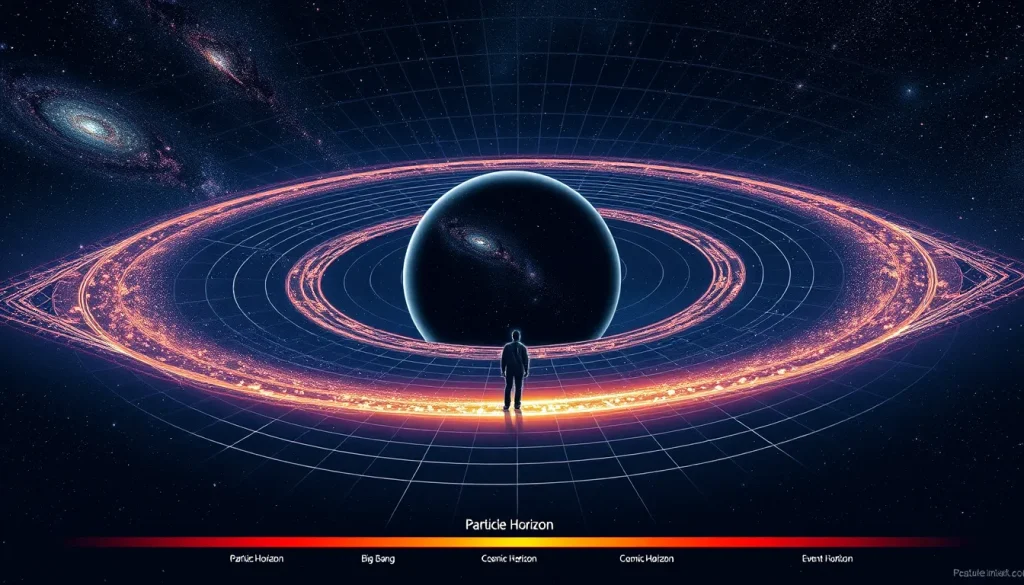
A cosmic horizon is a boundary in space-time beyond which events cannot be observed from a given vantage point. In cosmology, the term most often refers to the particle horizon, which marks the edge of the observable universe—the maximum distance from which light has had time to reach us since the Big Bang. A second type, the event horizon, sets the boundary of all possible future observations.
| Property | Value |
|---|---|
| Particle horizon distance | ~46.5 billion light-years (comoving) |
| Age of universe | 13.8 billion years |
| Event horizon (future limit) | ~16 billion light-years (comoving) |
| Hubble constant (H₀) | ~67.4 km/s/Mpc (Planck 2018) |
| Cosmic microwave background temperature | 2.725 K |
| Key missions | COBE, WMAP, Planck, JWST |
Main Explanation
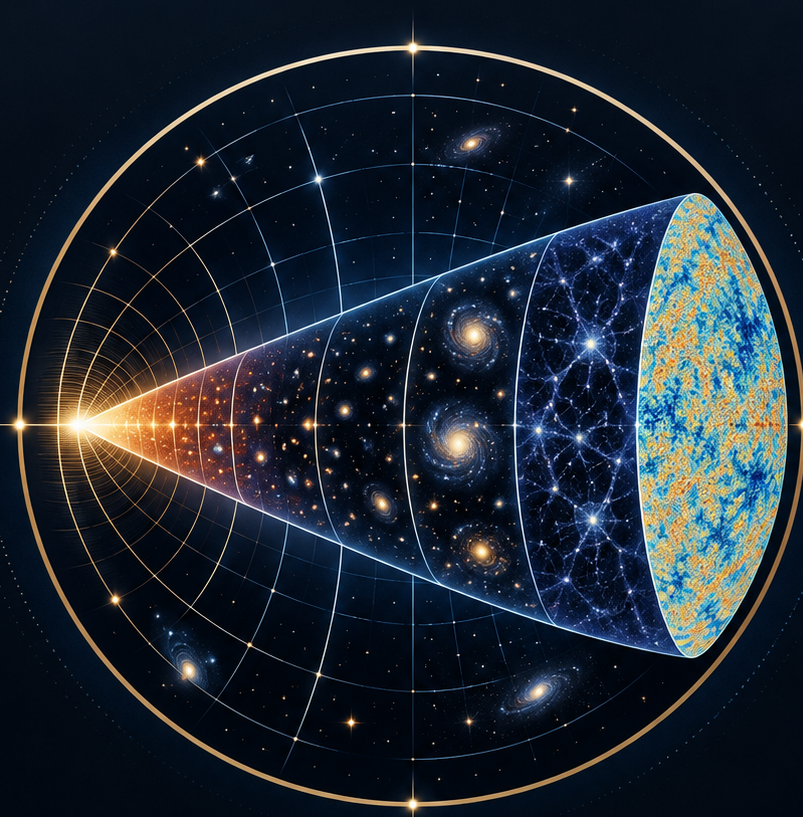
The universe is expanding, and light travels at a finite speed. As a result, we can only see objects whose light has had enough time to reach us since the beginning of cosmic expansion. The particle horizon is the comoving distance to the farthest region from which light has traveled to the observer over the entire age of the universe. It defines the size of the observable universe. Because space itself expands, this distance is not simply the age of the universe times the speed of light (13.8 billion light-years), but rather the speed of light times the conformal time, which accounts for the stretching of space. The current comoving distance to the particle horizon is roughly 46.5 billion light-years.
The event horizon is different: it separates events that can ever be observed from those that cannot, even if we wait forever. In an accelerating universe (driven by dark energy), the expansion causes distant galaxies to recede faster than light can traverse the growing space between us, so there is a limit to how far into the future we can see. The event horizon is the boundary of the “future observable universe.”
Both horizons arise from the interplay of general relativity, cosmic expansion, and the finite age of the universe. They are not physical walls but geometric boundaries in space-time.
Cosmic Epochs: A Timeline of the Universe
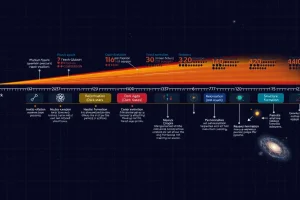
The standard cosmological model (ΛCDM) describes a sequence of epochs from the initial singularity to the present. The following table summarizes the key phases, and the sections below provide details.
| Epoch | Time After Big Bang | Temperature | Redshift | Key Events |
|---|---|---|---|---|
| Planck epoch | <10⁻⁴³ s | >10³² K | >10³² | Quantum gravity era; all forces unified |
| Grand Unification epoch | 10⁻⁴³ – 10⁻³⁶ s | 10²⁷ – 10³² K | 10²⁷ – 10³² | Strong force separates from electroweak |
| Inflationary epoch | 10⁻³⁶ – 10⁻³² s | ~10²⁷ K | ~10²⁷ | Exponential expansion; seeds of structure |
| Electroweak epoch | 10⁻³² – 10⁻¹² s | 10¹⁵ – 10²⁷ K | 10¹⁵ – 10²⁷ | Electromagnetic and weak forces separate |
| Quark epoch | 10⁻¹² – 10⁻⁶ s | 10¹² – 10¹⁵ K | 10¹² – 10¹⁵ | Quarks and gluons form quark-gluon plasma |
| Hadron epoch | 10⁻⁶ – 1 s | 10¹⁰ – 10¹² K | 10¹⁰ – 10¹² | Protons and neutrons form; matter-antimatter asymmetry |
| Lepton epoch | 1 – 10 s | 10⁹ – 10¹⁰ K | 10⁹ – 10¹⁰ | Leptons dominate; neutrinos decouple |
| Photon epoch | 10 s – 380,000 yr | 10⁴ – 10⁹ K | 10⁴ – 10⁹ | Photons dominate; Big Bang nucleosynthesis |
| Recombination | ~380,000 yr | ~3,000 K | ~1,100 | Electrons combine with nuclei; CMB released |
| Dark Ages | 380,000 yr – ~150 million yr | ~3,000 K to ~60 K | 1,100 to ~20 | No luminous sources; neutral hydrogen fills space |
| Reionization | ~150 million – 1 billion yr | ~60 K to ~20 K | ~20 to ~6 | First stars and galaxies ionize hydrogen |
| Structure Formation | 1 billion yr – present | <20 K | <6 | Galaxies, clusters, and large-scale structure form |
Planck Epoch
When: <10⁻⁴³ s (the Planck time). Temperature: >10³² K. Redshift: >10³². Dominant physics: Quantum gravity; all four fundamental forces unified. What happened: The universe is in a state of extreme density and temperature, where classical general relativity breaks down. Before: The initial singularity (or a quantum gravity phase). After: Grand Unification epoch.
Grand Unification Epoch
When: 10⁻⁴³ – 10⁻³⁶ s. Temperature: 10²⁷ – 10³² K. Redshift: 10²⁷ – 10³². Dominant physics: Grand unified theories; strong force separates from electroweak. What happened: The strong nuclear force becomes distinct, while electromagnetic and weak forces remain unified. Before: Planck epoch. After: Inflationary epoch.
Inflationary Epoch
When: 10⁻³⁶ – 10⁻³² s (or later). Temperature: ~10²⁷ K. Redshift: ~10²⁷. Dominant physics: Scalar field (inflaton) drives exponential expansion. What happened: The universe expands by a factor of at least 10²⁶, smoothing out initial irregularities and seeding quantum fluctuations that later grow into galaxies. Before: Grand Unification epoch. After: Electroweak epoch.
Electroweak Epoch
When: 10⁻³² – 10⁻¹² s. Temperature: 10¹⁵ – 10²⁷ K. Redshift: 10¹⁵ – 10²⁷. Dominant physics: Electroweak interaction; Higgs mechanism. What happened: The electromagnetic and weak forces separate as the universe cools. Before: Inflationary epoch. After: Quark epoch.
Quark Epoch
When: 10⁻¹² – 10⁻⁶ s. Temperature: 10¹² – 10¹⁵ K. Redshift: 10¹² – 10¹⁵. Dominant physics: Quark-gluon plasma. What happened: Quarks and gluons exist freely, but as the universe cools they begin to combine into hadrons. Before: Electroweak epoch. After: Hadron epoch.
Hadron Epoch
When: 10⁻⁶ – 1 s. Temperature: 10¹⁰ – 10¹² K. Redshift: 10¹⁰ – 10¹². Dominant physics: Strong force; hadron formation. What happened: Protons and neutrons form. Matter and antimatter annihilate, leaving a slight excess of matter (baryogenesis). Before: Quark epoch. After: Lepton epoch.
Lepton Epoch
When: 1 – 10 s. Temperature: 10⁹ – 10¹⁰ K. Redshift: 10⁹ – 10¹⁰. Dominant physics: Leptons (electrons, muons, neutrinos). What happened: Leptons and antileptons annihilate; neutrinos decouple and free-stream. Before: Hadron epoch. After: Photon epoch.
Photon Epoch
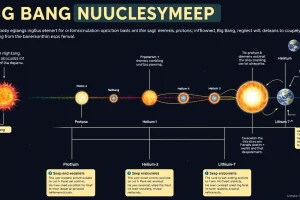
When: 10 s – 380,000 yr. Temperature: 10⁴ – 10⁹ K. Redshift: 10⁴ – 10⁹. Dominant physics: Photons, electrons, and nuclei in thermal equilibrium. What happened: Big Bang nucleosynthesis produces light elements (H, He, Li). The universe is a hot, opaque plasma. Before: Lepton epoch. After: Recombination.
Recombination
When: ~380,000 yr. Temperature: ~3,000 K. Redshift: ~1,100. Dominant physics: Atomic physics; electron capture. What happened: Electrons combine with protons and helium nuclei to form neutral atoms. Photons decouple, creating the cosmic microwave background (CMB). Before: Photon epoch. After: Dark Ages.
Dark Ages
When: 380,000 yr – ~150 million yr. Temperature: ~3,000 K to ~60 K. Redshift: 1,100 to ~20. Dominant physics: Gravity; neutral hydrogen. What happened: The universe is dark and filled with neutral hydrogen gas. No stars or galaxies yet. Before: Recombination. After: Reionization.
Reionization
When: ~150 million – 1 billion yr. Temperature: ~60 K to ~20 K. Redshift: ~20 to ~6. Dominant physics: First stars and galaxies; ultraviolet radiation. What happened: The first stars (Population III) and galaxies form, emitting UV light that ionizes the surrounding hydrogen. Before: Dark Ages. After: Structure Formation.
Structure Formation
When: 1 billion yr – present. Temperature: <20 K. Redshift: <6. Dominant physics: Gravity; dark matter; dark energy. What happened: Galaxies, clusters, and superclusters form under gravitational collapse, while dark energy accelerates expansion. Before: Reionization. After: Present day.
Why It Matters
Cosmic horizons define the limits of our knowledge. The particle horizon sets the boundary of the observable universe—everything we can ever see, limited by the speed of light and the age of the universe. The event horizon determines what we might observe in the future. Understanding these horizons is essential for interpreting cosmological observations, such as the CMB, which provides a snapshot of the universe at recombination. The CMB, discovered by COBE and mapped with increasing precision by WMAP and the Planck mission, encodes the initial conditions from which all large-scale structure grew. The cosmic horizon also raises profound questions: What lies beyond? Is the universe infinite? These questions drive ongoing research and future missions like JWST, which peer deeper into the cosmic past.
Evidence / Sources
The standard model of cosmology is supported by multiple independent lines of evidence:
- Cosmic microwave background: The near-perfect blackbody spectrum and tiny temperature anisotropies measured by COBE, WMAP, and Planck match predictions of inflation and recombination.
- Big Bang nucleosynthesis: The observed abundances of light elements (hydrogen, helium, lithium) agree with predictions from the photon epoch.
- Large-scale structure: Galaxy surveys (e.g., SDSS, DES) show a distribution of matter consistent with gravitational growth from initial quantum fluctuations seeded during inflation.
- Accelerating expansion: Supernova observations and BAO measurements reveal dark energy, which shapes the event horizon.
Related Registry Entries
- Particle Horizon – The boundary of the observable universe.
- Event Horizon – The limit of future observations.
- Cosmic Microwave Background – Relic radiation from recombination.
- Inflation – Exponential expansion that set initial conditions.
- ΛCDM Model – The standard cosmological model.
FAQ
What is the difference between a particle horizon and an event horizon?
The particle horizon defines the maximum distance from which light has reached us so far—the edge of the observable universe. The event horizon marks the boundary of events that can ever be observed, even in the infinite future, due to cosmic acceleration.
Why is the observable universe larger than 13.8 billion light-years?
Because space itself has expanded while light has been traveling. The comoving distance to the particle horizon is about 46.5 billion light-years, even though the light has traveled for only 13.8 billion years.
What is the cosmic microwave background?
The CMB is the remnant radiation from the photon epoch, released when the universe cooled enough for electrons and protons to form neutral hydrogen. It provides a snapshot of the universe at about 380,000 years old.
How do we know inflation happened?
Inflation explains the observed flatness, homogeneity, and scale-invariant spectrum of density fluctuations. The detailed pattern of CMB anisotropies measured by WMAP and Planck matches inflation's predictions.
Leave a Reply