Short Answer
Short Answer: In cosmology, Omega (Ω) is the ratio of the actual density of the universe to the critical density—the precise density that makes space geometrically flat. If Ω = 1, the universe is flat and will expand forever (asymptotically slowing). If Ω 1, space is positively curved (closed) and expansion eventually reverses into a Big Crunch. Modern measurements place Ω_total at 1 within a small uncertainty, consistent with the inflationary paradigm and the Lambda-CDM model.
| Property | Value |
|---|---|
| Symbol | Ω (Omega) |
| Definition | Ratio of actual density (ρ) to critical density (ρcrit) |
| Formula | Ω = ρ / ρcrit |
| Critical density | ρcrit = 3H² / (8πG) |
| Geometry | Ω1: closed (spherical) |
| Current value | Ω_total ≈ 1.002 ± 0.010 (Planck 2018) |
| Components | Ω_matter ≈ 0.31, Ω_dark energy ≈ 0.69 |
Main Explanation
Omega is one of the most fundamental numbers in cosmology. It encodes the average density of the universe relative to a critical threshold set by the expansion rate. This single parameter determines the global geometry of space, the ultimate fate of cosmic expansion, and the growth of large-scale structure. In the standard Lambda-Cold Dark Matter (ΛCDM) model, Omega is not a single number but a sum of contributions from matter, radiation, and dark energy.
The critical density itself is derived from general relativity: it is the density at which the kinetic energy of expansion exactly balances the gravitational potential energy, leading to a flat, Euclidean geometry. As the UCLA cosmology tutorial explains, the curvature of space depends on the ratio ρ/ρcrit = Ω [1]. For Ω 1 it is positively curved (spherical) [1].
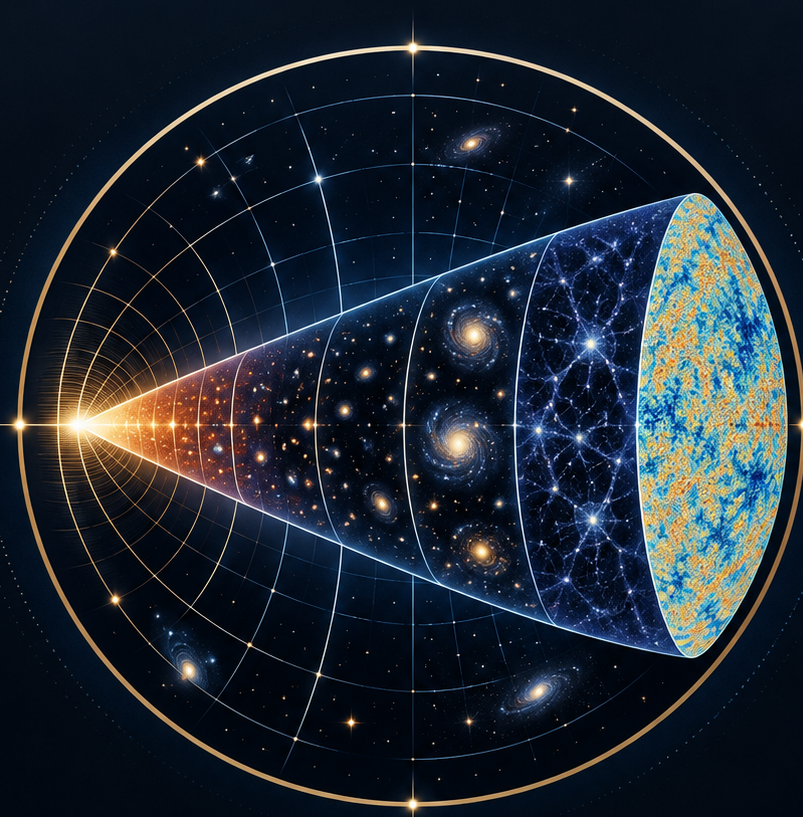
Omega also ties directly to the history of the universe. During the earliest moments—the Planck epoch, the Grand Unification epoch, and the inflationary era—the density parameter was driven toward 1 by cosmic inflation. Any tiny deviation from Ω=1 would have been amplified over time, so the fact that Ω is still very close to 1 today is powerful evidence that inflation occurred [3].
The cosmic microwave background (CMB) provides the most precise measurement of Ω. Observations from COBE, WMAP, and the Planck satellite have mapped the tiny temperature anisotropies in the CMB, whose angular power spectrum reveals the geometry of space. The position of the first acoustic peak in the CMB power spectrum directly indicates that the universe is spatially flat, implying Ω_total ≈ 1 [4].
Concept: Omega and the Shape of the Cosmos
Definition
Omega (Ω) is the ratio of the actual energy density of the universe to the critical density required for flat geometry. It is a dimensionless number that can be broken into components: Ω_matter (baryons + dark matter), Ω_radiation, and Ω_Λ (dark energy). The sum of all components gives Ω_total.
How It Works
The value of Ω determines the spatial curvature of the universe at any given time. In general relativity, the Friedmann equations relate the expansion rate (Hubble parameter H) to the density and curvature. The critical density ρcrit = 3H²/(8πG) is the dividing line. If the actual density is less than this, space has negative curvature (open); if greater, positive curvature (closed); if exactly equal, flat.
Omega also governs the fate of expansion. In a universe with only matter and radiation (no dark energy), Ω1 leads to a Big Crunch; Ω=1 leads to expansion that asymptotically approaches zero speed. However, the discovery of dark energy (Ω_Λ ≈ 0.69) changes this: even a flat universe with Ω_total=1 will accelerate forever due to the cosmological constant.
Equation
The fundamental equation is:
Ω = ρ / ρcrit, where ρcrit = 3H² / (8πG)
Here H is the Hubble constant, G is Newton’s gravitational constant, and ρ is the total energy density. In the ΛCDM model, Ω_total = Ω_m + Ω_r + Ω_Λ, where Ω_m includes baryonic and dark matter, Ω_r is radiation (photons and neutrinos), and Ω_Λ is the dark energy density relative to critical.
Example
Imagine a universe with H = 70 km/s/Mpc (typical observed value). The critical density is about 9 × 10⁻²⁷ kg/m³. If the actual density of matter is 3 × 10⁻²⁷ kg/m³, then Ω_m ≈ 0.33. Adding dark energy density of 6 × 10⁻²⁷ kg/m³ gives Ω_Λ ≈ 0.67, so Ω_total ≈ 1.0. This is roughly what we observe today.
Observable Consequences
The most direct observable consequence of Ω is the angular size of the first acoustic peak in the CMB power spectrum. For a flat universe (Ω=1), this peak appears at an angular scale of about 1 degree. For open or closed universes, the peak shifts to larger or smaller angles respectively. Planck measurements confirm the peak at the flat-universe position, yielding Ω_total = 1.002 ± 0.010 [4].
Omega also affects the growth of cosmic structure. In a high-density universe (Ω>1), gravitational collapse is stronger, leading to more clustered galaxies. In a low-density universe, structure formation freezes earlier. Observations of galaxy clustering and baryon acoustic oscillations (BAO) independently constrain Ω_m ≈ 0.31, consistent with CMB results.
Common Misconceptions
Misconception 1: “Omega must be exactly 1 because the universe is flat.” While observations are consistent with Ω_total = 1 within a small uncertainty, it is not proven to be exactly 1. The error bar allows for tiny deviations, but inflation predicts Ω is driven extremely close to 1.
Misconception 2: “Omega is a measure of how much matter there is.” Omega includes all forms of energy—matter, radiation, and dark energy. The matter density parameter Ω_m is only one component.
Misconception 3: “If Ω > 1, the universe will definitely collapse.” With dark energy, even a closed universe (Ω>1) can expand forever if the dark energy density is high enough. The fate depends on the equation of state of dark energy.
The Cosmic Epochs and Omega
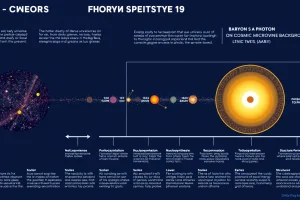
Omega evolves with time. In the early radiation-dominated era, Ω was extremely close to 1 because inflation flattened the universe. As the universe expanded and cooled, the density parameters of matter and radiation changed, but the total Ω remained near 1. The following table summarizes the major epochs and their connection to Omega.
| Epoch | Time after Big Bang | Temperature | Redshift | Dominant Physics | Key Events |
|---|---|---|---|---|---|
| Planck epoch | 0 to 10−43 s | >1032 K | >1032 | Quantum gravity | All forces unified; unknown physics |
| Grand Unification epoch | 10−43 to 10−36 s | 1027–1032 K | 1027–1032 | GUT forces | Strong force separates |
| Inflationary epoch | 10−36 to 10−32 s | ~1027 K | ~1027 | Inflaton field | Exponential expansion; Ω driven to 1 |
| Electroweak epoch | 10−32 to 10−12 s | 1015–1027 K | 1015–1027 | Electroweak force | Higgs mechanism gives mass |
| Quark epoch | 10−12 to 10−6 s | 1012–1015 K | 1012–1015 | Quark-gluon plasma | Quarks and gluons free |
| Hadron epoch | 10−6 to 1 s | 1010–1012 K | 1010–1012 | Hadrons, baryons | Protons and neutrons form |
| Lepton epoch | 1 to 10 s | 109–1010 K | 109–1010 | Leptons, neutrinos | Neutrinos decouple |
| Photon epoch | 10 s to 380,000 yr | 3,000–109 K | 1,000–109 | Photons, nuclei, electrons | Nucleosynthesis (BBN) |
| Recombination | ~380,000 yr | ~3,000 K | ~1,100 | Atoms form | CMB released |
| Dark Ages | 380,000 yr to ~150 million yr | ~50–3,000 K | ~20–1,100 | Neutral hydrogen | No stars yet |
| Reionization | ~150 million to 1 billion yr | ~10–50 K | ~6–20 | First stars and galaxies | UV light reionizes hydrogen |
| Structure Formation | 1 billion yr to present | 2.7 K | 0–6 | Gravity, dark energy | Galaxies, clusters form |
Why It Matters
Omega is not just a theoretical parameter; it is a measured quantity that tells us the composition and fate of the universe. Knowing Ω_total lets us determine whether space is flat or curved, which affects the propagation of light and the interpretation of astronomical distances. The fact that Ω_total is so close to 1 supports the idea of cosmic inflation, which naturally drives Ω to 1. Moreover, the separate components—Ω_m and Ω_Λ—reveal the surprising dominance of dark energy, which now accelerates cosmic expansion. Understanding Omega is therefore central to answering the oldest questions: Are we alone in a finite or infinite universe? Will expansion continue forever? What is the universe made of?
Evidence / Sources
The evidence for Ω ≈ 1 comes from multiple independent observations:
- CMB anisotropies: The position of the first acoustic peak in the power spectrum measured by Planck and WMAP locates the geometry of space. The peak at ℓ ≈ 220 corresponds to a flat universe [1][4].
- Baryon acoustic oscillations (BAO): The characteristic scale of galaxy clustering imprinted by sound waves in the early universe gives a standard ruler that also implies flatness when combined with CMB data.
- Supernovae Ia: Distant supernovae reveal an accelerating expansion, indicating Ω_Λ > 0, which when combined with matter density gives Ω_total ≈ 1.
- Inflationary theory: The near-flatness of the universe is a natural prediction of inflation, and observations are consistent with that prediction.
Key missions: COBE (1992) first detected CMB anisotropies; WMAP (2003–2012) produced detailed maps; Planck (2013–2018) refined measurements to high precision. The James Webb Space Telescope (JWST) is now probing reionization and structure formation, further testing the ΛCDM model.
Related Registry Entries
FAQ
Why is Omega so close to 1?
Cosmic inflation stretches any initial curvature to near-flatness, driving Ω extremely close to 1. Observations confirm this, as any significant deviation would have grown over time to a value very different from 1 today.
Does Omega change over time?
Yes. In the early radiation-dominated era, Ω was very close to 1. As the universe expands, the density parameters of matter and radiation evolve differently, but the total Ω remains near 1 if dark energy behaves like a cosmological constant. The individual components (Ω_m, Ω_Λ) change with time.
What is the difference between Ω_m and Ω_Λ?
Ω_m is the matter density (baryonic and dark matter) relative to critical density, while Ω_Λ is the dark energy density relative to critical. Together with radiation, they sum to Ω_total. Current values are Ω_m ≈ 0.31 and Ω_Λ ≈ 0.69.
How is Omega measured?
The most precise measurement comes from the cosmic microwave background. The angular scale of the first acoustic peak in the temperature power spectrum directly reveals the spatial curvature. Combining CMB data with BAO and supernova observations gives Ω_total ≈ 1.002 ± 0.010.



Leave a Reply