Skip to content
BigBangRegistry.com
  • Big Bang
  • Cosmic
  • Cosmic Timeline
  • Cosmology
  • Early Universe
  • Observations
  • Experiments
  • Tools
    • Universe Age at Redshift Calculator
    • Interactive Cosmic Timeline
    • Cosmological Distance Calculator

Recent Posts

  • What Is the Eddington Limit and Why Does It Matter for Black Hole Growth?
  • How Did Matter–Antimatter Asymmetry Arise? (Baryogenesis)
  • What Are Primordial Black Holes?
  • What Are Redshift Surveys and What Do They Reveal About the Universe?
  • What Is the BICEP/Keck Experiment and What Did It Reveal About Primordial Gravitational Waves?

Recent Comments

No comments to show.

Archives

  • November 2026
  • October 2026
  • September 2026
  • August 2026

Categories

  • Acoustic Peaks
  • Anisotropies
  • BAO
  • BBN
  • Big Bang
  • CMB
  • CMB Explained
  • CMB Maps
  • COBE Mission
  • Cosmic horizon
  • Cosmic Microwave Background
  • Cosmic Timeline
  • Cosmological principle
  • Cosmology Concepts
  • Critical density
  • Curvature
  • Dark Ages
  • Discovery of CMB
  • Early Universe
  • Evidence & Observations
  • Expansion
  • First Stars & Galaxies
  • Hadron Epoch
  • Hubble constant
  • Hubble–Lemaître law
  • Inflation
  • JWST
  • Large-scale structure
  • Lepton Epoch
  • Misconceptions
  • Missions & Experiments
  • Nucleosynthesis
  • Observable universe
  • Particle Physics
  • Photon Epoch
  • Planck
  • Planck Epoch
  • Planck Mission
  • Polarization
  • Power Spectrum
  • Quark Epoch
  • Questions
  • Recombination
  • Redshift
  • Reionization
  • Scale factor
  • Simons Observatory
  • SPHEREx
  • Supernova evidence
  • Temperature of CMB
  • Theory
  • Uncategorized
  • ΛCDM

Evidence & Observations

A collection of the key observational evidence that supports the Big Bang model of the universe’s origin and evolution.

What Are Baryon Acoustic Oscillations? A Cosmic Ruler for the Universe

What Are Baryon Acoustic Oscillations? A Cosmic Ruler for the Universe

August 25, 2026 | BAO, Cosmology Concepts, Large-scale structure | Earnest S. Carroll

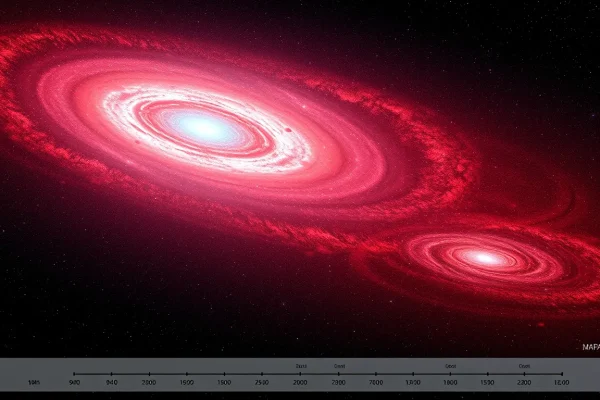
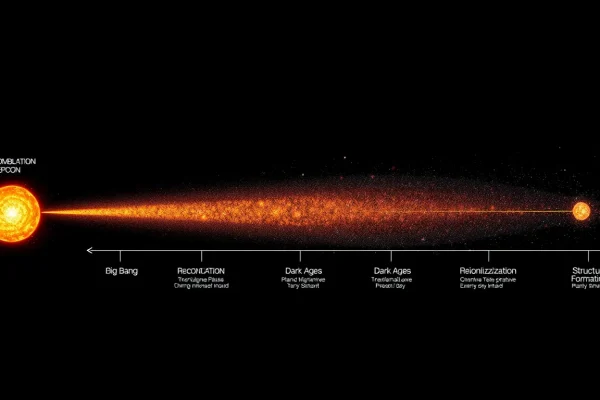
Baryon acoustic oscillations (BAO) are subtle ripples in the distribution of matter across the cosmos, frozen in when the universe was only 380,000 years old. They serve as a standard ruler for measuring cosmic distances and probing the nature of dark energy.
Read More →
Galaxy Redshift and the Expanding Universe: A Cosmic Timeline

Galaxy Redshift and the Expanding Universe: A Cosmic Timeline

August 23, 2026 | Redshift | Earnest S. Carroll

Galaxy redshift is the foundational observation that revealed the universe is expanding. This article traces how stretched light from distant galaxies became the cornerstone of modern cosmology, from Edwin Hubble’s discovery to the detailed cosmic timeline of the Lambda-CDM model.

Read More →
Why Can We Not See Before Recombination With Light?

Why Can We Not See Before Recombination With Light?

August 21, 2026 | CMB, Early Universe, Recombination | Earnest S. Carroll

Before recombination, the universe was an opaque plasma of free electrons and photons. When electrons and protons combined to form neutral hydrogen, light finally decoupled, creating the cosmic microwave background. This article explains the physics behind this cosmic milestone and why no telescope can see earlier with light.

Read More →
What Is Cosmological Redshift? A Guide to the Expanding Universe

What Is Cosmological Redshift? A Guide to the Expanding Universe

August 20, 2026 | Redshift | Earnest S. Carroll

Cosmological redshift is the stretching of light to longer wavelengths as the universe expands. This phenomenon underpins our understanding of cosmic history, from the Big Bang to the formation of galaxies, and is a cornerstone of modern cosmology.

Read More →
What Is Big Bang Nucleosynthesis Evidence?

What Is Big Bang Nucleosynthesis Evidence?

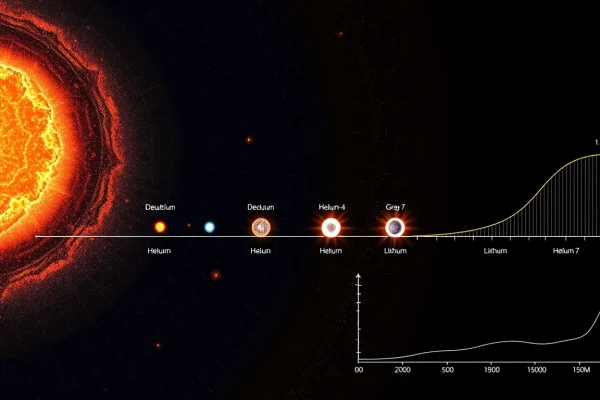
August 18, 2026 | BBN, Big Bang, Nucleosynthesis | Earnest S. Carroll

Big Bang nucleosynthesis (BBN) is the production of light elements during the first minutes of cosmic time. Its evidence comes from the remarkable agreement between predicted and observed primordial abundances, which also constrains the baryon density and supports the standard hot Big Bang model.

Read More →
How Type Ia Supernovae Revealed Accelerating Expansion

How Type Ia Supernovae Revealed Accelerating Expansion

August 18, 2026 | Supernova evidence | Earnest S. Carroll

In the late 1990s, two independent teams used Type Ia supernovae as standard candles to trace the universe’s expansion history. Their surprising conclusion—that cosmic expansion is accelerating—revolutionized cosmology and led to the concept of dark energy, a mysterious force driving the universe apart.

Read More →
How Does Primordial Helium Support Big Bang Cosmology?

How Does Primordial Helium Support Big Bang Cosmology?

August 16, 2026 | BBN, Big Bang, Nucleosynthesis | Earnest S. Carroll

Primordial helium, forged in the first minutes after the Big Bang, provides a crucial test of the hot Big Bang model. Its measured abundance matches theoretical predictions, reinforcing our understanding of the universe’s origin and evolution.

Read More →
How Cosmologists Measure the CMB From Earth

How Cosmologists Measure the CMB From Earth

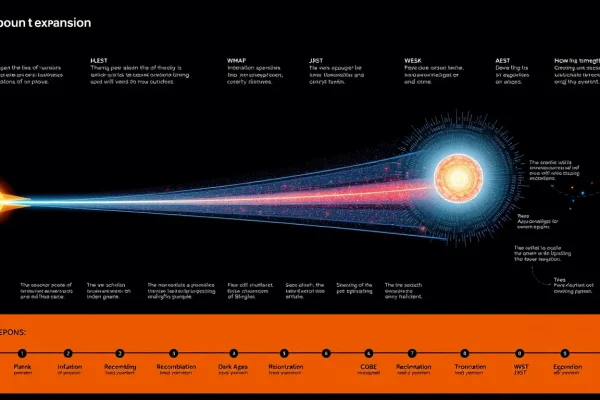
August 14, 2026 | CMB, CMB Explained, Cosmic Timeline | Earnest S. Carroll

The cosmic microwave background (CMB) is the oldest light in the universe, a relic of the hot Big Bang. This article explains how astronomers measure it from Earth, what it reveals about cosmic history, and why it anchors our modern understanding of the cosmos.

Read More →
What Is the Hubble–Lemaître Law?

What Is the Hubble–Lemaître Law?

August 12, 2026 | Hubble–Lemaître law | Earnest S. Carroll

The Hubble–Lemaître law describes the expansion of the universe, showing that galaxies recede at speeds proportional to their distance. It is a cornerstone of modern cosmology, linking the Big Bang to the cosmic microwave background and the large-scale structure of the cosmos.

Read More →
How Astronomers Measure the Age of the Universe: A Cosmic Timeline

How Astronomers Measure the Age of the Universe: A Cosmic Timeline

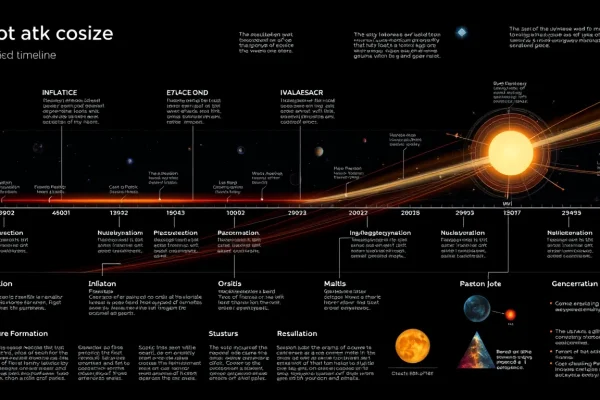
August 11, 2026 | CMB, Cosmic Timeline, Planck Mission | Earnest S. Carroll

The universe is 13.8 billion years old. This definitive guide explains how astronomers measure the age of the cosmos using the cosmic microwave background, stellar evolution, and the expansion rate, and traces the universe’s evolution from the Planck epoch to the present day.

Read More →

Posts pagination

← Previous 1 2 3 4 Next →

About This Site

Recent Articles

  • What Is the Eddington Limit and Why Does It Matter for Black Hole Growth?
  • How Did Matter–Antimatter Asymmetry Arise? (Baryogenesis)
  • What Are Primordial Black Holes?
  • What Are Redshift Surveys and What Do They Reveal About the Universe?
  • What Is the BICEP/Keck Experiment and What Did It Reveal About Primordial Gravitational Waves?
  • Home
  • Privacy Policy
  • About Us
  • Contact Us
  • Disclaimer
  • Terms of Service
© 2026 BigBangRegistry.com. All rights reserved. Powered by WordPress