Short Answer
Main Explanation
The cosmic microwave background (CMB) is the oldest light in the universe, a faint glow of radiation that fills all of space. Its discovery in 1965 by Arno Penzias and Robert Wilson was a turning point in modern cosmology, providing decisive evidence for the Big Bang theory and transforming our understanding of cosmic origins.
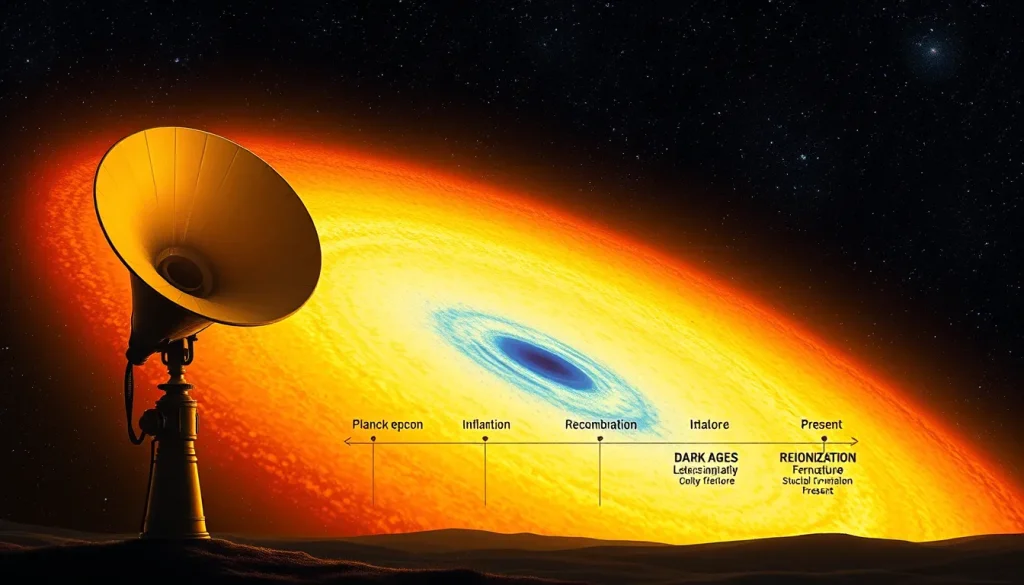
Penzias and Wilson were radio astronomers at Bell Telephone Laboratories in Holmdel, New Jersey. They were using a large horn antenna originally built for satellite communications (the Echo project) to study faint radio signals from the Milky Way. To their frustration, they found a persistent, unexplained background noise—a hiss that remained no matter where they pointed the antenna. After ruling out interference from pigeons and other potential sources, they concluded that the signal was real and isotropic (the same in all directions).
At the same time, a team at Princeton University led by Robert Dicke, Jim Peebles, and David Wilkinson was preparing to search for exactly such radiation—the leftover heat from the hot, dense early universe predicted by the Big Bang model. When Penzias and Wilson learned of their work, the pieces fell into place. The mysterious noise was the cosmic microwave background, with a temperature of approximately 3.5 K (later refined to 2.725 K). In 1978, Penzias and Wilson received the Nobel Prize in Physics for their discovery.
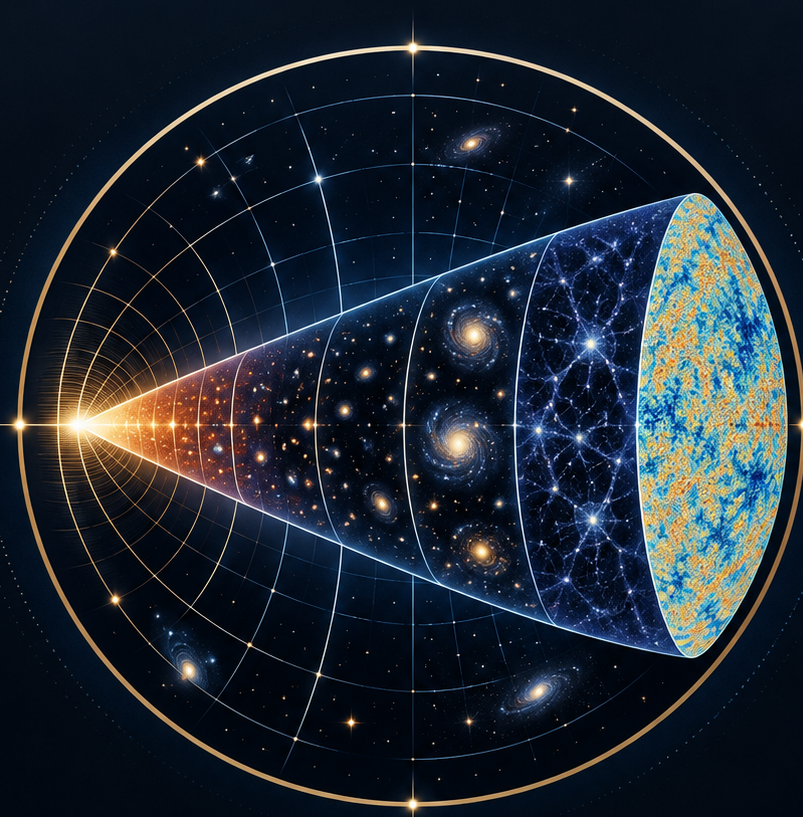
The CMB is a relic of the universe’s infancy. About 380,000 years after the Big Bang, the universe had cooled enough for protons and electrons to combine into neutral hydrogen atoms. Before that, photons were constantly scattered by free electrons, making the universe opaque. After recombination, photons could travel freely, and those same photons—now stretched by the expansion of space—form the CMB we observe today. This moment is known as the last scattering surface, and the CMB provides a snapshot of the universe at that epoch.
Cosmic Epochs: A Timeline
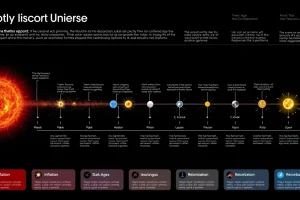
The history of the universe from the Planck epoch to the present is a story of cooling, expansion, and structure formation. The CMB is a key marker of the transition from a hot, opaque plasma to a transparent, neutral universe. The following table summarizes the major epochs of cosmic evolution according to the standard Lambda-CDM model.
| Epoch | Time After Big Bang | Temperature | Key Events |
|---|---|---|---|
| Planck Epoch | 0 to ~10⁻⁴³ s | >10³² K | Quantum gravity effects dominate; no known physics describes this era. |
| Grand Unification Epoch | 10⁻⁴³ to 10⁻³⁶ s | 10²⁷–10³² K | Strong and electroweak forces unified; inflation begins at the end. |
| Inflationary Epoch | 10⁻³⁶ to 10⁻³² s | ~10²⁷ K | Exponential expansion; quantum fluctuations seeded large-scale structure. |
| Electroweak Epoch | 10⁻³² to 10⁻¹² s | 10¹⁵–10²⁷ K | Electromagnetic and weak forces separate; W and Z bosons acquire mass. |
| Quark Epoch | 10⁻¹² to 10⁻⁶ s | 10¹²–10¹⁵ K | Quarks and gluons form a quark-gluon plasma; baryogenesis may occur. |
| Hadron Epoch | 10⁻⁶ to 1 s | 10¹⁰–10¹² K | Quarks combine into protons and neutrons; matter-antimatter annihilation. |
| Lepton Epoch | 1 to 10 s | 10⁹–10¹⁰ K | Leptons dominate; electron-positron pairs annihilate, leaving a small excess of matter. |
| Photon Epoch | 10 s to 380,000 years | 3,000–10⁹ K | Photons dominate; nucleosynthesis forms light elements (H, He, Li). |
| Recombination | ~380,000 years | ~3,000 K | Electrons bind to nuclei; universe becomes transparent; CMB released. |
| Dark Ages | 380,000 to ~150 million years | ~100–3,000 K | No stars yet; neutral hydrogen fills space; CMB cools and redshifts. |
| Reionization | ~150 million to 1 billion years | ~10–100 K | First stars and galaxies emit UV light, ionizing hydrogen; structure grows. |
| Structure Formation | 1 billion years to present | 2.725 K (CMB today) | Galaxies, clusters, and large-scale structure form under gravity; dark energy accelerates expansion. |
Each epoch is characterized by distinct physical processes and particle content. The CMB we observe today is the highly redshifted light from the recombination epoch—its temperature has dropped from about 3,000 K to just 2.725 K due to the expansion of space.
Why It Matters
The discovery of the CMB did more than confirm the Big Bang; it opened a direct observational window into the early universe. Detailed maps of the CMB, first made by the COBE satellite (1989–1993), then by WMAP (2001–2010) and Planck (2009–2013), have allowed cosmologists to measure the universe’s geometry, composition, and age with remarkable precision. The CMB’s tiny temperature fluctuations (anisotropies) reveal the seeds of all cosmic structure—galaxies, clusters, and superclusters—that grew through gravitational instability. The CMB also provides strong evidence for dark matter and dark energy, which together make up about 95% of the universe’s energy budget.
Moreover, the CMB is a direct test of the inflationary paradigm. The near-perfect blackbody spectrum and the statistical properties of the anisotropies match predictions of inflation. Upcoming experiments, such as the Simons Observatory and the James Webb Space Telescope (JWST), continue to probe the CMB and the first galaxies, refining our understanding of cosmic origins.
Evidence / Sources
The discovery of the CMB is well documented in historical and scientific sources. The Nobel Prize press release from 1978 (see NobelPrize.org) confirms the award to Penzias and Wilson for their discovery. An overview of the discovery is provided by the American Physical Society (APS News) and PBS (A Science Odyssey). The Wikipedia article on the discovery (Discovery of CMB) notes that Andrew McKellar had earlier measured an effective temperature of 2.3 K from CN absorption lines, but its significance was not recognized until after Penzias and Wilson’s work.
Related Registry Entries
- Cosmic Microwave Background (CMB)
- Big Bang Nucleosynthesis
- Inflation
- Recombination
- Dark Ages
- Reionization
FAQ
What exactly did Penzias and Wilson discover?
They discovered a persistent, isotropic microwave background noise with a temperature of about 3.5 K, which turned out to be the cosmic microwave background radiation—the relic of the Big Bang.
Why is the CMB important evidence for the Big Bang?
The CMB is the afterglow of the hot, dense early universe. Its near-perfect blackbody spectrum and tiny fluctuations match predictions of the Big Bang model and rule out the steady-state theory.
How has the CMB been studied since its discovery?
NASA's COBE (1989), WMAP (2001), and ESA's Planck (2009) mapped the CMB with increasing precision, measuring its temperature fluctuations, polarization, and spectrum. These data have refined cosmological parameters and supported the Lambda-CDM model.
What happened before the CMB was emitted?
Before recombination, the universe was a hot, opaque plasma of photons, electrons, and nuclei. During the photon epoch, nucleosynthesis produced light elements. Inflation occurred much earlier, seeding the density fluctuations that later became galaxies.
Leave a Reply