Short Answer
Main Explanation
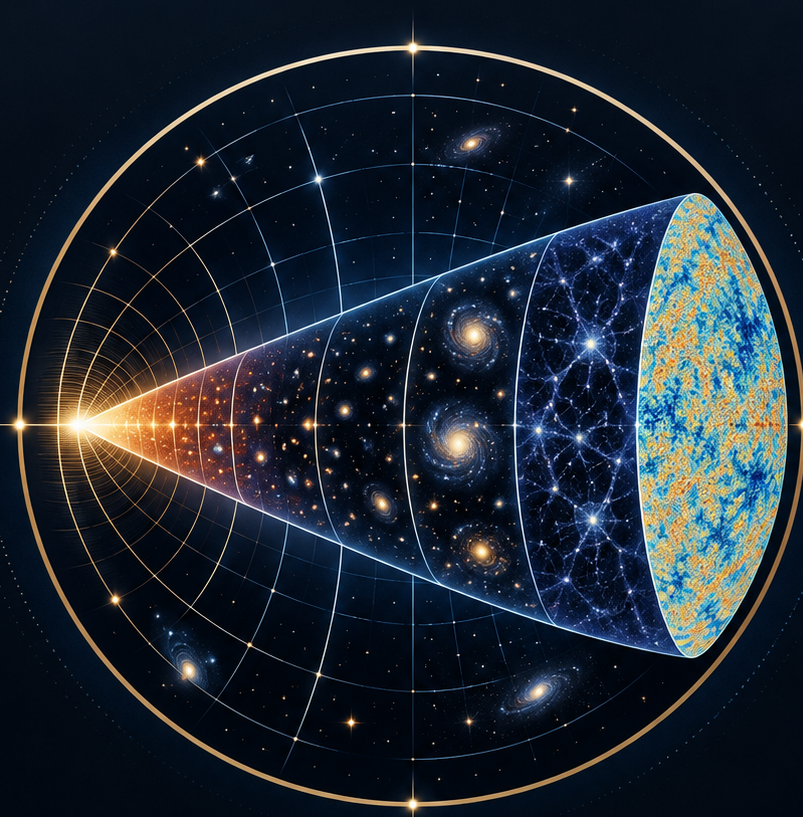
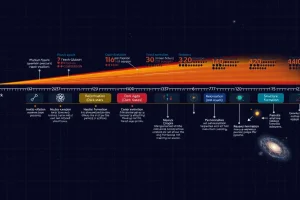
The photon epoch is a critical chapter in the standard Big Bang model, marking the period when photons—particles of light—dominated the energy content of the universe. It began roughly 10 seconds after the Big Bang, following the annihilation of most leptons and antileptons at the end of the lepton epoch, and lasted until about 380,000 years later, when the universe cooled enough for electrons to combine with nuclei, forming neutral atoms and releasing the cosmic microwave background (CMB).
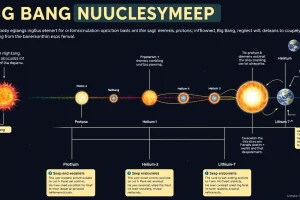
During the photon epoch, the universe was a hot, dense plasma of atomic nuclei, electrons, and photons. The high-energy photons continuously interacted with charged particles, keeping matter and radiation in thermal equilibrium. This epoch witnessed the primordial nucleosynthesis—the formation of light elements such as helium, deuterium, and trace amounts of lithium—during the first few minutes. As the universe expanded and cooled, the photon energy dropped, eventually allowing stable atoms to form, an event known as recombination, which ended the photon epoch and made the universe transparent to radiation.
The photon epoch is not an isolated event but part of a sequence of cosmic epochs that together describe the evolution of the universe from the Planck epoch to the present day. Understanding this period is essential for interpreting the CMB, which is a direct relic of the end of the photon epoch and provides a snapshot of the universe at that time.
Cosmic Epoch: The Photon Epoch
When It Happened
The photon epoch started about 10 seconds after the Big Bang and ended about 380,000 years later, at the moment of recombination. This timeline is well established by cosmological observations and theoretical models.
Temperature
At the beginning of the photon epoch, the temperature was roughly 1010 K (about 10 billion kelvin). By the end, at recombination, the temperature had fallen to approximately 3,000 K. The CMB we observe today has a temperature of about 2.725 K, corresponding to a redshift of about 1,100.
Approximate Redshift
The photon epoch spans redshifts from extremely high values (z > 109 at the start) down to z ≈ 1,100 at recombination. The CMB we detect today is redshifted from that era.
Dominant Particles/Physics
During the photon epoch, the universe was filled with a plasma of protons, neutrons, electrons, and photons. The physics is governed by quantum electrodynamics and nuclear reactions. At the start, photons were energetic enough to photodissociate deuterium, but as expansion cooled the universe, nucleosynthesis proceeded, creating helium-4, deuterium, and small amounts of lithium and beryllium.
What Happened
In the first few minutes, nucleosynthesis produced light elements. For the remainder of the epoch, the universe was a hot plasma where photons constantly scattered off free electrons and nuclei, preventing the formation of neutral atoms. This coupling meant the universe was opaque to radiation. As the temperature dropped to about 3,000 K, electrons and protons combined to form hydrogen atoms—recombination—and photons decoupled, streaming freely as the CMB.
What Came Before
The photon epoch was preceded by the lepton epoch, during which leptons and antileptons annihilated, leaving a small excess of matter. Before that were the hadron, quark, electroweak, and inflationary epochs, extending back to the Planck epoch.
What Came Next
After recombination, the universe entered the Dark Ages, a period with no luminous sources. Gravity then amplified tiny density fluctuations, leading to the formation of the first stars and galaxies, which triggered reionization and structure formation.
Evidence
The primary evidence for the photon epoch is the cosmic microwave background, discovered in 1965 and mapped precisely by COBE, WMAP, and Planck. The CMB’s near-perfect blackbody spectrum and its anisotropies match predictions of the photon epoch and recombination. Additionally, the observed abundances of light elements (e.g., helium-4, deuterium) agree with Big Bang nucleosynthesis calculations.
Why It Matters
The photon epoch is a cornerstone of modern cosmology. It explains the origin of the light elements, the existence of the CMB, and the transition from a plasma universe to a neutral one. The CMB provides a direct observational window into this era, allowing us to test the Big Bang model and measure fundamental parameters such as the density of baryonic matter and the curvature of space. Moreover, the photon epoch sets the initial conditions for structure formation, as the tiny density fluctuations imprinted in the CMB later grew into galaxies and clusters.
Evidence / Sources
Key sources include the Wikipedia article on the photon epoch, HandWiki’s astronomy entry, the History of the Universe website, and Harvard’s Cosmic Evolution series. These provide detailed descriptions of the timeline, physical processes, and observational evidence.
Related Registry Entries
This article is part of a series on cosmic epochs. See also: Planck Epoch, Inflationary Epoch, Quark Epoch, Hadron Epoch, Lepton Epoch, Recombination, Dark Ages, Reionization, and Structure Formation.
FAQ
What is the photon epoch?
The photon epoch is the period in the early universe, from about 10 seconds to 380,000 years after the Big Bang, when photons dominated the energy density. It ended with recombination, which produced the cosmic microwave background.
How long did the photon epoch last?
It lasted from about 10 seconds after the Big Bang to about 380,000 years later, a duration of roughly 380,000 years.
What happened during the photon epoch?
During the photon epoch, the universe was a hot plasma of nuclei, electrons, and photons. Big Bang nucleosynthesis created light elements, and the universe remained opaque until recombination formed neutral atoms and released the CMB.
What evidence do we have for the photon epoch?
The cosmic microwave background is the primary evidence. Its spectrum and anisotropies match predictions, and the observed abundances of light elements agree with nucleosynthesis calculations.

Leave a Reply