Short Answer
Main Explanation
The lepton epoch is a short but consequential chapter in the standard Big Bang timeline. It began roughly 1 second after the Big Bang, after the hadron epoch ended, and lasted until about 10 seconds. During this window, the mass-energy of the universe was dominated by leptons—electrons, positrons, and neutrinos—rather than by hadrons or photons. Although it lasted only a few seconds, the lepton epoch set the electron abundance, allowed neutrinos to decouple, and prepared the universe for the synthesis of the first light elements.
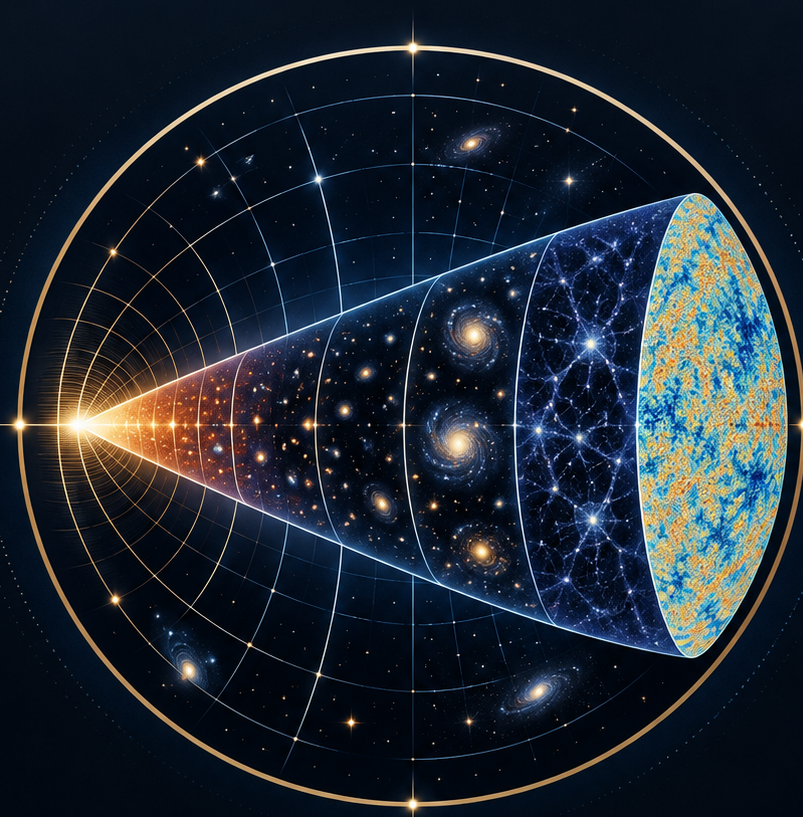
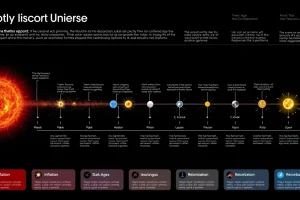
To understand the lepton epoch, it helps to see it within the larger cosmic timeline. The standard Lambda-CDM model describes the universe as expanding and cooling from an extremely hot, dense state. Each epoch is defined by which particles or forces dominated the behavior of the cosmos.
| Epoch | Time After Big Bang | Key Events |
|---|---|---|
| Planck epoch | Before 10-43 s | Quantum gravity; all forces possibly unified |
| Grand unification epoch | ~10-43–10-36 s | Strong force separates |
| Inflationary epoch | ~10-36–10-32 s | Rapid exponential expansion; seeds of structure |
| Electroweak epoch | ~10-32–10-12 s | Weak and electromagnetic forces separate |
| Quark epoch | ~10-12–10-6 s | Quark-gluon plasma; leptons also present |
| Hadron epoch | ~10-6–1 s | Quarks bind into hadrons; matter-antimatter annihilation |
| Lepton epoch | ~1–10 s | Leptons dominate; electron-positron annihilation; neutrino decoupling |
| Photon epoch | ~10 s–380,000 years | Photons dominate; Big Bang nucleosynthesis |
| Recombination | ~380,000 years | First neutral atoms; CMB released |
| Dark Ages | ~380,000–150 million years | Neutral hydrogen; no stars |
| Reionization | ~150 million–1 billion years | First stars and galaxies ionize gas |
| Structure formation | ~1 billion years–present | Galaxies, clusters, and large-scale structure |
One useful analogy for cosmic expansion is a stretching rubber sheet. As space expands, the wavelengths of light traveling through it also stretch, shifting them toward the red end of the spectrum. Astronomers use this cosmological redshift as a clock: the higher the redshift, the earlier the time we are observing. The cosmic microwave background (CMB), released when the first neutral atoms formed about 380,000 years after the Big Bang, is a direct relic of this hot early phase. Missions such as COBE, WMAP, and Planck measured the CMB’s temperature and tiny anisotropies, turning it into one of the strongest pieces of evidence for the Big Bang. The James Webb Space Telescope (JWST) now extends this story by observing the first galaxies that emerged after the dark ages and reionization.
Inflation is a brief period of extremely rapid expansion that stretched quantum fluctuations to cosmic scales, seeding the density variations that later grew into galaxies. After recombination, the universe entered the dark ages, a period with no stars. Gravity slowly amplified tiny density fluctuations, and the first stars and galaxies formed, ending the dark ages and beginning reionization. JWST is now observing some of the earliest galaxies, providing direct evidence for this transition. The lepton epoch, though much earlier, is part of the same continuous story: the cooling, expanding universe moved through a sequence of particle-dominated eras, each leaving observable traces.
Cosmic Epoch: The Lepton Epoch
When It Happened
The lepton epoch started roughly 1 second after the Big Bang and ended about 10 seconds later. It began when the universe had expanded and cooled enough that hadrons and anti-hadrons could no longer be created in large numbers, and it ended when the temperature dropped below the threshold for creating electron-positron pairs.
Temperature
During the lepton epoch, the universe was still hot enough to create neutrino and electron-positron pairs. This corresponds to temperatures of billions of kelvins. By about 10 seconds after the Big Bang, the temperature had fallen to the point where electron-positron pairs were gradually annihilated and could no longer be replenished.
Approximate Redshift
Because temperature scales inversely with the scale factor of the universe, the lepton epoch corresponds to a cosmological redshift of roughly 109. This is an estimate based on the temperature evolution of the standard model; the exact boundary is not sharp.
Dominant Particles/Physics
The dominant particles were leptons: electrons, positrons, electron neutrinos, muon and tau neutrinos, and their antiparticles. Photons were also abundant, and weak interactions still coupled neutrinos to the rest of the plasma. The strong force no longer dominated the large-scale behavior, because hadrons had largely annihilated at the end of the hadron epoch.
What Happened
At the start of the lepton epoch, leptons and anti-leptons were in thermal equilibrium with photons. As the universe expanded and cooled, the creation of lepton-antilepton pairs became inefficient. Most electrons and positrons then annihilated into photons, leaving a small residue of electrons—just enough to keep the universe electrically neutral. At the same time, neutrinos decoupled from the rest of the plasma and began free streaming through space. This neutrino decoupling is a defining feature of the epoch.
What Came Before
The lepton epoch followed the hadron epoch. The hadron epoch ended when the universe had expanded so much, and the energy density had fallen to such a level, that no more hadrons could be created. The majority of hadrons and anti-hadrons annihilated each other, leaving a small matter-antimatter asymmetry that would later form the protons and neutrons of ordinary matter.
What Came Next
After about 10 seconds, the universe entered the photon epoch, in which photons dominated the mass-energy. Big Bang nucleosynthesis overlaps with this period: during the first few minutes, protons and neutrons fused into the lightest nuclei, including deuterium, helium-3, helium-4, and lithium-7. The small residue of electrons from the lepton epoch later combined with these nuclei at recombination, about 380,000 years later.
Evidence
The lepton epoch is not observed directly, but its consequences are written into the universe. The cosmic neutrino background, a relic of neutrino decoupling, has not yet been detected directly, but its presence is inferred from Big Bang nucleosynthesis and the cosmic microwave background. The observed primordial abundances of helium and deuterium match predictions that depend on the expansion rate and particle content during and just after the lepton epoch. CMB anisotropies also constrain the number of relativistic particle species, providing indirect evidence for the neutrino background.
Why It Matters
The lepton epoch connects particle physics to cosmology. The annihilation of electron-positron pairs heated the photon bath relative to the decoupled neutrinos, leaving a subtle temperature difference between the CMB and the cosmic neutrino background. This difference affects the expansion rate during Big Bang nucleosynthesis and therefore the primordial abundances of light elements. Understanding the lepton epoch also sharpens our picture of how the universe became charge-neutral and how the first atoms could eventually form. In short, a few seconds of lepton-dominated physics helped set the stage for everything from the first nuclei to the first stars and galaxies.
Evidence / Sources
The description of the lepton epoch is grounded in standard Big Bang cosmology and particle physics. Key references include:
- Wikipedia: Lepton epoch
- History of the Universe: Lepton Epoch 1 to 10 seconds
- Scientific Library: Lepton epoch
- Physics Stack Exchange: Why did the quark epoch occur earlier than the lepton epoch?
These sources consistently place the lepton epoch between about 1 and 10 seconds after the Big Bang and identify electron-positron annihilation and neutrino decoupling as its central events.
Related Registry Entries
- Hadron Epoch — the preceding era when hadrons dominated and matter-antimatter annihilation occurred.
- Photon Epoch — the following era when photons dominated and Big Bang nucleosynthesis took place.
- Big Bang Nucleosynthesis — the formation of the first light nuclei minutes after the Big Bang.
- Cosmic Microwave Background — the relic radiation released at recombination, about 380,000 years later.
- Recombination — the epoch when electrons and nuclei combined to form neutral atoms.
- Dark Ages and Reionization — the periods before and during the formation of the first stars and galaxies.
FAQ
What is the lepton epoch?
It was the period from about 1 to 10 seconds after the Big Bang when leptons—electrons, positrons, and neutrinos—dominated the mass of the universe.
What happened to electron-positron pairs during the lepton epoch?
As the universe cooled, pair creation stopped and most electrons and positrons annihilated, leaving a small residue of electrons needed to keep the universe electrically neutral.
Why is neutrino decoupling important?
It produced a cosmic neutrino background that has influenced the expansion rate and the formation of light elements, providing a test of Big Bang cosmology.
What came after the lepton epoch?
The photon epoch followed, overlapping with Big Bang nucleosynthesis, when the first atomic nuclei formed.
Leave a Reply