Short Answer
Main Explanation
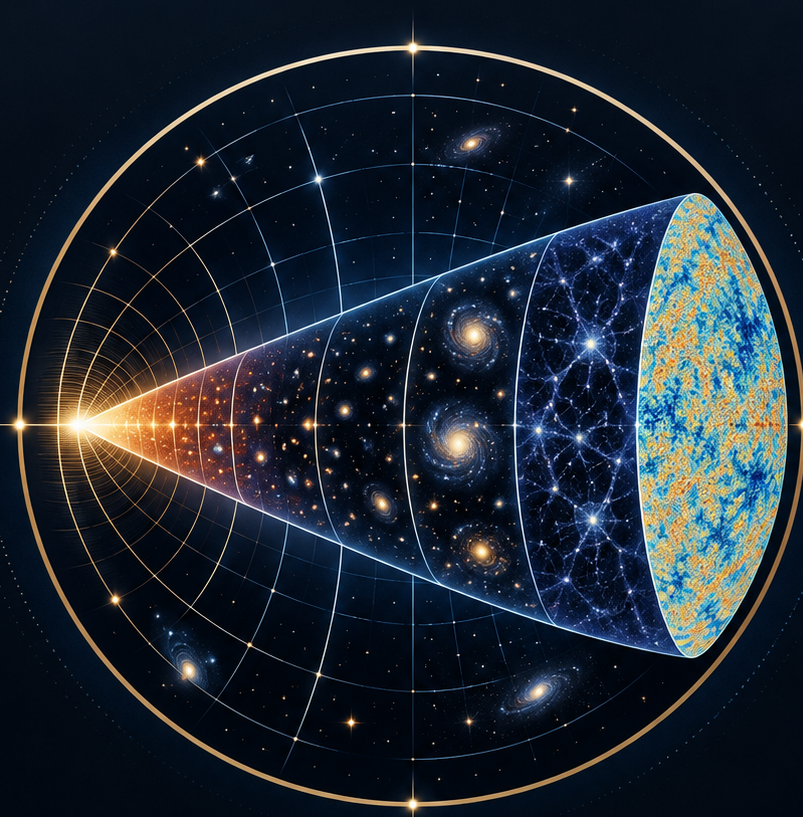
The Big Bang theory is the prevailing cosmological model describing the origin and evolution of the universe. It is not, as many imagine, an explosion that scattered matter into pre-existing space. Instead, it is the expansion of space itself from an extremely hot, dense state about 13.8 billion years ago. This expansion, first observed by Edwin Hubble in 1929, continues today, and the universe is still cooling and thinning.
Popular accounts often flatten the theory into misleading sound bites. The phrase “Big Bang” itself was coined in 1949 by astronomer Fred Hoyle during a radio broadcast, and it stuck, but it conveys a sense of a conventional explosion that is fundamentally wrong. In reality, the Big Bang was not an explosion in space; it was an expansion of space. There was no center, no edge, and no moment when everything was packed into a single point in a pre-existing void. The universe began as a hot, dense state that expanded and cooled, giving rise to all the structures we see today.
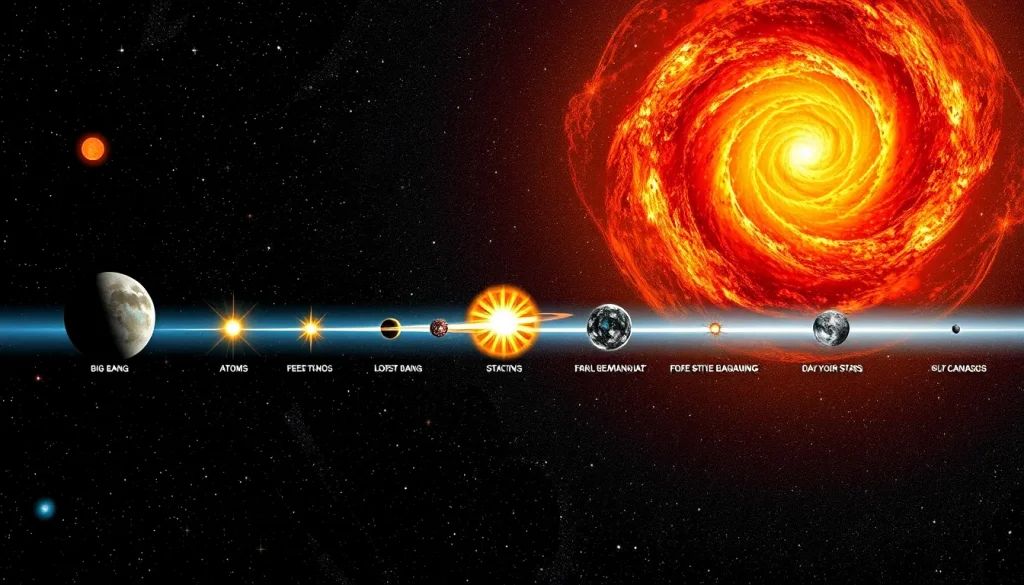
To understand the Big Bang, we must trace the cosmic timeline from the earliest instants to the present. This guide will walk you through the key epochs, the evidence that supports the model, and the most persistent misconceptions that continue to confuse even seasoned science enthusiasts.
Concept
Definition
The Big Bang theory describes the universe’s origin as a hot, dense state that has been expanding and cooling ever since. It is not a theory of what caused the expansion, but rather a description of how the universe evolved from that initial state. The standard model of cosmology, known as Lambda-CDM, incorporates the Big Bang along with dark energy and cold dark matter to explain observations.
How It Works
The expansion of the universe is a stretching of space itself. Galaxies are not moving through space; rather, the space between them is expanding, causing their light to be redshifted. This redshift, observed by Hubble, follows the Hubble–Lemaître law: the recession velocity of a galaxy is proportional to its distance. As space expands, the wavelengths of photons stretch, shifting them toward the red end of the spectrum.
The universe began in an incredibly hot, dense state. In the first fractions of a second, it underwent a period of exponential expansion called cosmic inflation, which smoothed out any irregularities and set the stage for structure formation. As the universe expanded, it cooled, allowing fundamental forces to separate and particles to form. About 380,000 years after the Big Bang, the universe had cooled enough for electrons to combine with protons to form neutral hydrogen atoms, releasing the cosmic microwave background (CMB) radiation that we observe today.
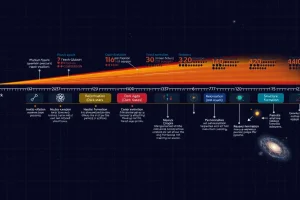
The following table summarizes the major cosmic epochs:
| Epoch | Time After Big Bang | Temperature | Key Events |
|---|---|---|---|
| Planck Epoch | 0 to 10⁻⁴³ s | >10³² K | Quantum gravity effects dominate; no known physics |
| Grand Unification Epoch | 10⁻⁴³ to 10⁻³⁶ s | 10²⁷–10³² K | Strong and electroweak forces unify; inflation begins |
| Inflationary Epoch | 10⁻³⁶ to 10⁻³² s | ~10²⁷ K | Exponential expansion; quantum fluctuations seeded |
| Electroweak Epoch | 10⁻³² to 10⁻¹² s | 10¹⁵–10²⁷ K | Electromagnetic and weak forces separate; quarks and leptons form |
| Quark Epoch | 10⁻¹² to 10⁻⁶ s | 10¹²–10¹⁵ K | Quarks and gluons exist in a quark-gluon plasma |
| Hadron Epoch | 10⁻⁶ to 1 s | 10¹⁰–10¹² K | Quarks combine to form protons and neutrons; matter-antimatter annihilation |
| Lepton Epoch | 1 s to 10 s | 10⁹–10¹⁰ K | Leptons dominate; neutrinos decouple |
| Photon Epoch | 10 s to 380,000 yr | 3,000–10⁹ K | Photons dominate; nucleosynthesis of light elements |
| Recombination | ~380,000 yr | ~3,000 K | Electrons combine with protons to form neutral hydrogen; CMB released |
| Dark Ages | 380,000 yr to ~150 million yr | ~3,000 K to ~50 K | No stars yet; universe is dark and neutral |
| Reionization | ~150 million to ~1 billion yr | ~50 K to ~10 K | First stars and galaxies form; ionize neutral hydrogen |
| Structure Formation | ~1 billion yr to present | ~2.7 K | Galaxies, clusters, and large-scale structure evolve |
Equation
The expansion of the universe is described by the Friedmann equations, derived from general relativity. A simpler relation is the Hubble–Lemaître law: v = H₀d, where v is the recession velocity, d is the distance, and H₀ is the Hubble constant. This linear relationship is a direct consequence of uniform expansion.
Example
A common analogy is a balloon with dots drawn on its surface. As the balloon inflates, the dots move apart from each other, but no dot is the center. Similarly, galaxies recede from each other because the space between them expands, not because they are moving through space. An observer on any galaxy would see all others receding, with no preferred location.
Observable Consequences
- Cosmic Microwave Background (CMB): The afterglow of the Big Bang, discovered in 1965, is a nearly uniform radiation filling the sky at 2.725 K. It matches the predicted blackbody spectrum and contains tiny anisotropies that seeded structure.
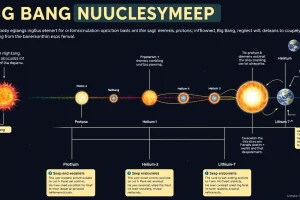
- Primordial Nucleosynthesis: The observed abundances of light elements (hydrogen, helium, lithium) match predictions from Big Bang nucleosynthesis, which occurred in the first few minutes.
- Large-Scale Structure: The distribution of galaxies and clusters, including the cosmic web, is consistent with the growth of quantum fluctuations during inflation.
- Redshift of Galaxies: The systematic redshift of distant galaxies confirms the expansion of space.
Common Misconceptions
- Misconception 1: The Big Bang was an explosion. It was not an explosion in space; it was an expansion of space itself. There was no center, and matter did not fly outward into a void.
- Misconception 2: The universe was once a point. The observable universe was once extremely small and dense, but the entire universe may have been infinite even then. The Big Bang did not occur at a single point in space.
- Misconception 3: The Big Bang happened at a specific location. It happened everywhere simultaneously. Space itself began expanding, so every point in the universe is the center of the expansion.
- Misconception 4: The universe is expanding into something. There is no “outside” to the universe. Space is not expanding into anything; it is simply expanding.
- Misconception 5: The Big Bang was a violent event. It was a rapid expansion of space, not a violent explosion. The early universe was hot and dense, but the expansion was smooth and uniform.
- Misconception 6: The Big Bang theory explains the origin of the universe. It describes the evolution from an initial hot, dense state, but it does not explain what caused that state or what came before. That remains an open question.
Why It Matters
Understanding the Big Bang is not just an academic exercise. It is the foundation of modern cosmology, explaining the origin of all matter, the formation of stars and galaxies, and the large-scale structure of the cosmos. The cosmic microwave background, the abundance of light elements, and the expansion of the universe are all direct consequences of the Big Bang model. By debunking misconceptions, we can better appreciate the elegance and power of this theory, and we can make informed decisions about scientific research and exploration.
Evidence / Sources
The Big Bang theory is supported by multiple independent lines of evidence. The cosmic microwave background, first detected by Penzias and Wilson in 1965, is the most direct relic of the early universe. Missions like COBE, WMAP, and Planck have mapped the CMB with increasing precision, confirming its blackbody spectrum and revealing temperature anisotropies that match predictions from inflation. Big Bang nucleosynthesis accurately predicts the observed abundances of helium and deuterium. The redshift-distance relation, established by Hubble and later refined, confirms the expansion of space. The James Webb Space Telescope (JWST) is now probing the epoch of reionization, providing new insights into the first stars and galaxies.
Related Registry Entries
For further exploration, see the entries on the Cosmic Microwave Background, Cosmic Inflation, Recombination, Reionization, and the Planck Mission. These topics are deeply interconnected and provide a fuller picture of the universe’s history.
Last Reviewed: September 4, 2026
FAQ
Did the Big Bang happen at a single point?
No. The observable universe was once extremely small and dense, but the entire universe may have been infinite even then. The Big Bang happened everywhere simultaneously, not at a specific location.
What caused the Big Bang?
The Big Bang theory describes the evolution from an initial hot, dense state, but it does not explain what caused that state. This remains an open question in physics, possibly involving quantum gravity or a multiverse.
Is the Big Bang still happening?
In a sense, yes. The universe is still expanding and cooling, which is a continuation of the Big Bang. However, the initial explosive expansion is long over.
What is the cosmic microwave background?
It is the afterglow of the Big Bang, released about 380,000 years after the start when the universe became transparent. It fills the sky at a temperature of 2.725 K and provides a snapshot of the early universe.
How do we know the Big Bang happened?
Evidence includes the cosmic microwave background, the observed abundances of light elements, the redshift of galaxies, and the large-scale structure of the universe, all of which match predictions from the Big Bang model.
Leave a Reply