
Short Answer
Short Answer / Definition
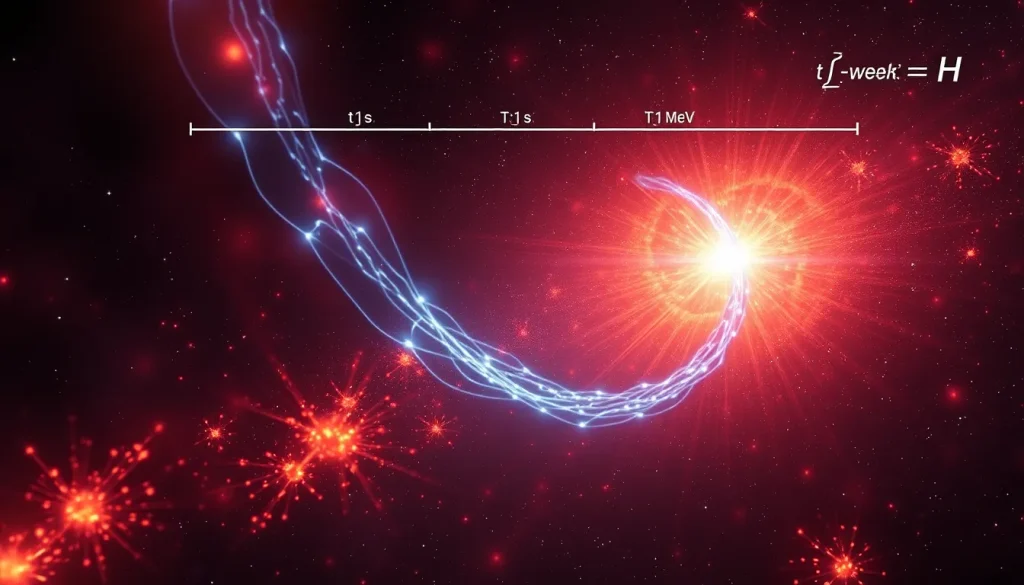
Neutrino decoupling is the epoch in the early universe, roughly one second after the Big Bang, when the rate of weak interactions involving neutrinos dropped below the universal expansion rate. From that point onward, neutrinos no longer exchanged energy with protons, neutrons, and electrons, and they have been traveling freely through space ever since. This event produced the cosmic neutrino background (CνB), an ancient relic analogous to the cosmic microwave background but far more elusive.
Main Explanation
In the standard hot Big Bang model, the universe began in an extremely hot, dense state and expanded and cooled. During the first second, the temperature exceeded 1 MeV (about 10 billion kelvin), and neutrinos were in full thermal equilibrium with photons, electrons, and positrons via the weak interaction. This equilibrium was maintained by reactions such as ν + e± ↔ ν + e± and ν + ν̄ ↔ e+ + e−.
As the universe expanded, the rate of these weak interactions, which scales as Γ ∝ GF2 T5 (where GF is the Fermi constant and T is temperature), fell faster than the Hubble expansion rate, H ∝ T2 / MPl. When the two rates became equal, at roughly Tdec ≈ 1 MeV (t ≈ 1 s), neutrinos effectively stopped interacting with the rest of the cosmic plasma. They decoupled and have been streaming freely ever since, a process described in detail by Akita and Yamaguchi (2022) and by the Particle Data Group review.

After decoupling, the neutrino population simply redshifted with the expansion, cooling but preserving its thermal (almost Fermi–Dirac) spectrum. Shortly afterward, when electrons and positrons annihilated (around t ≈ 10 s), the photon bath was heated relative to the neutrinos, giving rise to the well-known temperature ratio Tγ/Tν ≈ 1.4. The cosmic neutrino background today has a temperature of about 1.95 K and a number density of roughly 336 cm−3 per flavor, though it has not yet been directly detected.
Neutrino Decoupling in the Cosmic Timeline
Neutrino decoupling marks the boundary between the Lepton Epoch and the Photon Epoch. To place it in context, here is the standard sequence of cosmic epochs from the Planck epoch to the present day:
| Epoch | Time after Big Bang | Temperature | Key Events |
|---|---|---|---|
| Planck epoch | < 10−43 s | > 1032 K | Quantum gravity effects dominate; no known physics |
| Grand Unification epoch | 10−43 – 10−36 s | 1028 – 1032 K | Strong and electroweak forces unify |
| Inflationary epoch | 10−36 – 10−32 s | Cooling rapidly | Exponential expansion; seeds for structure |
| Electroweak epoch | 10−32 – 10−12 s | 1015 – 1028 K | Electromagnetic and weak forces separate |
| Quark epoch | 10−12 – 10−6 s | 1012 – 1015 K | Quarks and gluons form quark–gluon plasma |
| Hadron epoch | 10−6 – 1 s | 1010 – 1012 K | Protons and neutrons form; matter–antimatter asymmetry |
| Lepton epoch | 1 – 10 s | 109 – 1010 K | Neutrino decoupling occurs at ~1 s |
| Photon epoch | 10 s – 370,000 yr | 104 – 109 K | Electron–positron annihilation; photons dominate |
| Recombination | ~370,000 yr | ~3000 K | Electrons combine with protons; CMB released |
| Dark Ages | 370,000 yr – ~150 million yr | Cooling from 3000 K | No luminous sources; neutral hydrogen |
| Reionization | ~150 million – 1 billion yr | ~10 – 100 K | First stars and galaxies ionize hydrogen |
| Structure Formation | 1 billion yr – present | 2.7 K (CMB today) | Galaxies, clusters, large-scale structure form |
When It Happened
Neutrino decoupling occurred approximately one second after the Big Bang, when the universe was about 10 billion kelvin (1 MeV). This timing is derived by equating the weak interaction rate with the Hubble expansion rate, as detailed in the Wikipedia entry on neutrino decoupling.
Temperature
The decoupling temperature is Tdec ≈ 1 MeV (≈ 1010 K). At this temperature, the mean free path of neutrinos became comparable to the Hubble horizon, and they ceased to interact.
Approximate Redshift
Using the relation between temperature and redshift (T ∝ (1+z)), and the current CMB temperature of 2.725 K, the decoupling redshift is roughly z ≈ 1010 / 2.7 ≈ 3.7 × 10⁹. More precisely, z ≈ 5 × 10⁹ if one accounts for the neutrino-to-photon temperature ratio after e± annihilation.
Dominant Particles/Physics
At decoupling, the universe was filled with neutrinos, antineutrinos, electrons, positrons, photons, and small numbers of protons and neutrons. The weak interaction (mediated by W and Z bosons) was the only force coupling neutrinos to other particles. After decoupling, neutrinos became a free-streaming radiation component.
What Happened
As the universe expanded, the weak interaction rate fell as T5, while the Hubble rate fell as T2. When the two rates crossed, neutrinos stopped scattering off electrons and positrons. They have been expanding and cooling adiabatically ever since, forming the cosmic neutrino background.
What Came Before
Before decoupling, during the hadron epoch and earlier, neutrinos were in thermal equilibrium. The universe was a hot soup of quarks, gluons, leptons, and photons, with neutrinos participating actively in all weak processes.
What Came Next
After decoupling, the electron–positron annihilation heated the photon bath but not the neutrinos, creating a slight temperature difference. This set the stage for Big Bang nucleosynthesis (BBN), which occurred a few minutes later, producing the light elements (deuterium, helium-4, etc.). The neutrino background also influences the growth of cosmic structure through its gravitational effects.
Evidence
Direct detection of the cosmic neutrino background has not yet been achieved, but its existence is strongly supported by two indirect lines of evidence:
- Big Bang nucleosynthesis: The predicted primordial helium abundance depends on the number of neutrino flavors and the energy density of neutrinos during BBN. Observations of helium in low-metallicity systems match the standard model with three neutrino species.
- Cosmic microwave background: The CMB angular power spectrum is sensitive to the radiation density, parameterized as Neff (effective number of relativistic species). Planck data give Neff = 2.99 ± 0.17, consistent with the standard value of 3.046 that includes the cosmic neutrino background.
Why It Matters
Neutrino decoupling is not just a historical curiosity; it has profound consequences for modern cosmology. It sets the initial conditions for BBN, determines the expansion rate during the radiation-dominated era, and leaves a relic background that can be used to probe particle physics beyond the Standard Model. The cosmic neutrino background, if ever detected, would open a new window on the universe’s first second, complementing the CMB and providing a direct test of the hot Big Bang model.
Evidence / Sources
The following sources provide authoritative, up-to-date information on neutrino decoupling:
- Wikipedia: Neutrino decoupling — https://en.wikipedia.org/wiki/Neutrino_decoupling
- Akita, K. & Yamaguchi, M. (2022). A Review of Neutrino Decoupling from the Early Universe to the Current Universe. Universe, 8(11), 552. https://www.mdpi.com/2218-1997/8/11/552
- Particle Data Group (2018). Neutrinos in Cosmology. https://pdg.lbl.gov/2018/reviews/rpp2018-rev-neutrinos-in-cosmology.pdf
- Neutrino-physics.com: Neutrinos in the Early Universe — https://www.neutrino-physics.com/cosmology/neutrinos-in-early-universe/
Related Registry Entries
- Lepton Epoch
- Photon Epoch
- Big Bang Nucleosynthesis
- Cosmic Neutrino Background
FAQ
What exactly is neutrino decoupling?
Neutrino decoupling is the moment in the early universe when neutrinos stopped interacting with other particles (electrons, positrons, protons, neutrons) because the universe's expansion became too fast for the weak interaction to keep up. After that, neutrinos simply traveled freely, preserving a snapshot of the universe at about one second old.
Why did neutrino decoupling happen at around 1 second?
The weak interaction rate decreases as the fifth power of temperature, while the Hubble expansion rate decreases as the square of temperature. The two rates become equal when the temperature drops to about 1 MeV, which occurs roughly one second after the Big Bang. This is a robust prediction of the hot Big Bang model.
Have we detected the cosmic neutrino background?
Not directly. The cosmic neutrino background has not yet been observed because neutrinos are extremely weakly interacting and have very low energies (~10⁻¹⁰ times typical laboratory neutrinos). However, its indirect effects on BBN and the CMB are well established, and experiments like PTOLEMY are aiming for a future detection.
What is the difference between neutrino decoupling and recombination?
Neutrino decoupling occurred at ~1 second when neutrinos stopped interacting with matter via the weak force. Recombination occurred at ~370,000 years when electrons combined with protons to form neutral hydrogen, releasing the CMB. The two are different epochs with different physics.



Leave a Reply