Short Answer
Main Explanation
The Hubble constant (H₀) is the rate at which the universe expands today. It connects the recession velocity of a distant galaxy to its distance via the Hubble–Lemaître law: v = H₀ × d. Determining H₀ with precision unlocks the age of the universe, the scale of cosmic distances, and the behavior of dark energy. But measuring this single number has proven surprisingly contentious, with two leading methods yielding different values—a discrepancy known as the Hubble tension.
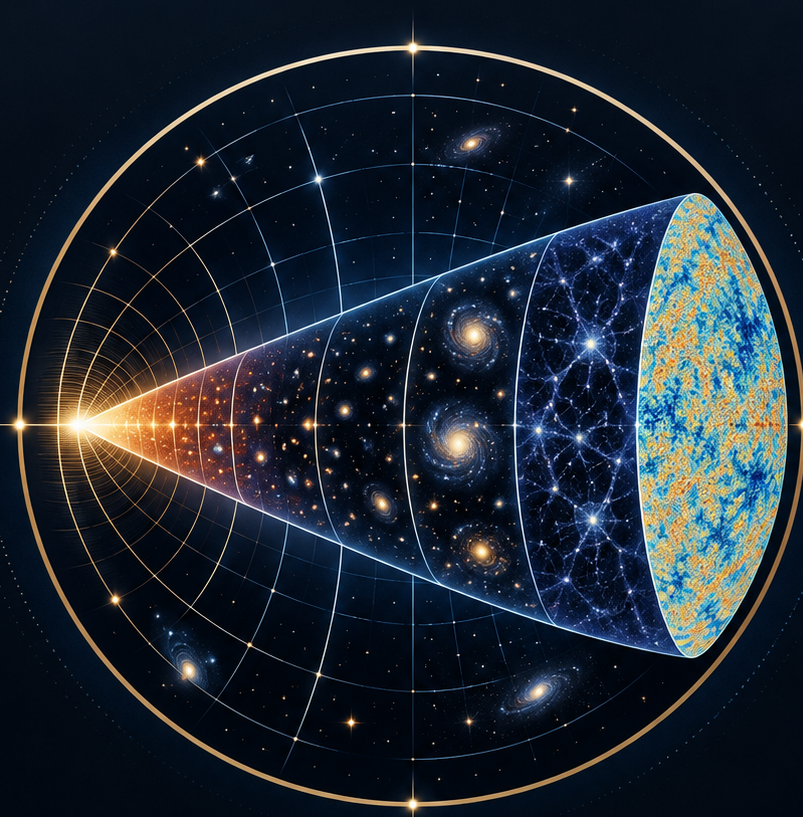
To understand how astronomers measure H₀, we must first appreciate the cosmic story that the constant describes. The universe began in an incredibly hot, dense state—the Big Bang—and has been expanding and cooling for 13.8 billion years. The expansion is not galaxies moving through space; rather, space itself stretches, carrying galaxies apart like raisins in rising bread dough. As light travels through this expanding space, its wavelength stretches, shifting toward the red—a phenomenon called cosmological redshift. The more distant a galaxy, the more its light is redshifted, and the faster it appears to recede.
The Cosmic Epochs: A Timeline
The standard model of cosmology, Lambda-CDM, describes a sequence of epochs from the Planck era to the present. The table below summarizes the key stages.
| Epoch | Time After Big Bang | Temperature | Key Events |
|---|---|---|---|
| Planck Epoch | 0 – 10⁻⁴³ s | >10³² K | Quantum gravity dominates; known physics breaks down. |
| Grand Unification Epoch | 10⁻⁴³ – 10⁻³⁶ s | 10²⁷ – 10³² K | Strong and electroweak forces unify; inflation begins. |
| Inflationary Epoch | 10⁻³⁶ – 10⁻³² s | ~10²⁷ K | Exponential expansion flattens space and seeds density fluctuations. |
| Electroweak Epoch | 10⁻³² – 10⁻¹² s | 10¹⁵ – 10²⁷ K | Electromagnetic and weak forces separate; particles acquire mass. |
| Quark Epoch | 10⁻¹² – 10⁻⁶ s | 10¹² – 10¹⁵ K | Quarks and gluons form a quark–gluon plasma. |
| Hadron Epoch | 10⁻⁶ – 1 s | 10¹⁰ – 10¹² K | Protons and neutrons form; matter–antimatter asymmetry emerges. |
| Lepton Epoch | 1 – 10 s | 10⁹ – 10¹⁰ K | Leptons dominate; neutrinos decouple. |
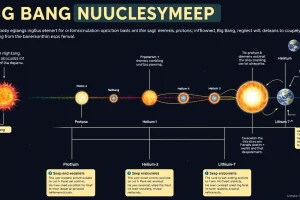
| Photon Epoch | 10 s – 380,000 yr | 10⁴ – 10⁹ K | Photons dominate; nucleosynthesis creates light elements. |
| Recombination | ~380,000 yr | ~3000 K | Electrons combine with protons to form neutral hydrogen; universe becomes transparent. |
| Dark Ages | 380,000 yr – ~150 million yr | ~3000 K – ~60 K | No stars yet; neutral hydrogen fills space. |
| Reionization | ~150 million – 1 billion yr | ~60 K – ~20 K | First stars and galaxies emit ultraviolet light, reionizing hydrogen. |
| Structure Formation | 1 billion yr – present | ~20 K – 2.7 K | Galaxies cluster under gravity; dark energy accelerates expansion. |
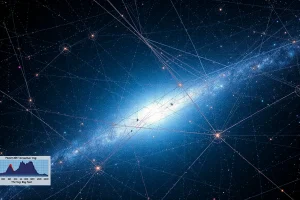
The cosmic microwave background (CMB) is a relic of the recombination epoch. At that moment, the universe cooled enough for protons and electrons to combine into neutral atoms, allowing photons to travel freely. Those photons have been redshifted by the expansion ever since, now appearing as a faint glow at 2.725 K—the CMB. Mapping its tiny temperature fluctuations (anisotropies) provides a snapshot of the universe at 380,000 years, encoding information about its composition and geometry.
Inflation, a brief period of exponential expansion in the first 10⁻³² seconds, stretched quantum fluctuations to cosmic scales, seeding the density variations that later grew into galaxies and clusters. The CMB’s near-uniformity and slight anisotropies are strong evidence for inflation.
The first atoms formed at recombination, and the first stars ignited during the Cosmic Dawn, ending the Dark Ages. These stars and galaxies reionized the intergalactic medium, and over billions of years, gravity assembled the large-scale structure we observe today. Missions like COBE, WMAP, and Planck have mapped the CMB with increasing precision, while JWST is now probing the era of first galaxies.
How We Measure the Hubble Constant
Value
The Hubble constant is currently measured to be approximately 67.4 km/s/Mpc from CMB observations (Planck) and 73.0 km/s/Mpc from the local distance ladder (SH0ES team). The discrepancy of about 5–6 km/s/Mpc is highly significant.
Units
Kilometers per second per megaparsec (km/s/Mpc). One megaparsec equals 3.26 million light-years.
Instrument
Key instruments include the Hubble Space Telescope (for Cepheids and supernovae), the James Webb Space Telescope (for refined distance ladder measurements), and CMB satellites: COBE, WMAP, Planck.
Method
Two independent approaches are used:
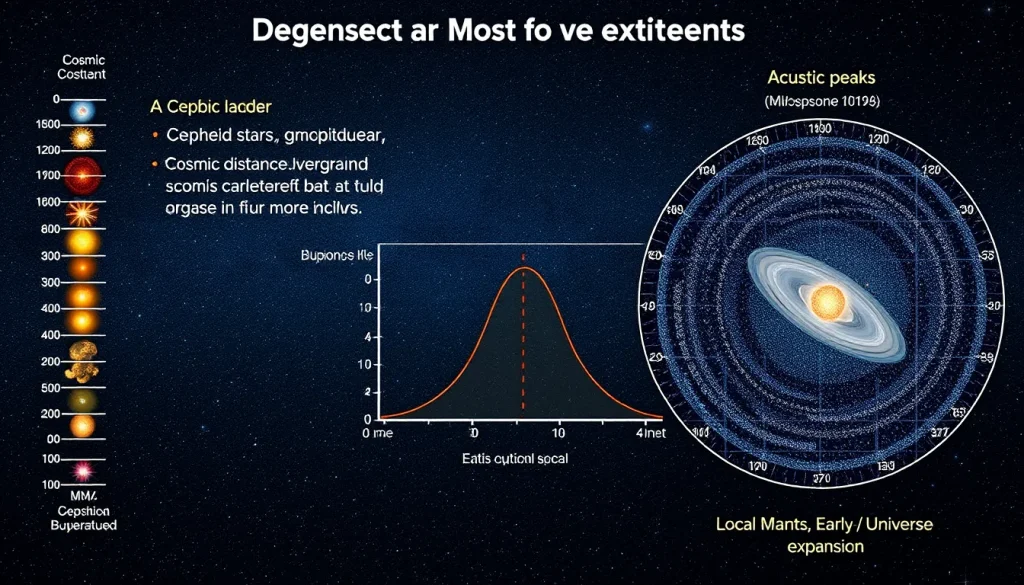
- Local Distance Ladder: Start with geometric parallax to calibrate Cepheid variable stars in the Milky Way and nearby galaxies. Use Cepheids to measure distances to Type Ia supernovae in nearby galaxies. Use those supernovae as standard candles to push to much larger distances, where the expansion dominates. Measure redshifts and apply the Hubble–Lemaître law.
- Early-Universe Probes: Analyze the temperature fluctuations in the CMB. The angular scale of acoustic peaks depends on the sound horizon at recombination and the geometry of the universe. Combine with baryon acoustic oscillations (BAO) from galaxy surveys to infer H₀. This method assumes the Lambda-CDM model.
Uncertainty
Current uncertainties are about 1–2% for each method. The tension between the two is far larger than the individual error bars, suggesting either unknown systematic errors or new physics.
Dataset
CMB data from Planck (2018 release) and WMAP; distance ladder data from SH0ES (Supernovae, H₀, for the Equation of State of Dark Energy) and the Carnegie-Chicago Hubble Program. Recent JWST observations have refined Cepheid distances.
Latest/Reference Measurement
As of 2026, the distance ladder value from Riess et al. (SH0ES) is 73.04 ± 1.04 km/s/Mpc. The Planck CMB value is 67.4 ± 0.5 km/s/Mpc. Chen & Wang (2026) review recent progress and systematics in distance-ladder measurements.
Why Measurements Differ
The tension may arise from systematic errors in either method (e.g., Cepheid calibration, CMB foregrounds) or from new physics such as evolving dark energy, extra relativistic species (e.g., sterile neutrinos), or modified gravity. No consensus yet exists, but the tension drives active research.
Why It Matters
The Hubble constant is a linchpin of modern cosmology. It sets the age of the universe (about 13.8 billion years for 67.4 km/s/Mpc). It determines the size of the observable universe and the critical density. Most importantly, the tension between local and early-universe measurements may reveal that our standard model of the universe is incomplete. If confirmed, it could point to new physics—perhaps a time-varying dark energy or exotic particles—that would transform our understanding of cosmic evolution.
Evidence / Sources
Key evidence comes from CMB observations by COBE, WMAP, and Planck, which measure the temperature anisotropies and infer cosmological parameters. The distance ladder uses Cepheid variables and Type Ia supernovae, calibrated with geometric distances from parallax and masers. The Hubble tension is documented in peer-reviewed literature, including Freedman & Madore (2023) and Chen & Wang (2026). NASA’s Hubble mission pages provide authoritative summaries.
Related Registry Entries
- Cosmic Microwave Background
- Inflation
- Recombination
- Dark Ages
- Reionization
- ΛCDM Model
FAQ
What is the Hubble constant?
The Hubble constant (H₀) is the rate at which the universe expands today, expressed as velocity per unit distance (km/s/Mpc). It relates how fast a galaxy recedes to its distance.
Why do the two measurement methods disagree?
The local distance ladder gives ~73 km/s/Mpc, while CMB-based measurements give ~67.4 km/s/Mpc. The discrepancy, called the Hubble tension, may stem from systematic errors or from new physics beyond the Lambda-CDM model, such as evolving dark energy or extra relativistic particles.
What is the cosmic microwave background?
The CMB is the oldest light in the universe, emitted about 380,000 years after the Big Bang when the universe cooled enough for atoms to form. It appears as a nearly uniform glow at 2.725 K and carries tiny temperature fluctuations that reveal the seeds of cosmic structure.
How do Cepheid variables help measure cosmic distances?
Cepheid variables are pulsating stars whose luminosity is directly related to their pulsation period. By measuring the period, astronomers know the true brightness, and comparing with apparent brightness gives the distance. This calibrates the distance ladder.
Leave a Reply