
Short Answer
Main Explanation
Local Geometry and Curvature
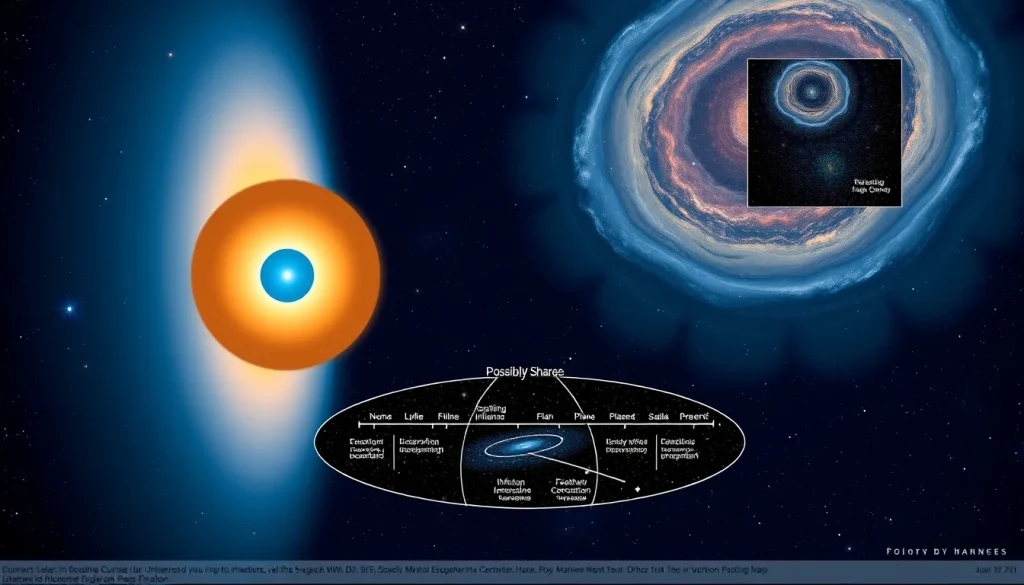
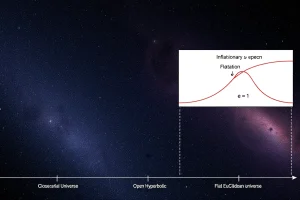
In physical cosmology, the shape of the universe refers to both its local geometry and cosmic topology. Local geometry is defined primarily by curvature, which general relativity explains as being constrained by gravity. Three possible spatial curvatures exist: positively curved like a sphere, flat like an infinite plane, or negatively curved like a saddle. Observations of the cosmic microwave background (CMB) and baryon acoustic oscillations have measured the curvature density parameter Ω_k to be close to zero, indicating a spatially flat universe to within 0.4% (as reported by WMAP, BOOMERanG, and Planck) [1][2]. But geometry alone does not determine the global shape—a flat universe could still wrap around in various ways, such as a 3-torus, which is finite but has zero curvature [1].
Global Topology
Global topology describes how space is connected on large scales. The universe could be simply connected like Euclidean space, or multiply connected like a torus, where traveling in one direction eventually returns to the starting point. The cosmological topology cannot be deduced from curvature measurements alone because locally indistinguishable spaces can have different global topologies [1]. Current data are consistent with a flat, infinite universe, but finite topologies are not ruled out [2]. The question remains one of the biggest open problems in cosmology [3].
Cosmic Epochs: From Planck to Present
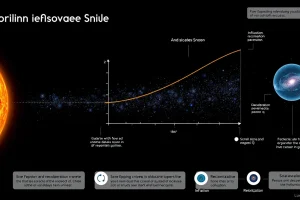
The universe began with the Big Bang and has passed through a series of distinct epochs. The following table summarizes key stages, times, temperatures, and events:
| Epoch | Time After Big Bang | Temperature | Key Events |
|---|---|---|---|
| Planck epoch | < 10⁻⁴³ s | > 10³² K | Quantum gravity effects dominate; no current theory fully describes this era. |
| Grand Unification epoch | 10⁻⁴³ – 10⁻³⁶ s | 10²⁸ – 10³² K | Fundamental forces (except gravity) unify; inflation begins. |
| Inflationary epoch | 10⁻³⁶ – 10⁻³² s | ~10²⁸ K | Rapid exponential expansion; quantum fluctuations seed large-scale structure. |
| Electroweak epoch | 10⁻³² – 10⁻¹² s | 10¹⁵ – 10²⁸ K | Electromagnetic and weak forces separate; particles acquire mass. |
| Quark epoch | 10⁻¹² – 10⁻⁶ s | 10¹² – 10¹⁵ K | Quarks and gluons exist in a quark-gluon plasma. |
| Hadron epoch | 10⁻⁶ – 1 s | 10¹⁰ – 10¹² K | Quarks combine into protons and neutrons; matter-antimatter asymmetry forms. |
| Lepton epoch | 1 – 10 s | 10⁹ – 10¹⁰ K | Leptons dominate; neutrinos decouple. |
| Photon epoch | 10 s – 380,000 yr | 3,000 – 10⁹ K | Photons dominate; nuclei form during Big Bang nucleosynthesis. |
| Recombination | ~380,000 yr | ~3,000 K | Electrons combine with nuclei to form neutral atoms; CMB is released. |
| Dark Ages | 380,000 yr – ~150 million yr | ~60 – 3,000 K | No stars yet; universe filled with neutral hydrogen and helium. |
| Reionization | ~150 million – 1 billion yr | ~10 – 60 K | First stars and galaxies form; their radiation reionizes hydrogen. |
| Structure Formation | ~1 billion yr – present | ~2.7 K (today) | Galaxies cluster into filaments and superclusters; dark energy accelerates expansion. |
The Cosmic Microwave Background
The CMB is the relic radiation from the photon epoch, released at recombination when the universe became transparent. It provides a snapshot of the universe at 380,000 years old, with tiny temperature anisotropies (on the order of 1 part in 100,000) that seeded the large-scale structure we see today. Missions such as COBE (1989), WMAP (2001), and Planck (2009) have mapped these anisotropies with increasing precision, confirming the flat geometry and supporting the Lambda-CDM model [1][2].
Formation of Atoms, Stars, and Galaxies
During Big Bang nucleosynthesis, protons and neutrons fused into light elements (mostly hydrogen and helium) within the first few minutes. At recombination, free electrons combined with nuclei to form neutral atoms, allowing photons to travel freely. The Dark Ages followed until gravity pulled matter into the first stars and galaxies, which reionized the universe during the epoch of Reionization. Over billions of years, these structures evolved into the cosmic web of galaxies and clusters observed today. The James Webb Space Telescope (JWST) is now probing this early era, revealing galaxies as they were just a few hundred million years after the Big Bang [3].
Concept: Shape of the Universe
Definition
The shape of the universe encompasses both its local curvature (spatial geometry) and its global topology (the overall connectedness of space). Local curvature is described by general relativity, while global topology is a property of the universe’s spatial manifold.
How It Works
Curvature is determined by the total energy density of the universe, including matter, radiation, and dark energy. The Friedmann equations relate the expansion rate and curvature to this density. If the density equals the critical density, the universe is flat; if greater, positively curved (closed); if less, negatively curved (open). Topology, however, is not fixed by curvature—a flat universe can be finite (e.g., a 3-torus) or infinite.
Equation
The curvature density parameter is defined as Ω_k = 1 – Ω_total, where Ω_total = Ω_m + Ω_r + Ω_Λ. Observations give Ω_k ≈ 0, consistent with a flat universe. The Friedmann equation in terms of curvature is: H² = (8πG/3)ρ – k/a², where k is the curvature constant (k=0 for flat, k=+1 for closed, k=-1 for open).
Example
Imagine drawing a triangle on different surfaces: on a flat plane, angles sum to 180°; on a sphere, they sum to more than 180°; on a saddle, less than 180°. The universe’s geometry determines how parallel lines behave on cosmic scales, though local gravity can warp spacetime.
Observable Consequences
Curvature affects the angular size of CMB fluctuations and the distribution of galaxies. A closed universe would cause light rays to converge, creating repeated images; an open universe would diverge. The flatness observed in the CMB power spectrum and BAO measurements strongly supports a flat geometry [1][2].
Common Misconceptions
One misconception is that the universe is a sphere or a balloon. In reality, the shape refers to the spatial geometry, not a boundary. Another is that a flat universe is infinite—this is not necessarily true; a flat torus is finite. Also, the universe’s shape does not change over time; it is a global property, though the expansion rate depends on curvature.
Why It Matters
Understanding the shape of the universe is fundamental to cosmology. It determines the ultimate fate of the cosmos (whether it will expand forever, recollapse, or reach a steady state) and constrains the initial conditions set by inflation. It also tests our theories of gravity and the nature of dark energy. The flatness observed today points to an incredibly fine-tuned early universe, which inflation naturally explains. Moreover, the topology could reveal whether we might see multiple images of the same objects—a direct probe of cosmic connectedness.
Evidence / Sources
The evidence for a flat universe comes from measurements of the CMB anisotropy spectrum (WMAP, Planck), baryon acoustic oscillations (BOSS, DES), and supernova distances. These independent probes consistently yield Ω_k ≈ 0. For topology, searches for repeated patterns in CMB maps have found none, but cannot rule out finite topologies larger than the observable horizon. Sources used in this article include the Wikipedia article on the shape of the universe [1], a Scientific American analysis [2], a New Scientist overview [3], and an accessible explanation from Alegsaonline [4].
Related Registry Entries
FAQ
Is the universe infinite?
Observations are consistent with an infinite, flat universe, but they do not prove it. A flat universe could be finite if it has a non-trivial topology, such as a 3-torus. The true extent remains unknown.
What is the shape of the universe?
The observable universe is spatially flat to within 0.4%, but the global topology (whether it is infinite, finite, or multiply connected) is not determined. Both positive and negative curvature are ruled out at large scales.
How do we know the universe is flat?
By measuring the angular size of temperature fluctuations in the CMB and the distribution of galaxies using BAO. The location of the first acoustic peak in the CMB power spectrum indicates a flat geometry, a result confirmed by WMAP and Planck.
What are the major cosmic epochs?
The universe went through the Planck, Grand Unification, Inflationary, Electroweak, Quark, Hadron, Lepton, Photon, Recombination, Dark Ages, Reionization, and Structure Formation epochs, each with distinct physical conditions.
Leave a Reply