Short Answer
Main Explanation
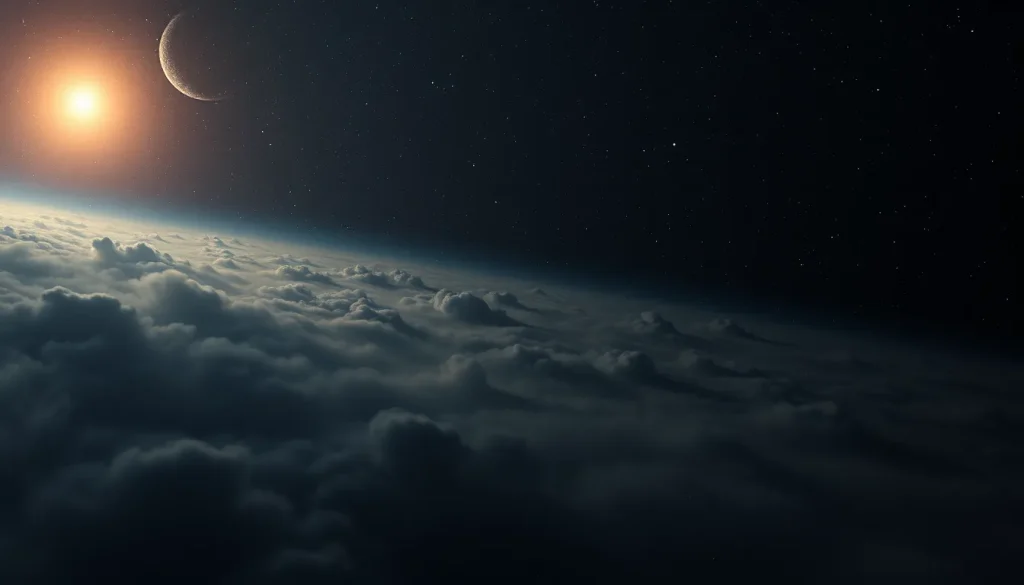
The cosmic dark ages are a pivotal chapter in the history of the universe, bridging the afterglow of the Big Bang and the emergence of the first stars and galaxies. This period, which began roughly 380,000 years after the Big Bang, is when the universe became transparent to light but was still shrouded in a fog of neutral hydrogen that absorbed the radiation from the first luminous objects. Understanding this era is essential for comprehending how the cosmos evolved from a hot, dense plasma to the structured universe we observe today.
The Cosmic Timeline: From Planck Epoch to Present
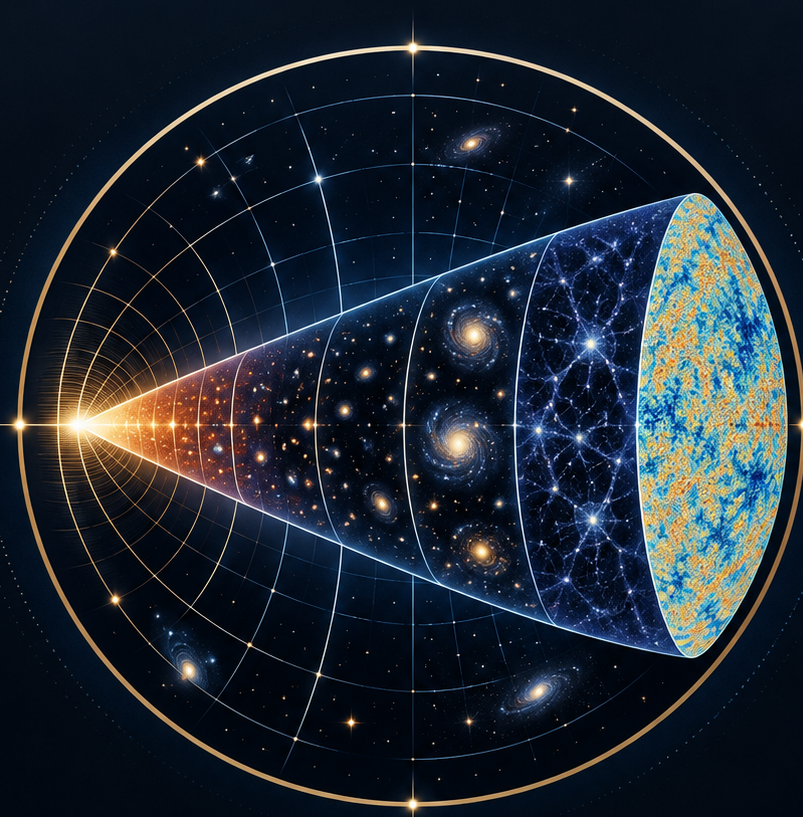
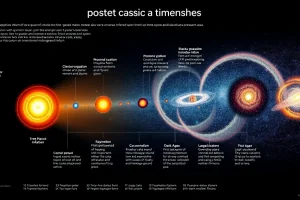
The standard model of cosmology, known as Lambda-CDM, describes a sequence of epochs that unfolded in the first moments and over billions of years. Here is a concise timeline of the major epochs:
| Epoch | Time After Big Bang | Key Events |
|---|---|---|
| Planck Epoch | 0 to 10^-43 s | Quantum gravity effects dominate; no current theory fully describes this era. |
| Grand Unification Epoch | 10^-43 to 10^-36 s | Strong and electroweak forces unify; inflation begins. |
| Inflationary Epoch | 10^-36 to 10^-32 s | Exponential expansion; quantum fluctuations seeded large-scale structure. |
| Electroweak Epoch | 10^-32 to 10^-12 s | Electromagnetic and weak forces separate; particles acquire mass. |
| Quark Epoch | 10^-12 to 10^-6 s | Quarks and gluons exist in a quark-gluon plasma. |
| Hadron Epoch | 10^-6 to 1 s | Quarks combine to form protons and neutrons; hadrons form. |
| Lepton Epoch | 1 s to 10 s | Leptons dominate; neutrinos decouple. |
| Photon Epoch | 10 s to 380,000 years | Photons are tightly coupled to matter; nucleosynthesis occurs. |
| Recombination | ~380,000 years | Electrons combine with nuclei to form neutral atoms; CMB released. |
| Dark Ages | ~380,000 to ~1 billion years | Neutral hydrogen fills the universe; no luminous sources yet. |
| Reionization | ~1 billion years | First stars and galaxies ionize the hydrogen; universe becomes transparent. |
| Structure Formation | ~1 billion years to present | Galaxies, clusters, and large-scale structure form. |
This timeline is based on the Lambda-CDM model, which is supported by a wealth of observations, including the cosmic microwave background (CMB) and the distribution of galaxies.
The Cosmic Dark Ages: A Closer Look
To understand the dark ages, we must first consider what happened at recombination. As the universe expanded and cooled, protons and electrons combined to form neutral hydrogen atoms. This process, which occurred about 380,000 years after the Big Bang, allowed photons to travel freely, producing the cosmic microwave background we observe today. However, the universe was still filled with neutral hydrogen gas, which absorbs ultraviolet light. The first stars and galaxies, when they formed, emitted intense ultraviolet radiation that broke apart these neutral atoms, reionizing the universe. This transition marks the end of the dark ages and the beginning of the cosmic dawn.
According to the sources, the cosmic dark ages are defined as the period when “sources of light were cloaked in a dense fog of neutral hydrogen gas” [1]. The first stars and galaxies created intense ultraviolet radiation that “broke apart the universe’s foglike hydrogen gas” [2]. This era is challenging to observe directly because it is dark, but astronomers are using indirect methods and powerful telescopes like the James Webb Space Telescope (JWST) to probe it.
When It Happened
The dark ages began at recombination, approximately 380,000 years after the Big Bang, and lasted until the first stars formed, which is thought to be around 100 to 200 million years later, though the exact timing is still uncertain. The period of reionization, when the universe became fully transparent, likely ended about 1 billion years after the Big Bang [3].
Temperature
At the start of the dark ages, the universe had cooled to about 3,000 K (the temperature of the CMB at recombination). As the universe expanded, the temperature continued to drop, reaching a few hundred kelvin by the time the first stars formed. The cosmic microwave background temperature today is 2.725 K, but during the dark ages it was higher.
Approximate Redshift
The redshift of the CMB is about z = 1100, corresponding to recombination. The dark ages span from z ~ 1100 down to z ~ 6-10, when reionization is thought to have been completed. The first stars likely formed at z ~ 20-30.
Dominant Particles/Physics
During the dark ages, the universe was dominated by dark matter and neutral hydrogen gas. Gravity was the key force, pulling matter together to form the first structures. The physics is described by general relativity and atomic physics, but no radiation sources were present to ionize the gas.
What Happened
In the dark ages, the tiny density fluctuations imprinted in the CMB grew under gravity. Dark matter clumped first, forming halos that attracted baryonic gas. As the gas collapsed, it heated up and eventually ignited nuclear fusion, giving birth to the first stars. These stars, likely massive and short-lived, emitted ultraviolet radiation that began to reionize the surrounding hydrogen. This process, known as reionization, gradually made the universe transparent to ultraviolet light.
What Came Before
Before the dark ages was the era of recombination, when the universe transitioned from a plasma to a neutral gas. This is when the CMB was emitted.
What Came Next
After the dark ages came the epoch of reionization, when the first stars and galaxies ionized the intergalactic medium. This was followed by the growth of galaxies and large-scale structure, leading to the universe we see today.
Evidence
Direct evidence of the dark ages is scarce because it is a period of darkness. However, observations of the CMB provide a snapshot of the initial conditions. The detection of high-redshift galaxies by JWST and other telescopes is beginning to reveal the end of the dark ages. Additionally, the 21-cm hydrogen line is a promising probe, though it has not yet been definitively detected.
Key Missions and Instruments
Several missions have been crucial in studying the early universe and the dark ages. The Cosmic Background Explorer (COBE), launched in 1989, measured the CMB spectrum and its anisotropies, confirming the Big Bang model. The Wilkinson Microwave Anisotropy Probe (WMAP) and the Planck satellite provided high-precision maps of the CMB, constraining cosmological parameters. The James Webb Space Telescope (JWST), launched in 2021, is designed to observe the first galaxies and stars, directly probing the end of the dark ages.
Why It Matters
The cosmic dark ages are not just a historical curiosity; they are a critical link in our understanding of cosmic evolution. The processes that occurred during this era set the stage for the formation of galaxies, stars, and ultimately life. By studying the dark ages, we learn about the nature of dark matter, the physics of the early universe, and the conditions that led to the reionization of the cosmos. Moreover, the dark ages are a unique laboratory for testing fundamental physics, such as the behavior of gravity on large scales and the properties of the first stars.
Evidence / Sources
The information in this article is based on the following sources:
- Space.com: “The cosmic dark ages — Everything you need to know” (2024) – https://www.space.com/what-are-the-cosmic-dark-ages
- Quanta Magazine: “How the Cosmic Dark Ages Snuffed Out All Light” (2020) – https://www.quantamagazine.org/how-the-cosmic-dark-ages-snuffed-out-all-light-20200302/
- UCLA Cosmic Dawn: “Cosmic Dark to Cosmic Dawn” – https://cosmicdawn.astro.ucla.edu/
- Astronomy.com: “The Beginning to the End of the Universe: The cosmic dark ages” – https://www.astronomy.com/science/the-beginning-to-the-end-of-the-universe-the-cosmic-dark-ages/
Related Registry Entries
Explore related topics in our cosmic timeline:
FAQ
What exactly are the cosmic dark ages?
The cosmic dark ages refer to the period after recombination (about 380,000 years after the Big Bang) when the universe was filled with neutral hydrogen gas that absorbed light from the first stars and galaxies. This era lasted until the first stars reionized the hydrogen, making the universe transparent.
How do we know about the dark ages if they were dark?
We infer the dark ages from the cosmic microwave background, which provides initial conditions, and from observations of the first galaxies at high redshift. The 21-cm hydrogen line is a promising probe, though not yet definitively detected.
What ended the cosmic dark ages?
The formation of the first stars and galaxies ended the dark ages. Their intense ultraviolet radiation ionized the surrounding neutral hydrogen, a process called reionization, which made the universe transparent to light.
Which missions have studied the early universe?
COBE, WMAP, and Planck have mapped the CMB, while JWST is designed to observe the first galaxies and stars, directly probing the end of the dark ages.
Leave a Reply