Short Answer
Main Explanation
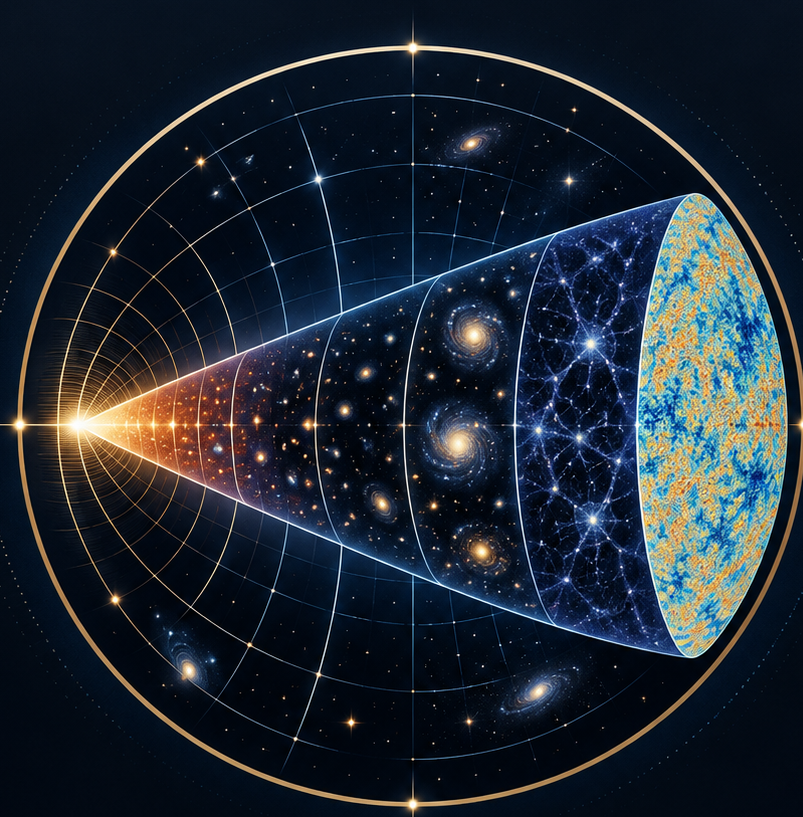
The universe began 13.8 billion years ago in the Big Bang—a violently hot, dense, and rapidly expanding state. Since then, space itself has stretched, matter has cooled and clumped, and the cosmos has evolved through a series of distinct epochs. Understanding these epochs is key to predicting the ultimate fate of everything.
From Planck Epoch to Recombination
The earliest moments are the most extreme and least understood. During the Planck epoch (up to 10⁻⁴³ seconds), the four fundamental forces were unified, and quantum gravity dominated. As the universe expanded and cooled, the Grand Unification epoch saw the strong force separate. Then, around 10⁻³⁶ seconds, the Inflationary epoch began—a brief burst of exponential expansion that stretched quantum fluctuations to cosmic scales, seeding the large-scale structure we see today. After inflation, the Electroweak epoch saw the electromagnetic and weak forces split, and the Quark epoch (10⁻¹² to 10⁻⁶ s) was filled with a quark-gluon plasma. As temperatures dropped below ~10¹² K, quarks combined into protons and neutrons during the Hadron epoch. The Lepton epoch followed, with leptons dominating and annihilating with antileptons. Around 1 second after the Big Bang, the Photon epoch began, where photons dominated the energy density. During this period, Big Bang nucleosynthesis fused the first light elements—hydrogen, helium, and traces of lithium—when the universe was about three minutes old.
Recombination, Dark Ages, and Reionization
About 380,000 years after the Big Bang, the universe had cooled to about 3,000 K, allowing electrons to combine with protons to form neutral hydrogen. This Recombination released the cosmic microwave background (CMB)—a relic radiation that we still observe today. After recombination, the universe entered the Dark Ages, a period with no stars or galaxies, only neutral gas and dark matter. Over hundreds of millions of years, gravity pulled matter into denser regions, eventually igniting the first stars and galaxies. The Reionization epoch (roughly 150 million to 1 billion years after the Big Bang) saw ultraviolet light from these first stars ionize the neutral hydrogen, making the universe transparent to ultraviolet light. Finally, Structure Formation—the growth of galaxies, clusters, and superclusters—continued under the influence of dark matter and gravity.

The Accelerating Universe and Dark Energy
In the late 1990s, observations of distant Type Ia supernovae revealed that the expansion of the universe is not slowing down, but accelerating. This discovery led to the concept of dark energy, a mysterious form of energy that permeates space and drives the acceleration. In the standard Lambda-CDM model, dark energy is represented by the cosmological constant—a constant energy density filling space homogeneously. The CMB measurements from COBE, WMAP, and Planck, along with baryon acoustic oscillations and galaxy surveys, have confirmed that dark energy makes up about 68% of the universe’s total energy density. This acceleration directly determines the ultimate fate.
Timeline of Cosmic Epochs
| Epoch | Time After Big Bang | Temperature | Key Events |
|---|---|---|---|
| Planck | <10⁻⁴³ s | >10³² K | Quantum gravity, unified forces |
| Grand Unification | 10⁻⁴³–10⁻³⁶ s | 10²⁷–10³² K | Strong force separates |
| Inflation | 10⁻³⁶–10⁻³² s | ~10²⁷ K | Exponential expansion |
| Electroweak | 10⁻³²–10⁻¹² s | 10¹⁵–10²⁷ K | EM and weak forces split |
| Quark | 10⁻¹²–10⁻⁶ s | 10¹²–10¹⁵ K | Quark-gluon plasma |
| Hadron | 10⁻⁶–10⁻³ s | 10¹²–10¹⁵ K | Protons and neutrons form |
| Lepton | 10⁻³–1 s | 10¹⁰–10¹² K | Lepton annihilation |
| Photon | 1 s–380,000 yr | 3,000–10¹⁰ K | Nucleosynthesis, photon dominance |
| Recombination | ~380,000 yr | ~3,000 K | CMB released, neutral atoms |
| Dark Ages | 380,000–150 million yr | ~10–3,000 K | No stars, neutral hydrogen |
| Reionization | 150 million–1 billion yr | ~10–100 K | First stars ionize gas |
| Structure Formation | 1 billion yr–present | 2.7 K | Galaxies, clusters form |
Comparison of Ultimate Fates
Quick Comparison
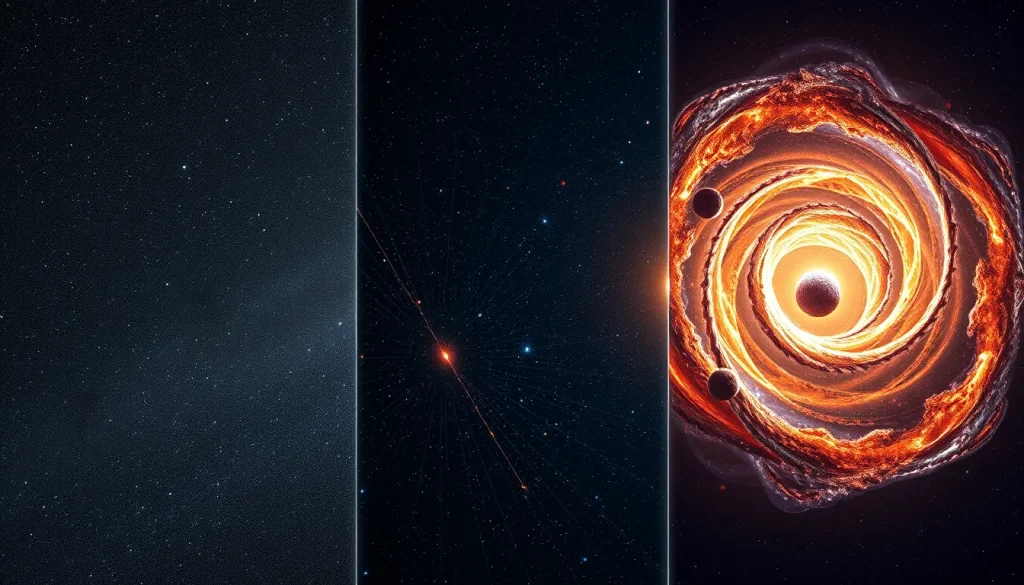
Three main scenarios describe the possible end of the universe: the Big Freeze (Heat Death), the Big Rip, and the Big Crunch. Each depends on the behavior of dark energy and the overall geometry of space.
| Scenario | Key Mechanism | Outcome | Current Support |
|---|---|---|---|
| Big Freeze | Continued expansion, cooling | Stars burn out, black holes evaporate, universe reaches thermal equilibrium | Strong (accelerating expansion) |
| Big Rip | Dark energy grows stronger over time | All structures torn apart, even atoms, in a finite time | Weak (requires phantom dark energy) |
| Big Crunch | Expansion reverses due to gravity | Universe collapses into a hot, dense state | Disfavored (accelerating expansion) |
Similarities
All three scenarios assume the universe began with the Big Bang and that its evolution is governed by general relativity and the contents of the cosmos. They all involve the interplay between gravity (attractive) and dark energy (repulsive).
Differences
The Big Freeze leads to a slow, asymptotic cooling and dilution. The Big Rip involves a finite-time singularity where dark energy’s repulsive force becomes infinite. The Big Crunch is a mirror of the Big Bang—a contraction phase that could potentially lead to a Big Bounce.
Historical Context
Before the discovery of cosmic acceleration, the Big Crunch was a leading possibility. Astronomers once thought the universe might oscillate between expansion and contraction. However, observations of distant supernovae in 1998 and subsequent CMB measurements revealed that the expansion is accelerating, making the Big Freeze the most likely outcome.
Which Model Is Accepted Today?
Current evidence overwhelmingly supports the Big Freeze within the Lambda-CDM model. The cosmological constant (dark energy) drives an eternal expansion. While the Big Rip is not ruled out, it requires a specific form of dark energy (phantom energy) that is not favored by observations. The Big Crunch is essentially ruled out because the expansion is accelerating, not decelerating.
Why It Matters
The ultimate fate of the universe is not just an academic question—it shapes our understanding of fundamental physics, the nature of dark energy, and the long-term prospects for life. If the universe ends in a Big Freeze, all complex structures will eventually decay, and the cosmos will become a cold, dark, and nearly empty place. If a Big Rip occurs, everything—including atoms—is torn apart in a finite time. Knowing which scenario is real helps us test theories of quantum gravity and the nature of vacuum energy. It also frames the philosophical question of whether the universe has a purpose or just an inevitable end.
Evidence / Sources
Key evidence comes from several sources. The cosmic microwave background, measured precisely by COBE, WMAP, and the Planck satellite, confirms the standard model of cosmology and provides the parameters (density of matter, dark energy, curvature) that determine the fate. Observations of Type Ia supernovae revealed the accelerating expansion. Large-scale structure surveys and baryon acoustic oscillations further constrain dark energy. The James Webb Space Telescope (JWST) is now probing the earliest galaxies, helping refine our understanding of structure formation and the timing of reionization. Together, these observations converge on the Lambda-CDM model with a cosmological constant, pointing to a Big Freeze.
Related Registry Entries
- Cosmic Microwave Background – Relic radiation from recombination, a snapshot of the universe at 380,000 years.
- Inflation – The brief exponential expansion that set initial conditions for structure.
- Dark Energy – The mysterious driver of accelerated expansion.
- Lambda-CDM Model – The standard cosmological model with a cosmological constant and cold dark matter.
FAQ
What is the most likely fate of the universe?
Based on current observations of accelerating expansion, the Big Freeze (Heat Death) is the most likely outcome. The universe will continue to expand and cool until stars burn out and all matter decays into a state of maximum entropy.
Could the universe end in a Big Crunch?
The Big Crunch would require gravity to overcome the repulsive effect of dark energy. Since observations show the expansion is accelerating, the Big Crunch is considered very unlikely under the standard model.
What is the Big Rip?
The Big Rip is a hypothetical scenario where dark energy becomes stronger over time, eventually tearing apart all structures—from galaxy clusters to atoms—in a finite time. It would require a form of dark energy called phantom energy, which is not supported by current data.
How do we know the universe is expanding?
Edwin Hubble's observations in the 1920s showed that galaxies recede from us at speeds proportional to their distance. Modern measurements of the cosmic microwave background, supernovae, and galaxy surveys confirm and refine this expansion, revealing that it is accelerating.
Leave a Reply