Short Answer
Main Explanation
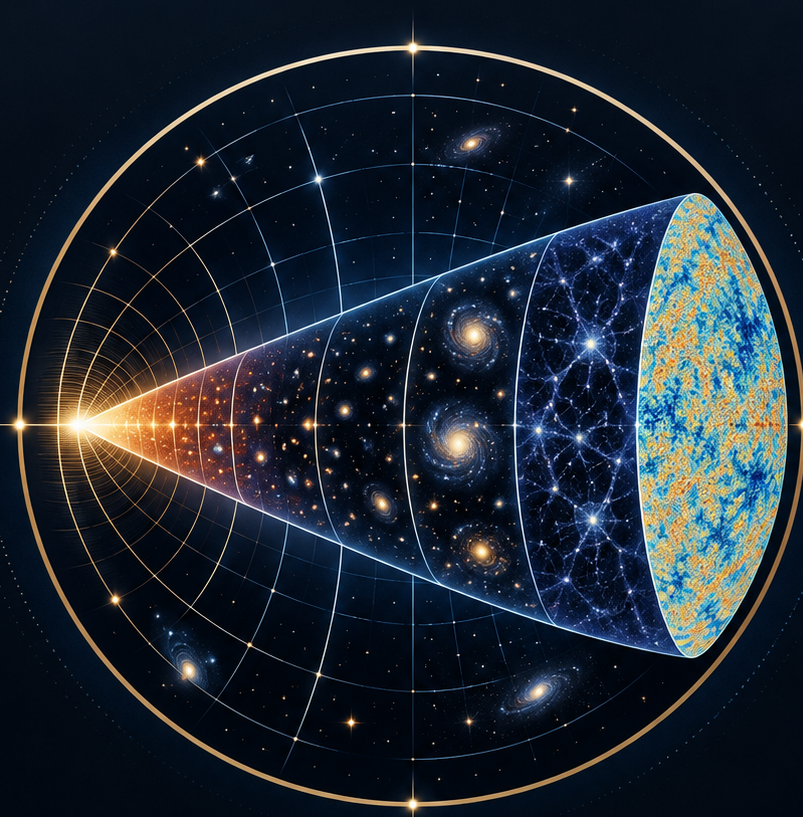
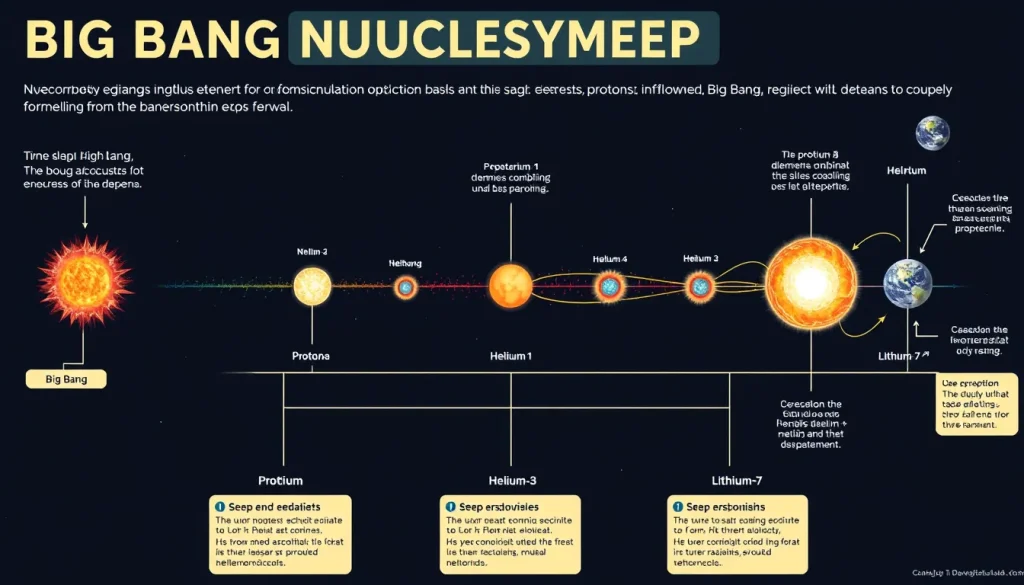
Big Bang Nucleosynthesis (BBN) is the epoch in the very early universe, roughly from 1 second to 20 minutes after the Big Bang, when the lightest atomic nuclei—deuterium (2H), helium-3 (3He), helium-4 (4He), and lithium-7 (7Li)—were synthesized from protons and neutrons. This process is one of the most powerful probes of the standard hot Big Bang cosmology, because its predictions depend on well-understood nuclear physics and the conditions of the early universe, and they agree with observations to remarkable precision across nine orders of magnitude in abundance (from 4He/H ≈ 0.08 down to 7Li/H ≈ 10−10).
BBN is not just a historical curiosity; it provides a direct link between particle physics and cosmology. The abundances of the light elements depend on the baryon density, the number of neutrino families, and the expansion rate of the universe, making BBN a sensitive test for new physics beyond the Standard Model. In this article, we will explore the physics of BBN, its place in the cosmic timeline, the evidence that supports it, and why it matters for our understanding of the universe.
The Cosmic Timeline: From Planck to Structure Formation
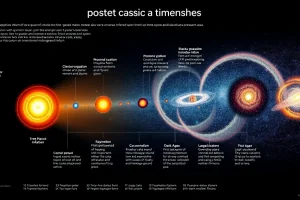
To understand where BBN fits, we need a brief overview of the major epochs of the universe. The table below summarizes the key phases from the Planck epoch to the formation of large-scale structure. Times and temperatures are approximate and based on the standard ΛCDM model.
| Epoch | Time after Big Bang | Temperature | Key Events |
|---|---|---|---|
| Planck epoch | 0 – 10−43 s | > 1032 K | Quantum gravity effects dominate; no known physics. |
| Grand Unification epoch | 10−43 – 10−36 s | 1032 – 1028 K | Strong and electroweak forces unify; possible inflation begins. |
| Inflationary epoch | 10−36 – 10−32 s | ~1028 K | Exponential expansion; quantum fluctuations seeded structure. |
| Electroweak epoch | 10−32 – 10−12 s | 1028 – 1015 K | Electromagnetic and weak forces separate; W, Z bosons acquire mass. |
| Quark epoch | 10−12 – 10−6 s | 1015 – 1012 K | Quarks and gluons form a quark-gluon plasma. |
| Hadron epoch | 10−6 – 1 s | 1012 – 1010 K | Protons and neutrons form; matter-antimatter annihilation. |
| Lepton epoch | 1 – 10 s | 1010 – 109 K | Leptons and antileptons dominate; neutrinos decouple. |
| Big Bang Nucleosynthesis | 10 s – 20 min | 109 – 108 K | Light nuclei form: D, 3He, 4He, 7Li. |
| Photon epoch | 20 min – 380,000 yr | 108 – 3000 K | Photons dominate; universe is a hot plasma. |
| Recombination | ~380,000 yr | ~3000 K | Electrons combine with nuclei; CMB released. |
| Dark Ages | 380,000 yr – ~150 million yr | 3000 – 50 K | No stars yet; universe is dark and neutral. |
| Reionization | ~150 million – 1 billion yr | ~50 – 10 K | First stars and galaxies ionize hydrogen. |
| Structure Formation | ~1 billion yr – present | < 10 K | Galaxies, clusters, and large-scale structure form. |
BBN occurs at the boundary between the lepton and photon epochs, when the temperature has fallen to about 1 MeV (1010 K). At higher temperatures, weak interactions keep neutrons and protons in equilibrium, but as the universe cools, these interactions freeze out, leaving a fixed neutron-to-proton ratio. The subsequent nuclear reactions then build the light elements.
The Physics of Big Bang Nucleosynthesis
The synthesis of light elements is sensitive to the physical conditions in the early radiation-dominated era at a temperature T ≈ 1 MeV, corresponding to an age t ≈ 1 s. At higher temperatures, weak interactions were in thermal equilibrium, maintaining equal numbers of neutrons and protons (with a slight excess of protons because they are lighter). As the temperature drops, the weak interactions that convert protons to neutrons and vice versa become slower than the expansion rate, and the neutron-to-proton ratio freezes out at about 1/6. This ratio then evolves due to free neutron decay (with a half-life of about 10 minutes) until nucleosynthesis begins.
The key nuclear reactions start when the temperature is low enough for deuterium to survive. Deuterium has a low binding energy (2.2 MeV), so at higher temperatures it is immediately photodissociated. This is the so-called deuterium bottleneck: nucleosynthesis cannot proceed until the universe has cooled enough for deuterium to persist. Once deuterium forms, it can react with protons and neutrons to produce 3He and 4He. Because 4He is very tightly bound, almost all available neutrons end up in 4He. The final abundances are determined by the competition between nuclear reaction rates and the expansion rate of the universe.
The standard BBN model predicts that about 25% of the baryonic mass is converted to 4He, with trace amounts of D, 3He, and 7Li. These predictions depend on the baryon-to-photon ratio, which is now precisely measured from the cosmic microwave background (CMB) by the Planck satellite. The agreement between BBN predictions and observed primordial abundances is a major success of the standard cosmology.
The BBN Epoch: A Detailed Look
We now focus specifically on the BBN epoch, using the framework of a cosmic epoch.
When It Happened
BBN occurred from about 10 seconds to 20 minutes after the Big Bang. The exact duration depends on the reaction rates and the expansion rate, but the entire process is over within the first half-hour of cosmic history.
Temperature
The temperature during BBN ranged from about 1010 K (1 MeV) down to about 108 K (10 keV). At these temperatures, the universe was a hot, dense plasma of photons, electrons, positrons, neutrinos, and nucleons.
Approximate Redshift
The redshift corresponding to BBN is roughly z ≈ 109 to 1010. This is far earlier than the CMB (z ≈ 1100) and reflects the extreme conditions of the first minutes.
Dominant Particles/Physics
The dominant particles were photons, neutrinos, electrons, positrons, and nucleons (protons and neutrons). The physics is governed by the weak interaction (for neutron-proton interconversion), the strong nuclear force (for nuclear reactions), and electromagnetism (for photon interactions). The expansion is described by general relativity, with radiation dominating the energy density.
What Happened
As the universe expanded and cooled, the weak interactions that kept neutrons and protons in equilibrium froze out, fixing the neutron-to-proton ratio at about 1/6. Then, once the temperature fell below the deuterium binding energy, nuclear reactions proceeded rapidly, building 4He and trace amounts of D, 3He, and 7Li. The process ended when the temperature dropped too low for nuclear reactions to overcome the Coulomb barrier, leaving the light elements as relics.
What Came Before
Before BBN, the universe was in the lepton epoch, where electrons, positrons, and neutrinos were in thermal equilibrium. At even earlier times, the hadron epoch saw the formation of protons and neutrons from quarks, and the annihilation of matter and antimatter left a small excess of matter.
What Came Next
After BBN, the universe entered the photon epoch, where photons dominated the energy density. The light elements remained unchanged until the first stars formed, which later produced heavier elements through stellar nucleosynthesis.
Evidence
The evidence for BBN comes from two independent directions. First, observations of the primordial abundances of D, 3He, 4He, and 7Li in environments that have undergone minimal stellar processing (e.g., metal-poor gas clouds, dwarf galaxies) match the BBN predictions. Second, the baryon density inferred from BBN agrees with the value derived from the CMB power spectrum measured by Planck. This concordance is a powerful confirmation of the standard model.
Why It Matters
Big Bang Nucleosynthesis is not just a historical footnote; it is a cornerstone of modern cosmology. It provides the only direct probe of the universe when it was just seconds old, and it tests our understanding of nuclear physics and particle physics under extreme conditions. The agreement between BBN predictions and observations validates the standard hot Big Bang model and constrains new physics, such as additional neutrino species, variations in fundamental constants, or the presence of dark matter particles that could affect the expansion rate.
Moreover, BBN sets the stage for the later universe. The helium produced in BBN is the raw material for the first stars, and the deuterium abundance is a sensitive measure of the baryon density. Without BBN, we would not have the light elements that are essential for the formation of stars and galaxies. Understanding BBN is therefore essential for a complete picture of cosmic evolution.
Evidence / Sources
The following sources provide authoritative and up-to-date information on Big Bang Nucleosynthesis:
- Particle Data Group (PDG) Review: “Big Bang Nucleosynthesis” (Revised August 2025) – https://pdg.lbl.gov/2025/reviews/rpp2025-rev-bbang-nucleosynthesis.pdf
- Wikipedia: “Big Bang nucleosynthesis” – https://en.wikipedia.org/wiki/Big_bang_nucleosynthesis
- Einstein-Online: “Big Bang Nucleosynthesis: Cooking up the first light elements” – https://www.einstein-online.info/en/spotlight/bbn/
- Cyburt, Fields, Olive, Yeh, “Big bang nucleosynthesis: Present status,” Rev. Mod. Phys. 88, 015004 (2016) – https://journals.aps.org/rmp/abstract/10.1103/RevModPhys.88.015004
Related Registry Entries
Explore other entries in the cosmic registry:
- Cosmic Microwave Background
- Recombination
- Inflation
- Dark Ages
- First Stars & Galaxies
FAQ
What is Big Bang Nucleosynthesis?
Big Bang Nucleosynthesis (BBN) is the process that produced the lightest atomic nuclei—deuterium, helium-3, helium-4, and lithium-7—during the first three minutes of the universe's history. It is a key prediction of the standard Big Bang model and is confirmed by observations of primordial abundances.
Why did BBN stop after about 20 minutes?
BBN stopped because the universe expanded and cooled to the point where the temperature was too low for nuclear reactions to overcome the Coulomb barrier between charged nuclei. Also, the neutron-to-proton ratio had dropped due to neutron decay, and the density became too low for reactions to proceed efficiently.
How does BBN constrain new physics?
BBN predictions depend on the expansion rate, which is sensitive to the number of relativistic particle species (e.g., neutrinos) and the baryon density. If BBN predictions disagreed with observations, it would indicate new physics such as additional neutrino species, variations in fundamental constants, or exotic particles. The current agreement strongly constrains such possibilities.
What is the deuterium bottleneck?
The deuterium bottleneck refers to the fact that deuterium has a low binding energy (2.2 MeV), so at temperatures above about 10^9 K, any deuterium formed is immediately destroyed by high-energy photons. Nucleosynthesis cannot proceed to heavier elements until the universe cools enough for deuterium to survive, which delays the process until about 100 seconds after the Big Bang.

Leave a Reply