
Short Answer
Main Explanation
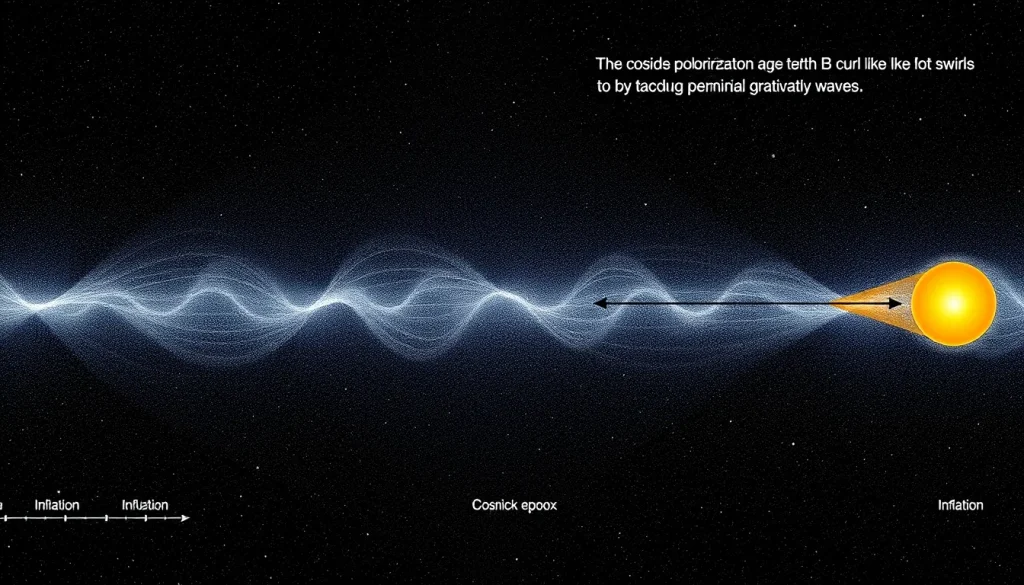
The tensor-to-scalar ratio, denoted r, is one of the most important numbers in modern cosmology. It quantifies the relative amplitude of primordial gravitational waves (tensor perturbations) compared to density fluctuations (scalar perturbations) that were generated during cosmic inflation. A nonzero value of r would leave a distinct imprint on the polarization of the cosmic microwave background (CMB), specifically in the form of B-modes. Because inflation is the leading theory for the origin of structure in the universe, measuring r provides a direct observational test of inflationary models.
Definition
The tensor-to-scalar ratio is defined as r = At / As, where At and As are the amplitudes of the primordial tensor and scalar power spectra, respectively (Montefalcone, 2026). It is a dimensionless quantity. In the simplest inflationary models, r is related to the energy scale of inflation and the shape of the inflaton potential. A larger r implies a more energetic inflation and stronger gravitational wave production.
How It Works
During inflation, the universe expanded exponentially, stretching quantum fluctuations to macroscopic scales. These fluctuations come in two types: scalar (density) perturbations and tensor (gravitational wave) perturbations. As the universe evolved, both types left imprints on the CMB. Scalar perturbations produce temperature anisotropies and E-mode polarization, while tensor perturbations also generate B-mode polarization—a curl-like pattern that cannot be produced by scalar density fluctuations alone (Efstathiou & Chongchitnan, 2006).
To understand the broader context, it helps to review the major epochs of cosmic evolution:
| Epoch | Time After Big Bang | Temperature (approx.) | Key Events |
|---|---|---|---|
| Planck epoch | < 10-43 s | > 1032 K | Quantum gravity effects dominate; no known physics. |
| Grand Unification epoch | 10-43 to 10-36 s | 1028–1032 K | Strong and electroweak forces unify; inflation may begin. |
| Inflationary epoch | 10-36 to 10-32 s | Dropping rapidly | Exponential expansion; quantum fluctuations seeded structure. |
| Electroweak epoch | 10-32 to 10-12 s | 1015–1028 K | Electromagnetic and weak forces separate; Higgs mechanism. |
| Quark epoch | 10-12 to 10-6 s | 1012–1015 K | Quarks and gluons form a quark-gluon plasma. |
| Hadron epoch | 10-6 to 1 s | 1010–1012 K | Protons and neutrons form; baryon asymmetry established. |
| Lepton epoch | 1 to 10 s | 109–1010 K | Leptons and antileptons annihilate; neutrinos decouple. |
| Photon epoch | 10 s to 380,000 yr | 104–109 K | Photons dominate; Big Bang nucleosynthesis occurs. |
| Recombination | ~380,000 yr | ~3000 K | Electrons combine with protons to form neutral hydrogen; CMB released. |
| Dark Ages | 380,000 yr to ~150 million yr | ~50–3000 K | No stars yet; universe is dark and neutral. |
| Reionization | ~150 million to 1 billion yr | ~10–50 K | First stars and galaxies form, reionizing the intergalactic medium. |
| Structure Formation | > 1 billion yr | < 10 K | Galaxies, clusters, and large-scale structure assemble under gravity. |
The CMB we observe today is a snapshot of the universe at recombination. Its temperature and polarization patterns encode the primordial fluctuations, including the tensor-to-scalar ratio. The B-mode signal from tensor perturbations is extremely faint and has not yet been definitively detected, but upper limits have been placed from combined BICEP and Planck data (Tristram et al., 2022).
Equation
Formally, the tensor-to-scalar ratio is defined as:
r = Pt(k) / Ps(k)
where Pt and Ps are the power spectra of tensor and scalar perturbations as a function of wavenumber k. In slow-roll inflation, r is related to the slow-roll parameter ε by r = 16ε, and it is also linked to the tilt of the scalar spectrum ns.
Example
Consider a simple single-field inflation model with a quadratic potential. Such a model predicts r ≈ 0.13. A model with a plateau potential, like Starobinsky inflation, predicts r ≈ 0.003. The current observational upper limit from BICEP/Planck is r < 0.032 (Tristram et al., 2022), which already rules out the simplest quadratic model and favors plateau-like potentials.
Observable Consequences
If r is nonzero, primordial gravitational waves would produce a stochastic background that could be detected by future space-based interferometers like LISA. In the CMB, the B-mode polarization signal from these waves appears on large angular scales. The amplitude of the B-mode signal is directly proportional to r, making it the cleanest observable. Additionally, r affects the lensing of the CMB and the structure of the E-mode polarization.
Common Misconceptions
One common misconception is that a detection of B-modes automatically implies detection of primordial gravitational waves. In reality, B-modes can also be generated by gravitational lensing of E-modes and by foreground dust. Separating these components requires careful multi-frequency observations. Another misconception is that r = 0 would disprove inflation. While many inflationary models predict r > 0, some models (e.g., those with a very flat potential) produce r so small that it is effectively undetectable. A null result would constrain but not eliminate inflation.
Why It Matters
The tensor-to-scalar ratio is a window into the energy scale of inflation. It tells us about the physics operating at energies up to 1016 GeV, far beyond the reach of particle accelerators. Measuring r helps distinguish between the hundreds of inflationary models, each predicting a different value. Moreover, the existence of primordial gravitational waves would confirm that gravity itself is quantized, as the waves are generated by quantum fluctuations of spacetime during inflation. This would be a landmark discovery in fundamental physics. The ratio also ties together the early universe, the CMB, and the large-scale structure we observe today, making it a cornerstone of the standard ΛCDM model.
Evidence / Sources
The current best constraint on r comes from a joint analysis of BICEP, Keck, and Planck data, giving r < 0.032 (95% confidence) (Tristram et al., 2022). The theoretical framework connecting r to inflation is well established (Efstathiou & Chongchitnan, 2006). The definition and observable signatures are detailed in review articles (Montefalcone, 2026). Future experiments such as the Simons Observatory and CMB-S4 aim to reach sensitivities of r ~ 0.001, potentially detecting or ruling out many models.
Related Registry Entries
FAQ
What does the tensor-to-scalar ratio measure?
It measures the relative strength of primordial gravitational waves (tensor perturbations) compared to density fluctuations (scalar perturbations) generated during inflation.
Why is the tensor-to-scalar ratio important for inflation?
Different inflationary models predict different values of r. Measuring r helps narrow down the physics of inflation and the energy scale at which it occurred.
How is the tensor-to-scalar ratio observed?
It is observed through the B-mode polarization of the cosmic microwave background. A detection of primordial B-modes would directly indicate a nonzero r.
What is the current status of measurements?
As of 2022, the combined BICEP/Keck/Planck analysis gives an upper limit of r < 0.032 at 95% confidence. No definitive detection has been made yet.


Leave a Reply