Short Answer
Dark matter is an invisible, hypothetical form of matter that does not interact with light or any electromagnetic radiation. It makes up about 27% of the universe’s mass-energy content, while ordinary matter accounts for only 5% and dark energy for 68%. Despite being invisible, its gravitational effects are observed everywhere—from the rotation of galaxies to the large-scale structure of the cosmos. This guide explores what dark matter is, how it shaped the universe from the Planck epoch to the present day, and the evidence that confirms its existence.
| Property | Value |
|---|---|
| Composition | Invisible, non-baryonic matter |
| Percentage of universe | ~27% of mass-energy |
| Interaction | Gravitational only (no electromagnetic) |
| First inferred | 1930s (Fritz Zwicky) |
| Confirmation | Galaxy rotation curves, gravitational lensing, CMB |
| Leading candidate | Weakly Interacting Massive Particles (WIMPs) |
Main Explanation
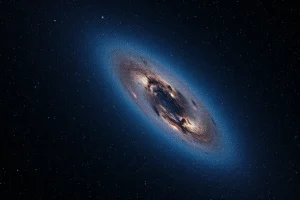
Dark matter is the cosmic glue that holds galaxies and clusters together. Its existence was first inferred by Fritz Zwicky in 1933 when he noticed that galaxies in the Coma cluster moved as if they were under the influence of far more mass than could be seen. Later, Vera Rubin’s observations of galaxy rotation curves confirmed that stars at the edges of galaxies orbit just as fast as those near the center—defying Newtonian gravity unless large amounts of invisible mass are present.
Definition
Dark matter is a form of matter that does not emit, absorb, or reflect electromagnetic radiation, making it invisible to telescopes. It interacts with ordinary matter primarily through gravity. According to NASA, dark matter makes up about 27% of the universe, while ordinary matter is only 5% (NASA Science, 2026). The remaining 68% is dark energy, a separate mystery driving cosmic acceleration.
How It Works
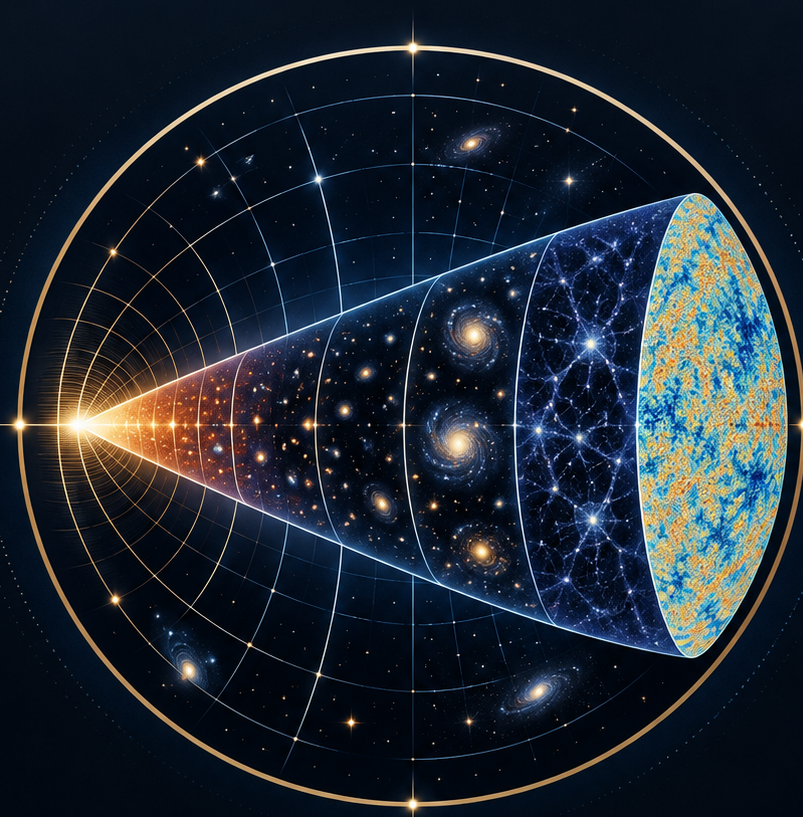
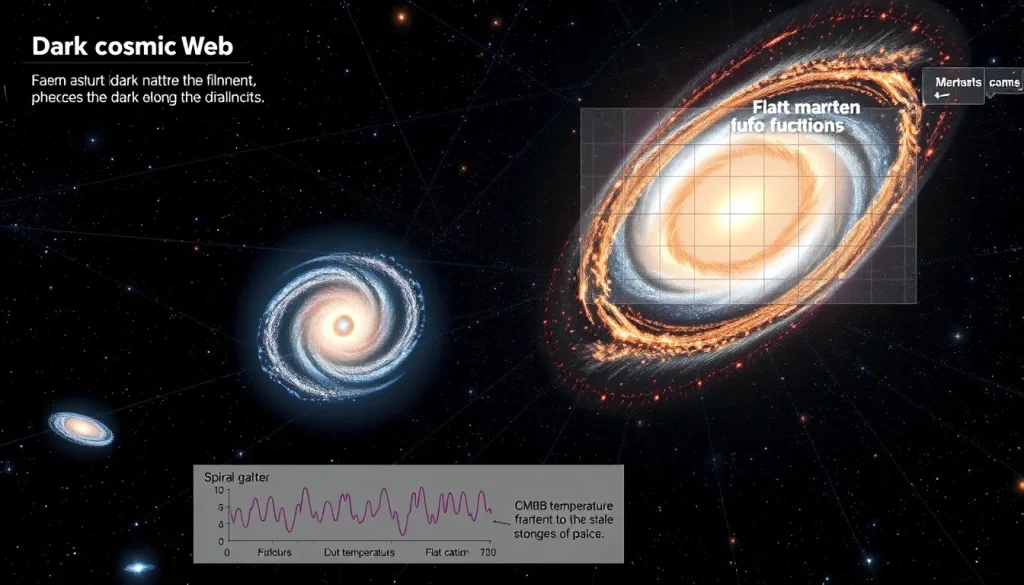
Dark matter’s influence is purely gravitational. It provides the extra gravitational pull that keeps galaxies from flying apart and shapes the cosmic web of large-scale structure. After the Big Bang, dark matter clumped into blobs along narrow filaments, creating the scaffolding on which galaxies later formed. This process is central to the standard Lambda-CDM model, which describes a universe with cold dark matter and a cosmological constant (dark energy).
The Cosmic Timeline
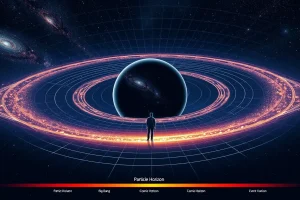
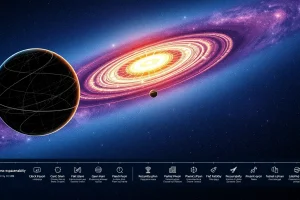
The universe’s evolution is divided into epochs, each with distinct physical conditions. Dark matter’s presence is felt throughout, but especially after inflation and during structure formation.
| Epoch | Time After Big Bang | Key Events | Role of Dark Matter |
|---|---|---|---|
| Planck Epoch | 0 to 10⁻⁴³ s | Quantum gravity dominates; all forces unified | Unknown; beyond current physics |
| Grand Unification Epoch | 10⁻⁴³ to 10⁻³⁶ s | Strong and electroweak forces separate | Dark matter may be produced (theoretically) |
| Inflationary Epoch | 10⁻³⁶ to 10⁻³² s | Exponential expansion; quantum fluctuations seeded | Dark matter distribution set by initial perturbations |
| Electroweak Epoch | 10⁻³² to 10⁻¹² s | Electromagnetic and weak forces separate | Dark matter abundance possibly determined |
| Quark Epoch | 10⁻¹² to 10⁻⁶ s | Quarks and gluons form quark-gluon plasma | Dark matter still non-interacting |
| Hadron Epoch | 10⁻⁶ to 1 s | Protons and neutrons form | Dark matter unaffected |
| Lepton Epoch | 1 to 10 s | Leptons dominate; neutrinos decouple | Dark matter may interact weakly |
| Photon Epoch | 10 s to 380,000 yr | Photons dominate; nucleosynthesis occurs | Dark matter influences density fluctuations |
| Recombination | ~380,000 yr | Atoms form; CMB released | Dark matter’s gravitational wells shape CMB anisotropies |
| Dark Ages | 380,000 to ~150 million yr | No stars; universe dark | Dark matter clumps, providing seeds for first structures |
| Reionization | ~150 million to 1 billion yr | First stars and galaxies ionize hydrogen | Dark matter halos host first galaxies |
| Structure Formation | 1 billion yr to present | Galaxies cluster into cosmic web | Dark matter scaffolding shapes large-scale structure |
Example
Imagine baking a cake: you weigh the flour, eggs, and sugar, but the final batter is six times heavier than expected. Something invisible must be adding mass. This is exactly what astrophysicists face with galaxy rotation curves. Stars on the outskirts of a galaxy orbit at speeds that require far more mass than visible stars and gas can provide. The extra mass is dark matter.
Observable Consequences
- Galaxy Rotation Curves: The flat rotation curves of spiral galaxies indicate a massive halo of dark matter.
- Gravitational Lensing: Light from distant galaxies is bent by dark matter’s gravity, producing distorted images.
- Cosmic Microwave Background: The CMB’s temperature fluctuations reflect the gravitational influence of dark matter on primordial plasma.
- Large-Scale Structure: Galaxy clusters and filaments align along dark matter filaments, as seen in surveys like SDSS.
- Bullet Cluster: The separation of dark matter from hot gas in a galaxy collision provides direct evidence.
Common Misconceptions
- Dark matter is not dark energy: Dark energy drives cosmic acceleration, while dark matter attracts gravitationally.
- Dark matter is not antimatter: Antimatter interacts with light and would annihilate with matter.
- Dark matter is not ordinary matter that is simply faint: It does not emit or absorb light at any wavelength.
- Dark matter is not a modification of gravity: While alternative theories exist, the consensus is that it is a particle.
Why It Matters
Dark matter is essential for the existence of galaxies, stars, and planets. Without it, the universe would not have clumped into the structures we see today. The cosmic microwave background, discovered by COBE and precisely mapped by WMAP and Planck, shows that dark matter’s gravitational influence was crucial for seeding galaxy formation. Understanding dark matter is key to understanding the universe’s past, present, and future—and to testing the limits of the Standard Model of particle physics.
Evidence / Sources
The evidence for dark matter is overwhelming and comes from multiple independent observations:
- Galaxy rotation curves (Vera Rubin, 1970s)
- Gravitational lensing of galaxy clusters (Fritz Zwicky, 1933; modern surveys)
- Cosmic microwave background anisotropies (COBE, WMAP, Planck)
- Baryon acoustic oscillations and large-scale structure surveys
- Bullet Cluster observations
Key missions: COBE (1989), WMAP (2001), Planck (2009), JWST (2021). These missions have measured the universe’s composition with increasing precision, confirming dark matter’s abundance at ~26.8% of the total mass-energy (Wikipedia, 2026).
Related Registry Entries
FAQ
Is dark matter dangerous?
No. Dark matter is all around us, but it interacts so weakly with ordinary matter that it passes through us without any noticeable effect. It does not pose a health hazard.
How do we know dark matter exists if we can't see it?
We infer its existence from its gravitational effects. Galaxy rotation curves, gravitational lensing, and the cosmic microwave background all require far more mass than visible matter can provide.
What is the difference between dark matter and dark energy?
Dark matter attracts gravitationally and helps clump matter together, while dark energy is a repulsive force that accelerates the expansion of the universe. They are separate phenomena.
Could dark matter be made of tiny black holes?
Primordial black holes are a possible candidate, but current constraints from lensing and CMB observations favor particle-like dark matter (e.g., WIMPs). The search is ongoing.
Leave a Reply