
Short Answer
Main Explanation
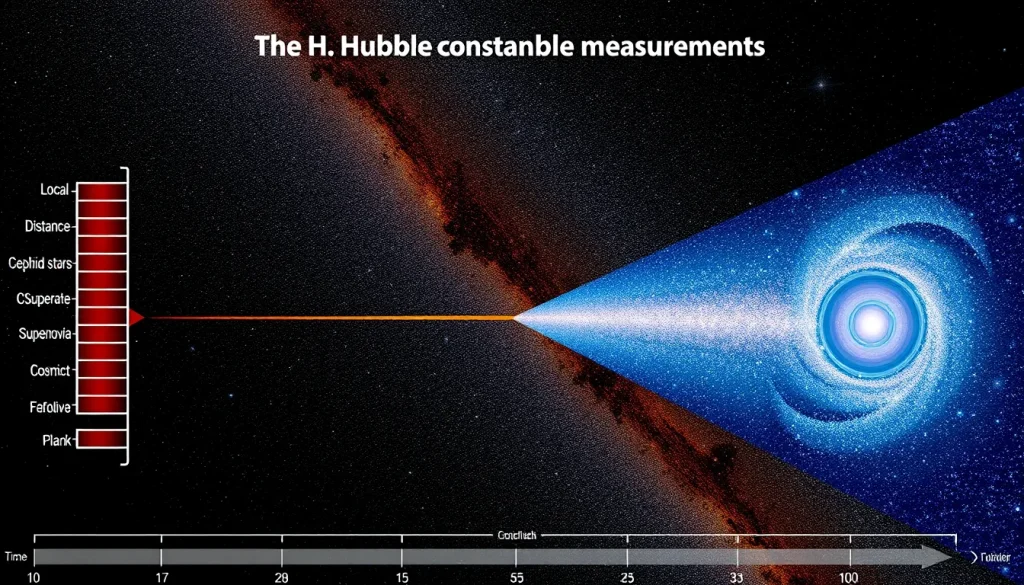
The Hubble tension is one of the most significant puzzles in modern cosmology. It arises from two independent, highly precise methods of measuring the present-day expansion rate of the universe — known as the Hubble constant (H₀) — that stubbornly disagree. This disagreement hints that our standard model of the universe, the Lambda-CDM model, may be incomplete. To understand the tension, we must first grasp how the universe expands and how we measure that expansion.
In 1929, Edwin Hubble discovered that galaxies are receding from us at speeds proportional to their distances, establishing the linear relationship now known as the Hubble–Lemaître law. The constant of proportionality, H₀, describes how fast the universe is expanding today. Its value determines the age of the universe, the size of the observable cosmos, and the fate of cosmic structures. Yet, as NASA notes, observations by the Hubble Space Telescope have pinned down H₀ with extraordinary precision, but two different routes to its value yield conflicting results.
The Two Measurement Methods
The first method, the local distance ladder, measures distances to nearby galaxies using standard candles such as Cepheid variable stars and Type Ia supernovae. This approach, refined by Adam Riess and colleagues, yields a value of approximately 73 km/s/Mpc (kilometers per second per megaparsec). The second method uses the cosmic microwave background (CMB) — the relic radiation from the Big Bang — observed by satellites like Planck. By fitting the CMB to the Lambda-CDM model, cosmologists infer an early-universe expansion rate that, when evolved forward, gives a lower value of about 67.4 km/s/Mpc. The difference, roughly 5–6 km/s/Mpc, is far larger than the combined uncertainties, a discrepancy that has grown more robust as measurements improve.
The Cosmic Timeline: From Planck Epoch to Present
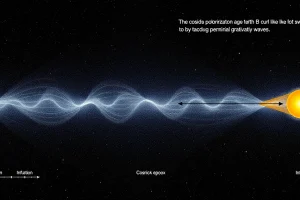
To appreciate the stakes, we must place the Hubble tension within the full history of the universe. The standard cosmological timeline begins with the Planck epoch, the earliest moment after the Big Bang (10⁻⁴³ seconds) when quantum gravity effects dominated. This was followed by the Grand Unification epoch, during which the strong and electroweak forces were unified. Then came cosmic inflation, a period of exponential expansion that stretched quantum fluctuations to cosmic scales, seeding the large-scale structure we see today. The inflationary epoch ended with the reheating of the universe, leading to the electroweak epoch, quark epoch, hadron epoch, and lepton epoch, as the universe cooled and particles condensed from the primordial soup.
At about 380,000 years after the Big Bang, the universe had cooled enough for electrons and protons to combine into neutral hydrogen — an event called recombination. The photons released at this moment form the cosmic microwave background, which we observe today as a nearly uniform glow at 2.725 K. After recombination, the universe entered the Dark Ages, a period with no luminous sources, followed by the Epoch of Reionization, when the first stars and galaxies formed and reionized the neutral hydrogen. Structure formation then assembled galaxies, clusters, and the cosmic web. Each of these epochs is governed by the expansion rate, so an incorrect H₀ would alter our understanding of their timing and duration.
The following table summarizes the major epochs:
| Epoch | Time After Big Bang | Key Events |
|---|---|---|
| Planck epoch | < 10⁻⁴³ s | Quantum gravity effects, unified forces |
| Grand Unification epoch | 10⁻⁴³ – 10⁻³⁶ s | Strong force separates, inflation begins |
| Inflationary epoch | 10⁻³⁶ – 10⁻³² s | Exponential expansion, seeds of structure |
| Electroweak epoch | 10⁻³² – 10⁻¹² s | Electromagnetic and weak forces separate |
| Quark epoch | 10⁻¹² – 10⁻⁶ s | Quarks and gluons exist freely |
| Hadron epoch | 10⁻⁶ – 1 s | Protons and neutrons form |
| Lepton epoch | 1 – 10 s | Leptons dominate, neutrinos decouple |
| Photon epoch | 10 s – 380,000 yr | Photons dominate, nucleosynthesis occurs |
| Recombination | ~380,000 yr | Neutral atoms form, CMB released |
| Dark Ages | 380,000 yr – ~150 million yr | No luminous sources, hydrogen neutral |
| Reionization | ~150 million – 1 billion yr | First stars and galaxies ionize hydrogen |
| Structure Formation | 1 billion yr – present | Galaxies, clusters, cosmic web form |
The cosmic microwave background is a cornerstone of this timeline. Missions such as COBE, WMAP, and Planck have mapped its temperature and polarization anisotropies with extraordinary precision, providing the data that underpin the early-universe H₀ value. The James Webb Space Telescope (JWST) is now probing the epoch of reionization and the first galaxies, offering new insights into structure formation and potentially the expansion rate.
The Measurement Crisis
The Hubble tension is not merely a nuisance; it may signal new physics. As the CERN Courier explains, the discrepancy could be resolved by modifications to dark energy, dark matter, or the introduction of exotic particles. The Scientific American article from April 2025 notes that a new independent measurement using galaxy properties has strengthened the case that the tension is real and not a systematic error. For now, the Lambda-CDM model remains the consensus, but the tension challenges its completeness.
Measurement: The Hubble Constant
Below we detail the two conflicting measurements that define the Hubble tension.
Value
Local distance ladder: ~73.0 km/s/Mpc (Riess et al., 2024). Early universe (Planck CMB): ~67.4 km/s/Mpc (Planck Collaboration, 2020).
Units
Kilometers per second per megaparsec (km/s/Mpc), expressing the recession velocity per unit distance.
Instrument
Hubble Space Telescope (for Cepheid distances), ground-based telescopes for Type Ia supernovae; Planck satellite for CMB.
Method
Local: distance ladder using parallax, Cepheids, and supernovae. Early: fitting the CMB power spectrum to the Lambda-CDM model to infer H₀.
Uncertainty
Both measurements have uncertainties of about 1–2 km/s/Mpc, yet the difference (~5–6 km/s/Mpc) exceeds the combined error bars, making the tension statistically significant.
Dataset
Supernova H0 for the Equation of State (SH0ES) program; Planck 2018 legacy release; recent JWST Cepheid observations.
Latest/Reference Measurement
As of 2025, the local value remains ~73 km/s/Mpc, while Planck gives ~67.4 km/s/Mpc. No single measurement has resolved the discrepancy.
Why Measurements Differ
Possible explanations include systematic errors in either method, or new physics such as early dark energy, varying dark energy, or interactions between dark matter and radiation. The true cause remains unknown.
Why It Matters
The Hubble tension is more than a technical dispute. The expansion rate directly determines the age of the universe, the distance scale, and the evolution of cosmic structures. If the local value is correct, the universe is younger than inferred from the CMB, which would challenge our understanding of the early universe and the Lambda-CDM model. Resolving the tension could reveal new particles, modified gravity, or a more complex dark energy behavior. It also underscores the need for independent measurements, such as those from JWST and future missions like the Euclid satellite or the Vera Rubin Observatory.
Evidence / Sources
The evidence for the Hubble tension comes from decades of observations. The Hubble Space Telescope’s precision measurements of Cepheid variables and supernovae established the local value. The Planck satellite’s CMB maps provided the early-universe value. Independent analyses, including gravitational-wave standard sirens and cosmic chronometers, add to the complexity. The following sources provide authoritative overviews: NASA’s Hubble Constant and Tension page, the CERN Courier article by Vivian Poulin, Scientific American’s April 2025 feature, and BBC Sky at Night Magazine’s explainer.
Related Registry Entries
Explore related concepts in our cosmic registry:
- Hubble Constant – The expansion rate of the universe today.
- Cosmic Microwave Background – The relic radiation from recombination.
- Lambda-CDM Model – The standard cosmological model with dark energy and cold dark matter.
- Inflation – The early exponential expansion that shaped the universe.
- Recombination – The epoch when neutral atoms formed.
Last Reviewed: September 5, 2026
FAQ
What is the Hubble tension?
The Hubble tension is the discrepancy between measurements of the universe's expansion rate (Hubble constant) obtained from local distance ladder observations and those inferred from the cosmic microwave background, exceeding expected uncertainties.
Why is the Hubble tension important?
It challenges the Lambda-CDM model and may indicate new physics, such as unknown dark energy behavior or exotic particles, which would alter our understanding of the universe's age and evolution.
Has the Hubble tension been resolved?
As of 2025, no. The discrepancy persists despite improved measurements and independent methods, leading some scientists to call it a 'crisis'.
What are the possible resolutions?
Potential resolutions include systematic errors in measurements, early dark energy, varying dark energy, or interactions between dark matter and radiation. No single explanation has gained consensus.
Leave a Reply