
Short Answer
Main Explanation
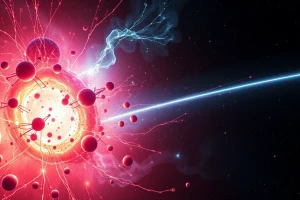
The Higgs mechanism is a fundamental process in particle physics that explains how elementary particles acquire mass. According to the Standard Model, without this mechanism all gauge bosons would be massless, yet measurements show that the W and Z bosons—carriers of the weak force—have large masses of around 80 GeV/c². The mechanism introduces a quantum field, the Higgs field, that permeates all of space. When particles interact with this field, they gain mass, much like moving through a thick molasses. The associated particle, the Higgs boson, was confirmed in 2012 at the Large Hadron Collider (LHC) at CERN.
In the context of the universe’s evolution, the Higgs mechanism is intimately tied to the electroweak epoch, a period when the electromagnetic and weak forces were unified. As the universe cooled, the Higgs field acquired a nonzero value everywhere, breaking the electroweak symmetry and giving mass to W and Z bosons while leaving the photon massless. This symmetry breaking is a pivotal event in the cosmic timeline, setting the stage for the subsequent formation of matter and the large-scale structure we observe today.
Definition
The Higgs mechanism is the process by which gauge bosons acquire mass through spontaneous symmetry breaking of the Higgs field. It is a key element of the electroweak theory, explaining why the weak force carriers are massive while the photon remains massless.
How It Works
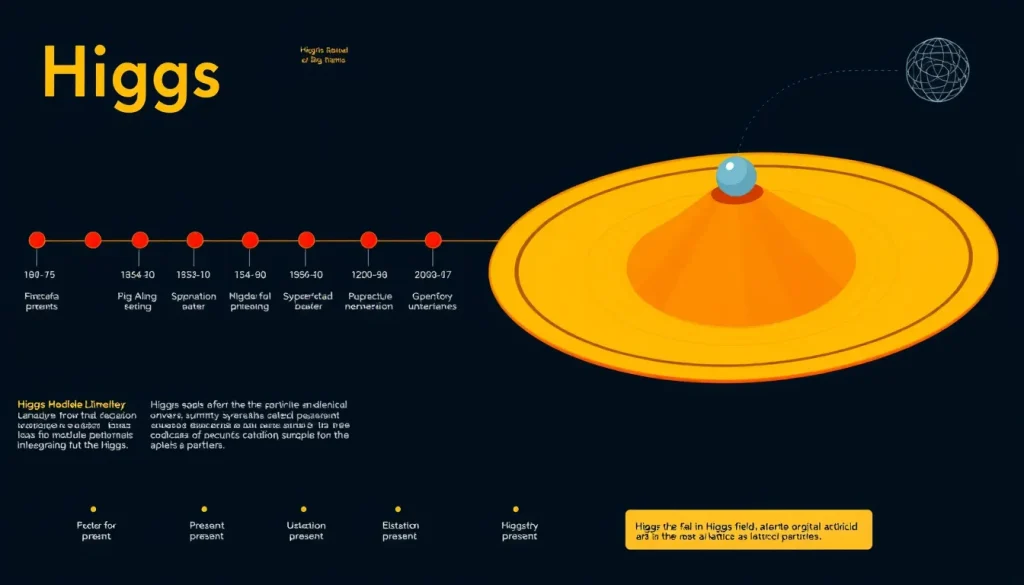
Imagine a ball resting at the center of a sombrero-shaped potential. The center is a local maximum, while the brim is a circle of minima. The Higgs field, analogous to the ball, initially sits at the unstable center. As the universe cools below a critical temperature, the field rolls down to one of the minima, breaking the symmetry. This nonzero vacuum expectation value interacts with W and Z bosons, giving them mass, while photons remain unaffected because they do not couple to the Higgs field.
Equation
The mass of a gauge boson in the Higgs mechanism is given by mV = gV v / 2, where gV is the gauge coupling constant and v is the vacuum expectation value of the Higgs field (approximately 246 GeV).
Example
Consider the weak force: the W and Z bosons are massive due to the Higgs mechanism, which limits the range of the weak force to about 10⁻¹⁸ meters. In contrast, the photon is massless, giving the electromagnetic force infinite range. This difference is why the weak force is short-range and the electromagnetic force is long-range.
Observable Consequences
The most direct observable consequence is the existence of the Higgs boson, a scalar particle with a mass of about 125 GeV/c², discovered in 2012. The mechanism also predicts specific couplings of the Higgs boson to other particles, which have been measured at the LHC and are consistent with the Standard Model.
Common Misconceptions
A common misconception is that the Higgs field gives mass to all matter. In reality, it gives mass to fundamental particles like quarks and electrons, but the mass of composite particles like protons and neutrons arises mostly from the binding energy of quarks, not the Higgs mechanism. Another misconception is that the Higgs boson is the ‘God particle’ that creates mass; the boson is just a quantum excitation of the field.
The Higgs Mechanism in the Cosmic Timeline
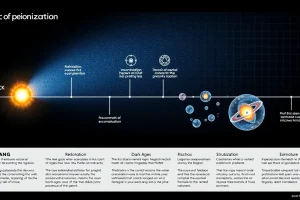
The universe’s history is divided into epochs, each characterized by distinct physical processes. The Higgs mechanism played a crucial role in the early universe, particularly during the electroweak epoch. Below is a table of the major cosmic epochs from the Planck epoch to the present day.
| Epoch | Time after Big Bang | Temperature | Key Events |
|---|---|---|---|
| Planck Epoch | 0 to 10⁻⁴³ s | >10³² K | Quantum gravity effects dominate; no current theory. |
| Grand Unification Epoch | 10⁻⁴³ to 10⁻³⁶ s | 10²⁷–10³² K | Strong and electroweak forces unified; possible inflation begins. |
| Inflationary Epoch | 10⁻³⁶ to 10⁻³² s | ~10²⁷ K | Exponential expansion; quantum fluctuations seeded large-scale structure. |
| Electroweak Epoch | 10⁻³² to 10⁻¹² s | 10¹⁵–10²⁷ K | Electromagnetic and weak forces separate; Higgs mechanism gives mass to W/Z bosons. |
| Quark Epoch | 10⁻¹² to 10⁻⁶ s | 10¹²–10¹⁵ K | Quarks and gluons exist in quark-gluon plasma; no bound hadrons. |
| Hadron Epoch | 10⁻⁶ to 1 s | 10¹⁰–10¹² K | Quarks combine into protons and neutrons; matter-antimatter annihilation. |
| Lepton Epoch | 1 to 10 s | 10⁹–10¹⁰ K | Leptons dominate; neutrinos decouple. |
| Photon Epoch | 10 s to 380,000 yr | 10⁹ K down to 3000 K | Photons dominate; nucleosynthesis forms light elements; universe becomes transparent at recombination. |
| Recombination | 380,000 yr | ~3000 K | Electrons combine with nuclei to form neutral atoms; cosmic microwave background released. |
| Dark Ages | 380,000 yr to ~150 million yr | ~3000 K to ~50 K | No stars; universe is dark and neutral. |
| Reionization | ~150 million to 1 billion yr | ~50 K to ~10 K | First stars and galaxies form; ultraviolet light reionizes hydrogen. |
| Structure Formation | 1 billion yr to present | <10 K | Galaxies cluster into large-scale structure; dark energy accelerates expansion. |
Why It Matters
The Higgs mechanism is not just a particle physics curiosity; it is central to understanding the universe’s evolution. The electroweak symmetry breaking, driven by the Higgs field, occurred when the universe was about 10⁻¹² seconds old. This event set the masses of the W and Z bosons, which in turn dictated the rates of weak interactions that governed the production of matter and antimatter. The precise balance of these interactions is why the universe contains matter rather than nothing.
Moreover, the Higgs field’s vacuum expectation value is responsible for the masses of quarks and electrons, which determine the formation of atoms and the chemistry of the cosmos. Without the Higgs mechanism, the universe would be a sea of massless particles, with no atoms, no stars, and no life. The discovery of the Higgs boson in 2012 confirmed the mechanism, and ongoing studies of its properties may reveal new physics beyond the Standard Model.
Evidence / Sources
The existence of the Higgs mechanism is supported by decades of experimental and observational evidence. The discovery of the Higgs boson at the LHC in 2012 was a landmark confirmation. Additionally, precise measurements of the W and Z boson masses and their couplings align with the predictions of electroweak theory. The cosmic microwave background, observed by missions like COBE, WMAP, and Planck, provides a snapshot of the universe at recombination, confirming the standard cosmological model and the role of the Higgs field in the early universe. The James Webb Space Telescope (JWST) continues to probe the era of reionization, offering further insights into structure formation.
Related Registry Entries
FAQ
Does the Higgs mechanism give mass to everything?
No. It gives mass to fundamental particles like quarks and electrons, but most of the mass of protons and neutrons comes from the binding energy of quarks, not the Higgs field.
Why is the photon massless while W and Z bosons are massive?
The photon does not interact with the Higgs field, so it remains massless. The W and Z bosons do interact, acquiring mass through the Higgs mechanism.
How does the Higgs mechanism relate to the early universe?
During the electroweak epoch, the Higgs field underwent symmetry breaking, separating the electromagnetic and weak forces and giving mass to the W and Z bosons. This event shaped the subsequent evolution of matter and structure.
Leave a Reply