
Short Answer
Main Explanation
The story of how the first stars and galaxies formed is the story of cosmic structure emerging from simplicity. It begins with the Big Bang, a state of unimaginable heat and density, and proceeds through a series of distinct epochs as the universe expanded and cooled. The standard model of cosmology — the Lambda-CDM model — provides a remarkably coherent narrative, supported by observations of the cosmic microwave background (CMB), the abundance of light elements, and the large-scale distribution of galaxies. This article walks through the major epochs, explains the physics that shaped the first stars and galaxies, and highlights the evidence that anchors our understanding.
The Cosmic Timeline
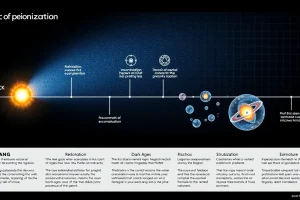
The universe’s history is often divided into epochs based on the dominant physical processes and particle content. The table below summarizes the key stages from the Planck epoch to the present.
| Epoch | Time After Big Bang | Approx. Redshift | Key Events |
|---|---|---|---|
| Planck epoch | < 10−43 s | > 1032 | Quantum gravity effects dominate; all forces unified. |
| Grand Unification epoch | 10−43 – 10−36 s | 1032 – 1028 | Strong force separates from electroweak. |
| Inflationary epoch | 10−36 – 10−32 s | 1028 – 1022 | Exponential expansion; seeds of structure created. |
| Electroweak epoch | 10−32 – 10−12 s | 1022 – 1015 | Electromagnetic and weak forces separate. |
| Quark epoch | 10−12 – 10−6 s | 1015 – 1010 | Quarks and gluons form a quark-gluon plasma. |
| Hadron epoch | 10−6 – 1 s | 1010 – 109 | Protons and neutrons form; matter-antimatter asymmetry emerges. |
| Lepton epoch | 1 – 10 s | 109 – 108 | Leptons dominate; neutrinos decouple. |
| Photon epoch | 10 s – 380,000 yr | 108 – 1,100 | Photons dominate; Big Bang nucleosynthesis creates light elements. |
| Recombination | ~380,000 yr | ~1,100 | Electrons combine with nuclei; CMB released. |
| Dark Ages | 380,000 yr – ~150 million yr | 1,100 – ~20 | No luminous sources; neutral hydrogen fills space. |
| Reionization | ~150 million – ~1 billion yr | 20 – 6 | First stars and galaxies ionize the intergalactic medium. |
| Structure Formation | ~1 billion yr – present | < 6 | Galaxies cluster; dark energy dominates expansion. |
From the Planck Epoch to Recombination
The universe began in the Planck epoch, a realm where quantum gravity ruled and our current physics breaks down. Within a fraction of a second, inflation stretched space exponentially, smoothing out irregularities and seeding the density fluctuations that later grew into galaxies. As the universe cooled, fundamental forces separated, and quarks combined into protons and neutrons. During Big Bang nucleosynthesis (in the photon epoch), the first stable nuclei — hydrogen, helium, and trace lithium — formed. The universe remained a hot, opaque plasma until recombination, when electrons bound to nuclei, allowing photons to stream freely. That relic radiation is the cosmic microwave background (CMB), first measured by COBE and later mapped with unprecedented precision by WMAP and the Planck mission. The CMB’s near-uniform temperature (2.725 K) and tiny anisotropies encode the seed fluctuations that gave rise to cosmic structure.
When It Happened (First Stars and Galaxies)
After recombination, the universe entered the Dark Ages — a period with no luminous sources. Gravity slowly amplified the density fluctuations imprinted by inflation. Over a few hundred million years, overdense regions of dark matter collapsed, pulling in primordial hydrogen and helium gas. The first stars, known as Population III stars, formed when these collapsing clouds reached high enough densities and temperatures to ignite fusion. These stars were likely very massive, hot, and short-lived, with masses potentially exceeding 100 times that of the Sun (Klessen & Glover, 2023). Their intense ultraviolet radiation began to reionize the surrounding neutral hydrogen, ending the Dark Ages and initiating the epoch of Reionization.
Temperature and Redshift
At the time of first star formation, the universe was roughly 100 million years old, with a redshift around 20–30 and a temperature of a few tens of kelvin. The CMB temperature scales as (1+z), so at z=20, the CMB temperature was about 57 K. The first galaxies assembled from these early stars and their supernova remnants, with the first dwarf galaxies forming at redshifts above 10. The James Webb Space Telescope (JWST) has pushed the frontier, detecting galaxies at redshifts beyond 13, probing the era when the first stars were lighting up.
Dominant Particles/Physics
During the Dark Ages, the universe was filled with neutral hydrogen and helium, dark matter, and the CMB photons. The physics governing structure formation was dominated by gravity (dark matter halos) and gas dynamics. Radiative cooling by molecular hydrogen (H2) allowed gas to condense and fragment, leading to star formation. The first stars’ feedback — radiation, stellar winds, and supernovae — injected energy and heavy elements into the intergalactic medium, profoundly altering the subsequent evolution of primordial gas (Johnson, 2011).
What Happened
The first stars formed in dark matter halos of about 105–106 solar masses. These halos provided the gravitational wells that gathered gas. Because the primordial gas lacked metals (elements heavier than helium), cooling was inefficient, so the gas remained warmer and more massive clumps collapsed, favoring the formation of very massive stars. These Population III stars lived only a few million years before exploding as supernovae, dispersing heavy elements into the surrounding medium. This enriched gas then cooled more efficiently, allowing the formation of lower-mass stars and the first galaxies. The first galaxies were small, irregular systems, often called dwarf galaxies, which later merged to form larger structures like the Milky Way.
What Came Before
Before the first stars, the universe was a dark, neutral gas of hydrogen and helium, with no luminous objects. The only structure was the subtle density fluctuations imprinted by inflation, which had been preserved in the CMB. Dark matter, invisible but gravitationally dominant, began to collapse into halos, providing scaffolding for gas to follow.
What Came Next
After reionization, the intergalactic medium became fully ionized. The first galaxies continued to grow through mergers and gas accretion, eventually assembling into the diverse galaxy population we see today. The epoch of reionization is a key frontier; JWST is now revealing the galaxies responsible for this cosmic transition (Bromm & Yoshida, 2011).
Evidence
Evidence for this cosmic narrative comes from multiple directions. The CMB measured by COBE, WMAP, and Planck shows a nearly uniform background with tiny fluctuations matching predictions of inflation and structure formation. The abundance of light elements (hydrogen, helium, lithium) agrees with Big Bang nucleosynthesis. Observations of distant quasars indicate that reionization completed by redshift ~6. JWST has detected galaxies at redshifts beyond 13, showing bright, early systems that are likely hosting Population III or early Population II stars. The existence of heavy elements in the most distant quasars implies that supernovae from the first stars enriched the universe quickly.
Why It Matters
Understanding the first stars and galaxies is fundamental to cosmology. These objects ended the cosmic Dark Ages, reionized the universe, and produced the first heavy elements — the raw material for planets and life. The epoch of first star formation bridges the simple, homogeneous early universe and the complex, structured cosmos we inhabit. By studying this era, we test our models of structure formation, star formation, and galaxy evolution. Missions like JWST are directly probing this epoch, while future observatories such as the Roman Space Telescope and the Square Kilometre Array will map the neutral hydrogen of the Dark Ages and the epoch of reionization. This research not only tells us where we came from but also constrains fundamental physics, including the nature of dark matter and the initial conditions of the universe.
Evidence / Sources
The primary sources for this article include peer-reviewed reviews and NASA’s public science communications. The Annual Review of Astronomy and Astrophysics article by Klessen & Glover (2023) provides a comprehensive review of first star formation. Bromm & Yoshida (2011) review the first galaxies. Johnson (2011) discusses the theory and simulations of first galaxy formation. NASA’s Webb telescope science page explains the expected properties of first stars.
Related Registry Entries
Related entries in this encyclopedia include: Cosmic Timeline, Recombination, Reionization, Dark Ages, Cosmic Microwave Background, Inflation, and Big Bang Nucleosynthesis.
FAQ
When did the first stars form?
The first stars are thought to have formed about 100–200 million years after the Big Bang, at redshifts around 20–30. This corresponds to the end of the cosmic Dark Ages and the beginning of reionization.
Why were the first stars so massive?
The first stars formed from primordial gas that contained only hydrogen and helium, with no heavy elements. Without metals, cooling was inefficient, so the gas remained relatively warm and could not fragment into small clumps. This led to the collapse of large, massive clouds, producing stars that were likely tens to hundreds of times the Sun's mass.
How do we observe the first stars and galaxies?
Directly seeing the very first stars is extremely challenging, but telescopes like the James Webb Space Telescope (JWST) can detect galaxies that existed when the universe was less than 500 million years old. These galaxies are likely hosting the early generations of stars. Additionally, the CMB and the absorption features in quasar spectra provide indirect evidence of reionization and the first stars.
Leave a Reply